
Imagine handing off your bookkeeping and just… never having to think about it again. No chasing, no explaining things twice, no late-night number crunching. It just gets done—accurately, quietly, and on time. That is what a great offshore bookkeeper does.
Of course, finding the right offshore bookkeeper is easier said than done. There are plenty out there, but not all of them will make your life easier. That is what this guide is here for.
We will show you how to find the right offshore bookkeeper (the kind you don’t have to chase down) and exactly where to look—so your books stay clean, and your head stays clear.
What You Need To Know About Hiring An Offshore Bookkeeper In Under A Minute
| Key Information | |
|---|---|
| Cost Savings | 30-70% reduction compared to US-based bookkeepers |
| Average Cost | $5-$25 per hour |
| Best Regions | Philippines, India, Mexico, South Africa, Poland |
| Top Benefits | Cost reduction, 24/7 operations, specialized expertise |
| Main Challenges | Communication barriers, data security, quality control |
🌟 Offshore Finance: How It Works, Examples, Pros, & Cons
🔥 Offshore Tax Preparation: Full Setup And Filing Guide
💯 Offshore Accounting Philippines: Top 10 Reasons To Outsource
What Is Offshore Bookkeeping?
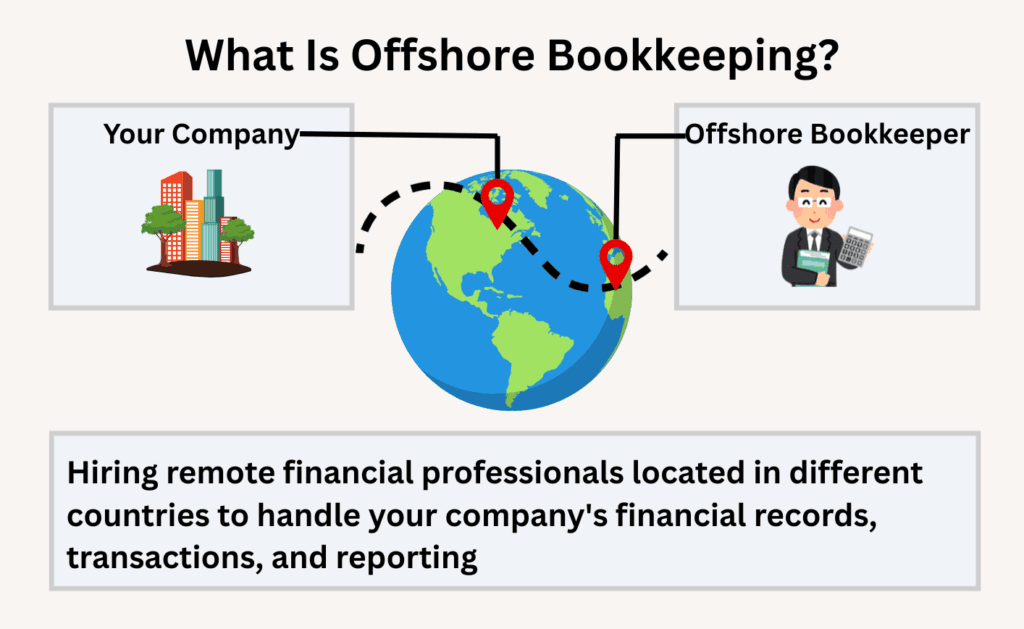
Offshore bookkeeping involves hiring remote financial professionals located in different countries to handle your company’s financial records, transactions, and reporting. These offshore bookkeepers work online and help keep your records accurate and up to date at a lower cost than hiring locally.
Why Hire An Offshore Bookkeeper? 6 Reasons That Every Growing Business Should Know
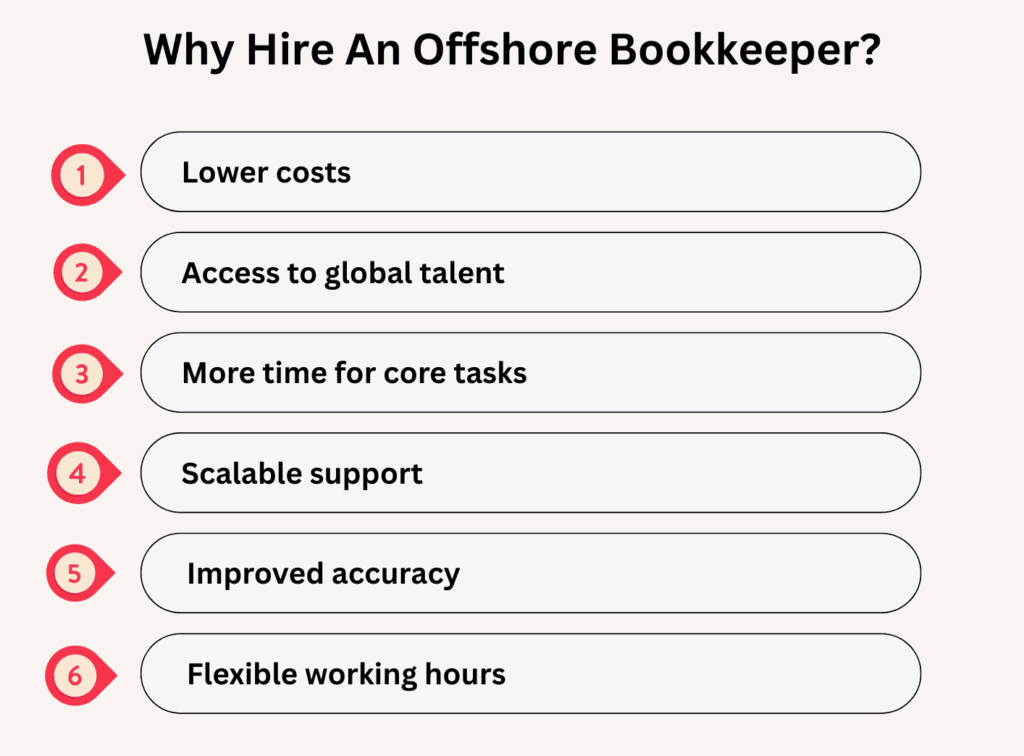
Let’s break down why hiring an offshore bookkeeper could be the smartest move for your business:
- Lower costs: Offshore bookkeepers charge 50–70% less than local hires, helping you reduce payroll expenses without sacrificing quality.
- Access to global talent: You can tap into a wide pool of experienced professionals who specialize in bookkeeping and accounting software.
- More time for core tasks: Delegating financial work frees up your time to focus on growth, strategy, and day-to-day operations.
- Scalable support: Easily increase or reduce the level of support based on your business needs (no long-term commitments required).
- Improved accuracy: Skilled offshore bookkeepers are trained to catch errors, follow clear processes, and deliver consistent, reliable reports.
- Flexible working hours: With time zone differences, some offshore bookkeepers can work while you sleep. This speeds up turnaround and ensures next-day delivery.
🤔 Did You Know?
Businesses that budget effectively are 30% more likely to expand.
What To Look For When Hiring An Offshore Bookkeeper: 7 Essential Qualities
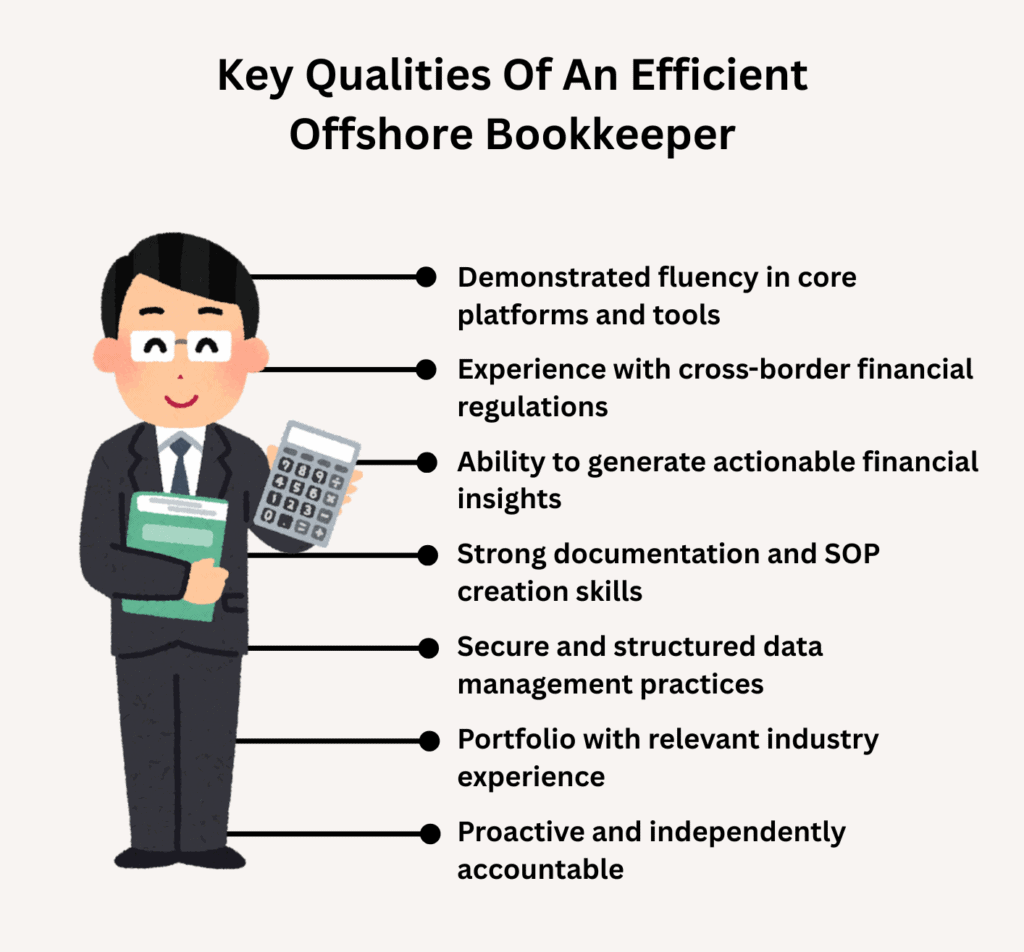
Look for these qualities to make sure you’re hiring an offshore bookkeeper who’s truly worth the investment:
- Demonstrated fluency in core platforms and tools: Look for candidates who can use tools like QuickBooks Online, Xero, Zoho Books, or NetSuite and understand how to integrate them with CRMs, payroll software, and invoicing tools.
- Experience with cross-border financial regulations: They should be familiar with your country’s tax requirements (US 1099 filing, UK VAT, or AU BAS) and know where their role ends and when to escalate to a CPA. They should also understand international payment processors, currency conversions, and how to handle multi-entity reporting.
- Ability to generate actionable financial insights: A high-quality bookkeeper can spot unusual trends, identify cash flow gaps, and suggest when to cut unnecessary expenses. They should be able to build custom reports and walk you through what the numbers mean for decision-making.
- Strong documentation and SOP creation skills: They must maintain organized records and be able to create/update standard operating procedures (SOPs) so anyone on your team can understand the process or audit trail without confusion.
- Secure and structured data management practices: They should follow best practices for remote work, like using secure passwords, two-factor authentication, VPNs, and encrypted file-sharing tools. Ask how they handle data backup, access control, and what security protocols they follow in case of breach attempts.
- Portfolio with relevant industry experience: Industry-aligned experience reduces onboarding time and error rates.
- Proactive and independently accountable: Great offshore bookkeepers take initiative. They point out problems before you notice them, ask smart questions, and suggest improvements. Long-term contracts or client retention are signs they work well with minimal supervision.
How To Hire The Right Offshore Bookkeeper In 9 Clear Steps
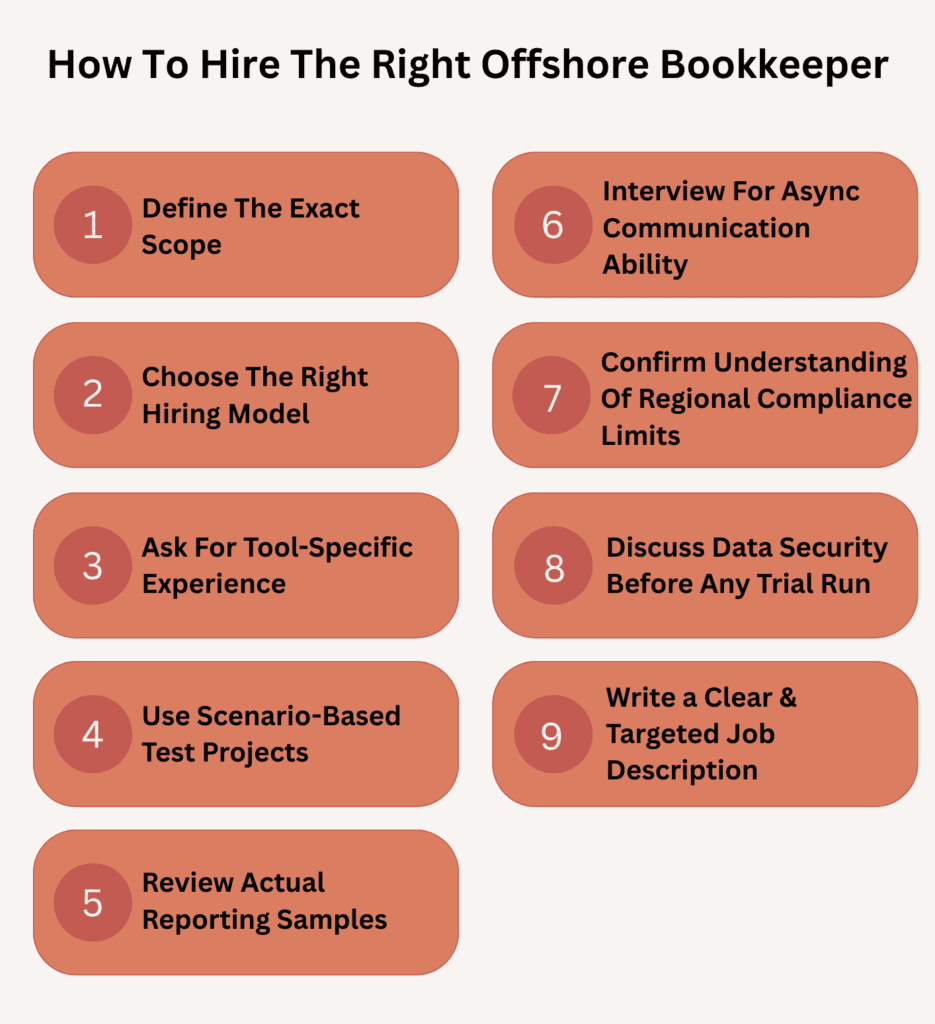
Follow these steps to make sure you hire an offshore bookkeeper who’s a true asset to your team:
1. Define The Exact Scope
- Identify exactly what the bookkeeper will handle, like monthly reconciliations, payroll support, invoicing, or tax prep assistance.
- Clarify how often tasks need to be done, like daily transaction updates, weekly reports, and monthly financial statements.
- Clarify what deliverables you expect each month. For example, do you need bank reconciliations, a cash flow summary, a monthly profit and loss statement, or flagged discrepancies for review? Make your expectations crystal clear.
- Include deadlines and turnaround times. For instance, reports must be delivered by the 3rd business day of each month, or invoices processed within 24 hours.
- Flag industry-specific needs. Mention any special workflows (eCommerce sales channels, SaaS subscription billing, or real estate accounting) that require domain knowledge.
2. Choose The Right Hiring Model
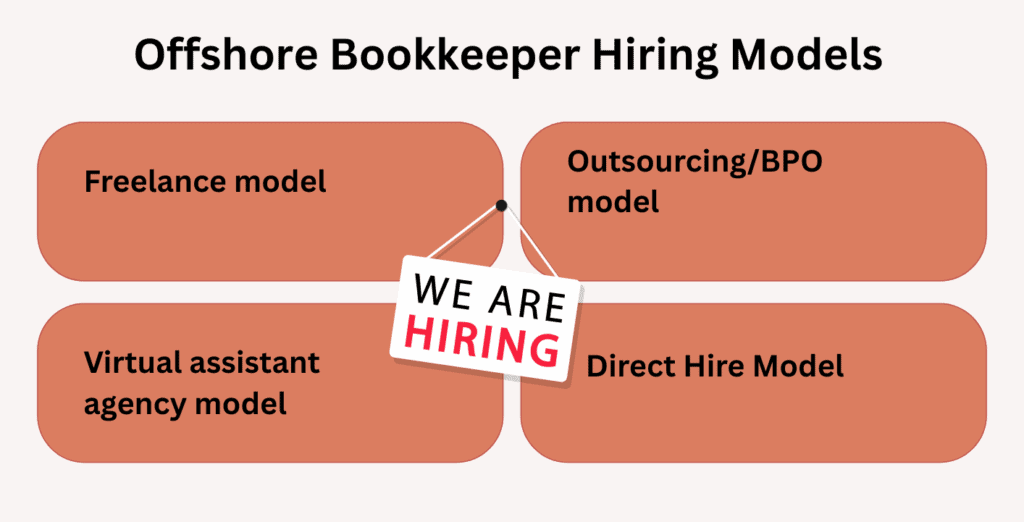
Choose from these offshore bookkeeper hiring models:
- Freelance model: This model gives you access to independent offshore bookkeepers. It’s flexible and cost-effective, making it great for short-term projects or task-based work. However, you’re responsible for finding, vetting, managing, and replacing talent if they leave.
- Virtual assistant agency model: Provide pre-vetted offshore bookkeepers who work for you part-time or full-time. The agency handles hiring, payroll, and some level of oversight. It’s a good balance between flexibility and support, especially for small businesses that want to avoid direct recruitment.
- Outsourcing/BPO model: In this setup, a professional services firm provides a dedicated offshore bookkeeping team under its management. These providers offer added benefits like training, compliance support, and enterprise-grade data security. It’s ideal for businesses that want structure, scale, and minimal management.
- Direct Hire Model: With this model, you hire an offshore bookkeeper directly, just like a regular employee. It gives you full control and long-term integration. You handle training, workflows, and day-to-day management.
3. Ask For Tool-Specific Experience
- List the exact tools your business uses. Name platforms like QuickBooks Online, Xero, Zoho Books, Stripe, Gusto, or Expensify, so candidates know what’s required.
- Ask how they’ve used each tool in real scenarios. For example: “How have you used Xero to automate expense categorization or generate recurring invoices?”
- Request screenshots or walkthroughs of past work. Have them show anonymized reports or dashboards they’ve created inside the tools you use.
- Check for integration knowledge. Ask if they’ve connected accounting tools with CRMs, payment processors, or inventory systems, and how they solved sync issues.
- Test their ability to troubleshoot common tool issues. Pose a scenario like: “A bank feed stops syncing in QuickBooks. What steps would you take to fix it?”
4. Use Scenario-Based Test Projects
- Create a real-world bookkeeping scenario. For example: “You discover a $500 discrepancy between the bank statement and QuickBooks. How would you investigate and fix it?”
- Test for both accuracy and communication. Ask them to not only solve the issue but also explain their reasoning in a short written summary, just like they would in your workflow.
- Limit time and scope to 1–2 hours. Keep the test realistic enough to evaluate skill, but short enough to respect their time (and yours).
- Use your actual tools or mock data. Set up a dummy account in Xero or provide anonymized CSV data so the test mirrors your real environment.
- Assess their ability to follow directions. Include 2–3 small instructions (“Label everything clearly” or “Submit as PDF”) to check their attention to detail.
“Efficient offshore bookkeepers help businesses move faster, make smarter decisions, and stay financially sharp.”
Burkhard Berger, Founder & CEO of Genius
5. Review Actual Reporting Samples
- Request anonymized financial reports from past clients. Ask for examples like balance sheets, P&L statements, cash flow reports, or reconciliation summaries with client names and data masked.
- Check formatting and structure. Look for clean layouts, consistent labeling, and clear sections that make the report easy to understand at a glance.
- Assess how insights are communicated. See if the bookkeeper explains key takeaways, highlights trends, or flags issues (not just dumps raw numbers into a spreadsheet).
- Look for tool-generated vs. custom-built reports. Ask whether they used built-in templates or created customized views with formulas, filters, or visual charts.
- Match their samples to your business model. Review whether their past reporting aligns with what you need—e.g., recurring revenue tracking for SaaS or inventory reporting for eCommerce.
6. Interview For Async Communication Ability
- Ask them to summarize a complex task in writing. Give a bookkeeping scenario and ask them to explain their approach through a written response. This shows how clearly they can communicate without a live call.
- Review their message clarity and tone. Look for concise, well-structured replies that are easy to follow. Avoid candidates who write vague or overly technical responses without explanation.
- Test how they document updates or next steps. Ask, “How would you update a client after closing out a month?” This reveals their ability to give clear written updates without being prompted.
- Observe responsiveness over email or messaging. During the hiring process, notice how quickly and clearly they respond to emails, instructions, or follow-up questions.
- Request a sample SOP or process note. Ask them to share a previously written standard operating procedure or a short how-to guide to see how they explain workflows for others.
7. Confirm Understanding Of Regional Compliance Limits
- Ask what financial tasks they’re legally allowed to perform. A qualified offshore bookkeeper should know their boundaries. For example, preparing reports is fine, but signing tax returns is not.
- Check if they’ve worked with your country’s tax rules. Ask for experience with systems like US 1099 filings, UK VAT submissions, or AU BAS reporting.
- Confirm how they’ve worked with CPAs or local tax professionals. Look for candidates who know when to pass tasks to a licensed professional and how to collaborate during tax season or audits.
- Review how they manage client compliance documentation. Ask how they organize financial records for tax prep, keep deadlines on track, and flag compliance risks to clients.
- Test their knowledge with a compliance scenario. Give a simple case like “A client is unsure if a foreign contractor needs a 1099” and ask how they’d respond or escalate.
8. Discuss Data Security Before Any Trial Run
- Ask what tools they use to protect client data. Look for password managers (LastPass, 1Password), two-factor authentication, and secure cloud storage like Google Drive with restricted access.
- Confirm if they use encrypted devices and secure networks. Ask if their devices are encrypted and if they work from private, password-protected networks, not public Wi-Fi or shared computers.
- Review their file-sharing methods. Make sure they use encrypted or access-controlled platforms (e.g., Dropbox Business, Google Workspace) instead of sending sensitive files over unsecured channels.
- Discuss access controls and role-based permissions. Ask how they manage logins and whether they request limited-access user roles in your accounting tools instead of full admin access.
- Request their data backup and recovery process. A qualified bookkeeper should have a plan for backing up your data and restoring it in case of system failure or breach.
9. Write A Clear & Targeted Job Description
- Start with a clear job title and purpose. Use titles like “Remote Bookkeeper – QuickBooks & U.S. GAAP Experience” and state exactly what they’ll be responsible for.
- List tasks like recording daily transactions, reconciling bank accounts, managing accounts payable/receivable, and generating monthly reports.
- Mention required tools and platforms like Xero, QuickBooks Online, Stripe, Gusto, or Google Sheets.
- Clarify if you need them full-time, part-time, or on retainer.
- State key outputs like timely monthly closes, accuracy standards, and frequency of updates or reports.
- Mention years of experience, previous clients (especially US, UK, AU), attention to detail, communication style, and ability to work independently.
Here’s a sample you can customize to your needs:
| Remote Bookkeeper – QuickBooks Online & US GAAP Experience Job Overview: We’re looking for a detail-oriented and reliable remote bookkeeper with strong experience in QuickBooks Online and a solid understanding of US GAAP. You’ll be responsible for managing day-to-day financial transactions, keeping our books up to date, and preparing accurate monthly reports that support smart business decisions. This is a part-time remote position (20–25 hours/week) with the potential to grow into a full-time role. We prefer candidates who can work independently and provide updates asynchronously, with occasional check-ins during U.S. business hours. Key Responsibilities: – Record and categorize daily transactions from multiple bank and credit card accounts – Reconcile bank and credit card statements on a weekly basis – Manage accounts receivable and accounts payable, including invoice tracking and vendor payments – Prepare monthly financial reports, including profit & loss, balance sheet, and cash flow statements – Maintain organized financial records in our accounting software and Google Drive – Flag unusual transactions or discrepancies for review – Collaborate with our CPA during tax season and ensure financial data is clean and ready – Provide a month-end close checklist and complete all closing tasks by the 3rd business day of each month Required Tools & Software: – QuickBooks Online (required) – Google Sheets – Stripe – Gusto (preferred) – Slack or ClickUp (for communication and task updates) Requirements: – 3+ years of professional bookkeeping experience – Prior experience working with U.S.-based clients – Strong knowledge of U.S. GAAP and small business accounting principles – Proven ability to deliver timely and accurate monthly reports – Comfortable working independently with limited supervision – Excellent written communication skills for async updates and documentation – High attention to detail and data accuracy – Ability to meet deadlines consistently Preferred: – Experience supporting SaaS, eCommerce, or service-based businesses – Familiarity with other tools like Xero or Zoho Books is a plus – Experience preparing books for CPA-led tax filing Working Hours & Expectations: – Part-time: 20–25 hours/week to start – Time zone: Prefer some overlap with PST or EST for weekly check-ins – Communication: Async updates expected 2x/week with end-of-month summary – Availability: Must be able to meet monthly deadlines without reminders |
Where To Find The Best Offshore Bookkeepers: 5 Countries To Consider
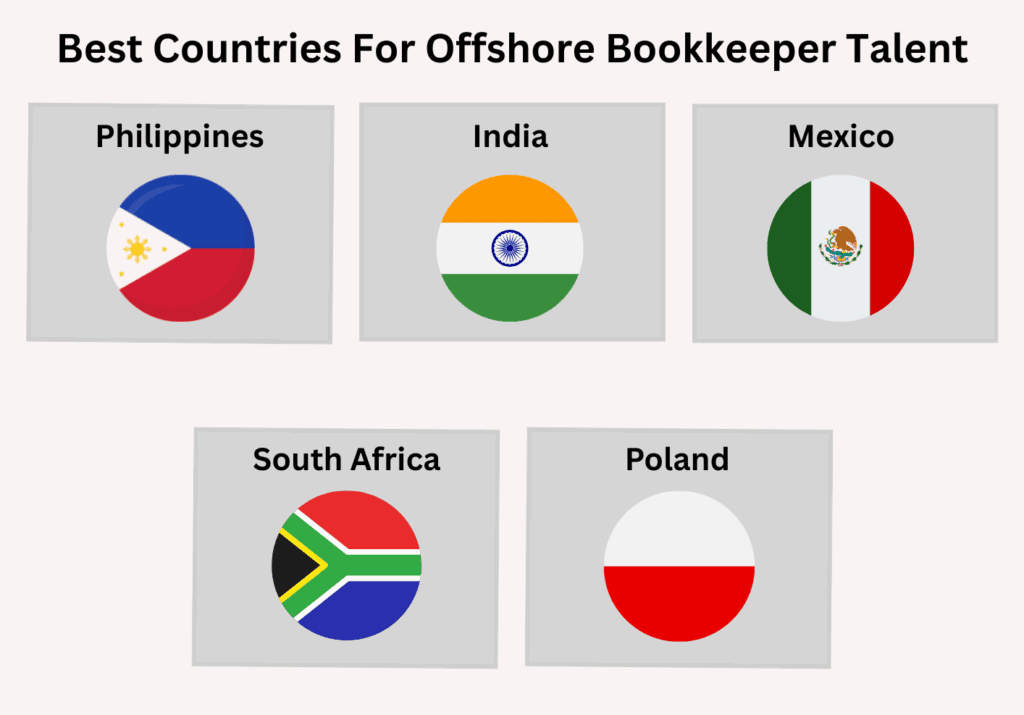
Here are the top 5 locations to hire an offshore bookkeeper:
1. Philippines
- The Philippines has 200,000 certified public accountants (CPAs).
- It ranks 22nd out of 116 countries in the EF English Proficiency Index, with a score of 570, indicating a high proficiency level.
- Operating on Philippine Standard Time (PST), the 12 to 15-hour time difference with US time zones supports a “follow-the-sun” workflow where bookkeepers can work on tasks overnight and have them ready by the next US business day.
- Institutions like the Philippine Institute of Certified Public Accountants (PICPA) ensure adherence to international standards and continuous professional development.
- With a strong understanding of Western business practices, Filipino professionals integrate seamlessly with international teams.
2. India
- India has over 1.4 million members registered with the Institute of Chartered Accountants of India (ICAI).
- India ranks 69th out of 113 countries in the EF English Proficiency Index, which indicates a moderate proficiency level.
- Operating on Indian Standard Time (IST), India has a 9.5 to 12.5-hour time difference with U.S. time zones. This is perfect for a round-the-clock workflow where your offshore bookkeeper can make progress while your team is offline.
- India has a mature BPO industry with strong data security practices, standardized workflows, and quality assurance systems.
- India’s National Financial Reporting Authority (NFRA) is responsible for overseeing auditing and accounting standards in India. It ensures that financial reporting and auditing practices meet international benchmarks, enhancing the credibility of Indian financial professionals.
3. Mexico
- Mexico had approximately 151,000 professionals employed in the accounting, auditing, and related services industry.
- Mexico operates on Central Standard Time (CST), which overlaps with US business hours by approximately 6 to 9 hours. This supports real-time communication and smooth day-to-day collaboration for US-based teams.
- As part of the USMCA (United States-Mexico-Canada Agreement), Mexico aligns closely with the US financial and tax systems, reducing friction in cross-border accounting practices.
- Organizations like the Mexican Institute of Public Accountants (IMCP) oversee the profession, ensuring adherence to standards and continuous professional development.
- Proximity to the US and cultural similarities enhance collaboration and understanding between Mexican bookkeepers and US-based clients.
4. South Africa
- South Africa has over 50,000 registered South African Institute of Chartered Accountants (SAICA) members.
- South Africa ranks 11th globally in the EF English Proficiency Index with a score of 594, reflecting a very high proficiency level.
- Operating on South African Standard Time (SAST), there is a 6-hour difference with Eastern Standard Time (EST). This is a 2–3 hour overlap during US morning hours.
- South Africa’s Protection of Personal Information Act (POPIA) promotes strong data privacy and security compliance for international outsourcing.
- Universities like the University of Cape Town and Stellenbosch produce thousands of skilled accounting and finance professionals annually.
5. Poland
- Poland’s Accounting & Auditing industry employs 138,000 professionals.
- Poland ranks high in English proficiency with a score of 588, placing 15th globally on the EF English Proficiency Index.
- Poland (CET) has 2–3 hours of overlap with Eastern Standard Time (EST), allowing for limited real-time collaboration during US morning hours.
- Polish professionals share similar business communication styles, ethics, and practices with Western clients, improving collaboration.
- Poland’s EU membership ensures regulatory consistency and data protection.
😱 This Might Surprise You
Financial services hold a 19% share of the offshoring market.
How Much Does An Offshore Bookkeeper Cost?
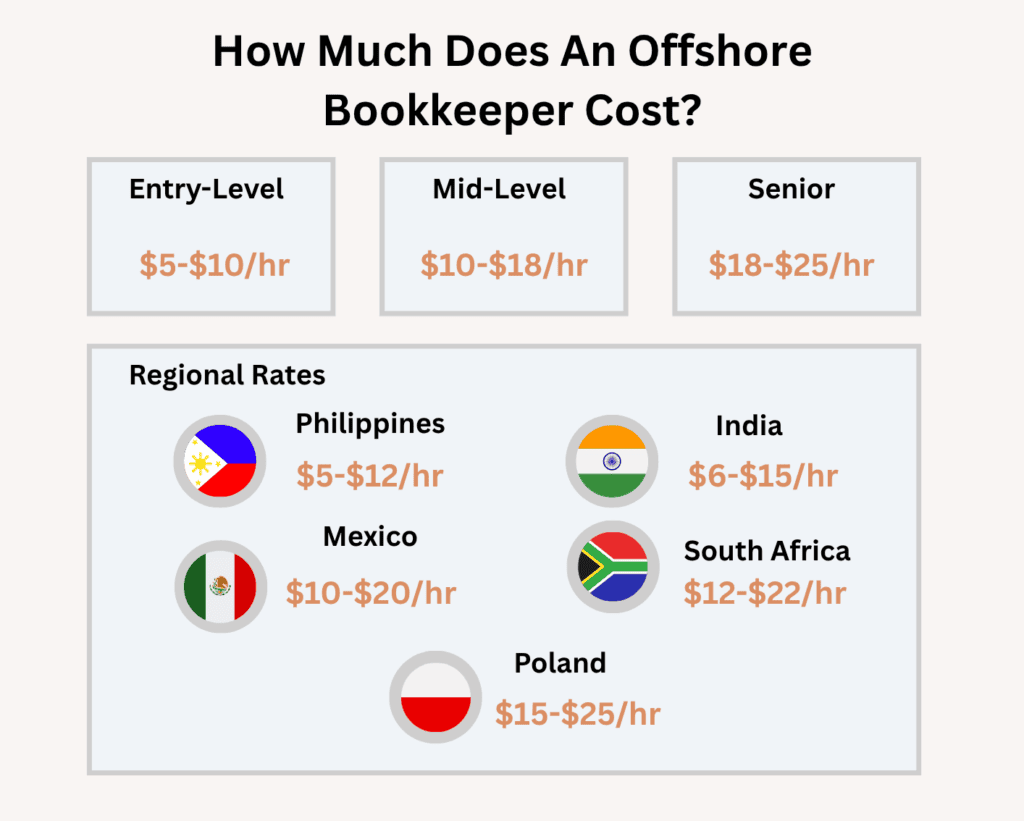
Offshore bookkeepers cost between $5 to $25 per hour, depending on location, experience, and scope of work. Some providers also offer flat monthly rates ranging from $250 to $1,500+.
By Experience Level:
- Entry-Level (0–2 years): $5–$10/hour
Suitable for basic tasks like data entry, invoice tracking, or uploading receipts. - Mid-Level (2–5 years): $10–$18/hour
Can manage reconciliations, payroll prep, and software tools with minimal oversight. - Senior-Level (5+ years): $18–$25+/hour
Brings strong financial insight, reporting accuracy, and the ability to improve workflows or handle complex books.
By Region (Hourly Rates):
- Philippines: $5–$12/hour
- India: $6–$15/hour
- Mexico: $10–$20/hour
- South Africa: $12–$22/hour
- Poland/Eastern Europe: $15–$25/hour
Common Pricing Models:
- Hourly billing: Ideal for flexible, part-time work
- Monthly retainers: Used for consistent, ongoing support
- Project-based pricing: For one-time tasks like catch-up bookkeeping or system setup
Where To Hire Offshore Bookkeepers: 5 Best Platforms & Services
Here’s where you can connect with experienced offshore bookkeepers:
1. Genius
Most overseas bookkeeping hires are a nightmare: sloppy reports, questionable credentials, communication gaps, constant turnover, and time zone confusion. Genius was built to solve that. We help you hire elite offshore bookkeepers from the Philippines and Latin America (people with US-level accuracy, strong software skills, and real-world experience) for up to 80% less than local hires.
There are no monthly fees—you only pay when you make a successful hire. That means no ongoing subscriptions or platform charges, just straightforward hiring with zero overhead.
Our on-the-ground recruiting network means we don’t rely on resumes alone—we source and screen candidates through local recruiters who know the market, verify credentials in person, and ensure you’re only seeing true A-players.
Every hire comes with a 6-month talent guarantee. So, if the hire doesn’t work out within the first 6 months, we’ll replace them for free, because we only win when you do. And if you don’t make a hire, you get a 100% refund, no questions asked.
- Type: Exclusive Global Talent Agency
- Pricing model: One-time fee, no monthly fees
- Talent expertise level: Mid-level, senior offshore bookkeepers
- Engagement model: Full-time
- Year founded: 2019
- Revenue: $1M – $2M
- No. of employees: 25
| Pros | Cons |
| Risk-free hiring with a 6-month talent guarantee and free interviews | Focuses on talent from Latin America and the Philippines (will expand soon because of popular demand) |
| Cut hiring costs by up to 80% | |
| Rigorous vetting with an on-the-ground team |
Why we like it: Genius offers a mix of high-quality recruiting and low-risk pricing. Our focus on sourcing elite offshore bookkeepers from cost-effective markets without charging monthly fees provides long-term financial talent with minimal risk.
2. TOA Global
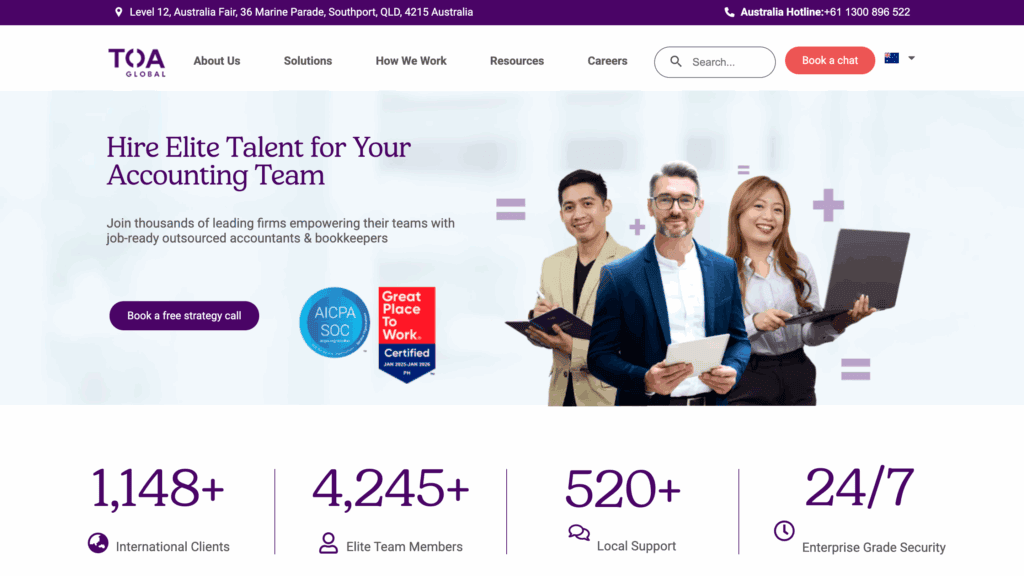
TOA Global is a talent solutions provider that connects accounting firms with full-time, dedicated offshore bookkeepers and accountants in the Philippines. With over 10 years of experience and more than 1,100 international clients, TOA Global focuses on helping firms reduce overhead by up to 66% while maintaining control, quality, and compliance.
- Type: Accounting outsourcing services
- Pricing model: Monthly rates range from $500-$10,000/mo
- Talent expertise level: Junior or senior offshore bookkeepers
- Engagement model: Full-time
- Year founded: 2013
- Revenue: $500M – $1B
- No. of employees: 3,500+
| Pros | Cons |
| Firms can cut labor costs by up to 66% | Full-time hiring model only |
| offers 24/7 SOC-compliant infrastructure to protect sensitive financial data | Philippines-only workforce |
| Proven track record |
Why we like it: TOA Global offers a reliable and secure way to scale with dedicated offshore bookkeepers trained in global standards. Their support structure, 24/6 assistance, and emphasis on long-term staffing help your business grow without overextending your local teams.
3. QX Accounting
QX Accounting is an offshore accounting and bookkeeping provider based in India, serving over 300 international accounting firms. They specialize in helping businesses reduce costs, increase capacity, and improve service quality by offering trained, full-time offshore bookkeepers and accountants.
With a focus on compliance, scalability, and specialization, QXAS offers a free trial, secure infrastructure, and continuous training through its in-house QXAS Academy.
- Type: Accounting outsourcing company
- Pricing model: Hourly rates, project-based fees, or retainer agreements
- Talent expertise level: Entry-level, mid-level, or senior-level offshore bookkeepers
- Engagement model: Dedicated individual or team to work exclusively on your project
- Year founded: 2006
- Revenue: $346M
- No. of employees: 3,500+
| Pros | Cons |
| Up to 50% cost savings | India-based time zone |
| Trained in global standards | Pricing not publicly listed, which may delay your decision-making process |
| Strong data security certifications |
Why we like it: QXAS blends deep accounting expertise with cost savings and enterprise-grade security. Their team is trained in US accounting standards and familiar with major accounting tools.
“Great offshore talent is out there—you just need someone who knows where to look.”
Christian Cabaluna, Senior Recruiter at Genius
4. Bench
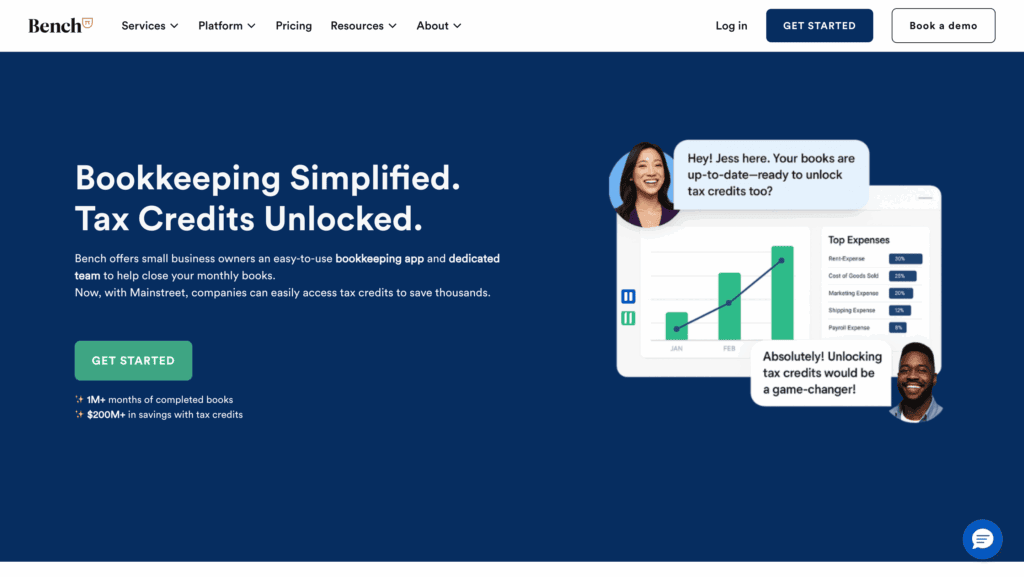
Bench is a US-based online bookkeeping and tax service designed for small businesses. It operates with a remote, tech-enabled team of expert bookkeepers. Their monthly service includes categorized transactions, financial statements, and year-end financial packages ready for tax filing. They also provide optional tax filing services and ongoing tax advice.
- Type: Cloud-based bookkeeping and financial services provider
- Pricing model: Monthly plan starts at $299/mo
- Talent expertise level: Entry-level offshore bookkeepers
- Engagement model: Full-time, part-time, and freelance
- Year founded: 2012
- Revenue: $500M – $1B
- No. of employees: 349
| Pros | Cons |
| All-in-one bookkeeping and tax support | US-only focus |
| You don’t need to vet or train offshore bookkeepers—Bench handles the entire process. | No control over who’s doing the work |
| Year-end tax package included | No access to raw accounting software |
Why we like it: Bench makes bookkeeping and tax support feel effortless for small business owners by combining remote expertise with user-friendly software. Their year-round support, clean reporting, and bundled tax services help you stay compliant and confident, without having to hire or manage individual offshore bookkeepers yourself.
5. Outsourcey
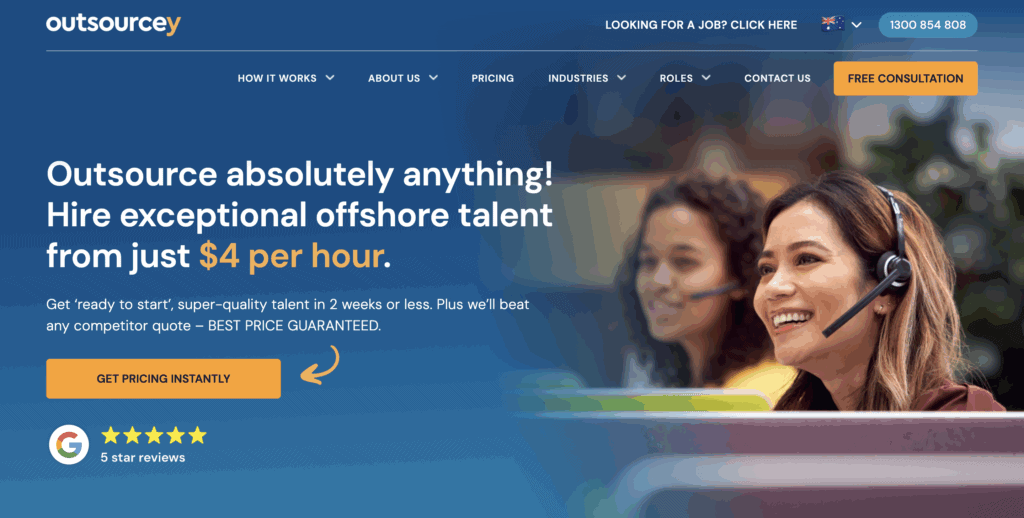
Outsourcey is a global outsourcing service that helps businesses hire vetted offshore talent within 2 weeks. They offer flexible hiring options with no lock-in contracts and a best price guarantee. With 24/7 operations and support for remote, hybrid, or office-based roles, they’re built for modern, distributed teams looking to scale bookkeeping functions efficiently.
- Type: Business Process Outsourcing (BPO)
- Pricing model: Hourly rates range from $4-$8/hr
- Talent expertise level: Entry-level, intermediate, or senior offshore bookkeepers
- Engagement model: Full-time or part-time
- Year founded: 2023
- Revenue: $10M – $20M
- No. of employees: 201-500
| Pros | Cons |
| No lock-in contracts | You can’t browse candidates or filter by skill |
| Fast hiring process | No built-in bookkeeping supervision |
| Scalable staffing | No direct integration support |
Why we like it: Outsourcey offers a fast and flexible way to hire offshore bookkeepers with no setup fees, no lock-in contracts, and a strong focus on affordability.
🔎 This Is Interesting
Accounting and IT services are the most popular outsourced processes for small businesses.
5 Red Flags To Watch Out For When Hiring An Offshore Bookkeeper

Beware of these challenges you might encounter when hiring an offshore bookkeeper:
- Vague or incomplete responses during interviews
- Solution: Ask scenario-based questions and request written explanations to test clarity and depth of knowledge.
- Solution: Ask scenario-based questions and request written explanations to test clarity and depth of knowledge.
- No portfolio or reporting samples available
- Solution: Require anonymized samples of past work, like P&Ls or reconciliation reports, before moving forward.
- Solution: Require anonymized samples of past work, like P&Ls or reconciliation reports, before moving forward.
- Unfamiliar with your country’s tax or compliance standards
- Solution: Verify they understand their role boundaries and have experience supporting clients in your region (US 1099s, UK VAT, AU BAS).
- Solution: Verify they understand their role boundaries and have experience supporting clients in your region (US 1099s, UK VAT, AU BAS).
- Lack of clear security practices
- Solution: Ask about their use of password managers, VPNs, two-factor authentication, and data backup procedures before granting access.
- Solution: Ask about their use of password managers, VPNs, two-factor authentication, and data backup procedures before granting access.
- Missed deadlines or slow responses during the trial phase
- Solution: Start with a paid test project and assess their communication speed, accuracy, and ability to deliver on time.
Conclusion
No doubt, hiring the right offshore bookkeeper clears your head. But don’t rush the process. The smartest move you can make is to treat this like any high-impact hire: define what you need, vet carefully, and choose a platform or partner that fits the way you work.
Genius makes hiring an offshore bookkeeper simple, fast, and risk-free. You don’t have to sift through piles of bad applications or guess who’s legit because we do the hard work for you. Our local recruiters find the top 1% of talent in the Philippines and Latin America, and we back every hire with a 6-month guarantee. No monthly fees. No commitment pressure. Just world-class bookkeeping support at 80% less than what you’d pay locally.
Ready to stop stressing over your books? Let Genius find you a true A-player.
FAQs
What tasks should I avoid assigning to an offshore bookkeeper?
Avoid giving them tasks that require a licensed CPA, like filing taxes or providing formal financial advice. They can prepare documents, but final submissions should be handled locally.
How long does onboarding an offshore bookkeeper usually take?
With clear documentation and access setup, onboarding can take 2 to 5 days. It may take longer if systems or workflows need customization or cleanup.
What should I include in an offshore bookkeeper agreement?
Include the scope of work, payment terms, communication rules, confidentiality clauses, access permissions, and security protocols to ensure clarity and accountability.
Can offshore bookkeepers handle multiple currencies and international accounts?
Yes, experienced bookkeepers often manage multi-currency accounts and international transactions, especially when using platforms like Xero or QuickBooks Online with built-in conversion features.