
You are not short on developers. You are short on ones who deliver. The kind who actually move your product forward. Instead, your payroll is bloated, and your team is too busy fixing bugs to build anything new. That is where an offshore PHP developer can make a real difference—not as a cheap substitute, but as your unfair advantage.
This guide shows you exactly how to hire offshore PHP talent that performs like your in-house A-team (without costing like one). From vetting real skills to avoiding vendor traps, we built this for decision-makers who are done settling.
Hiring An Offshore PHP Developer: All You Need To Know In A Minute
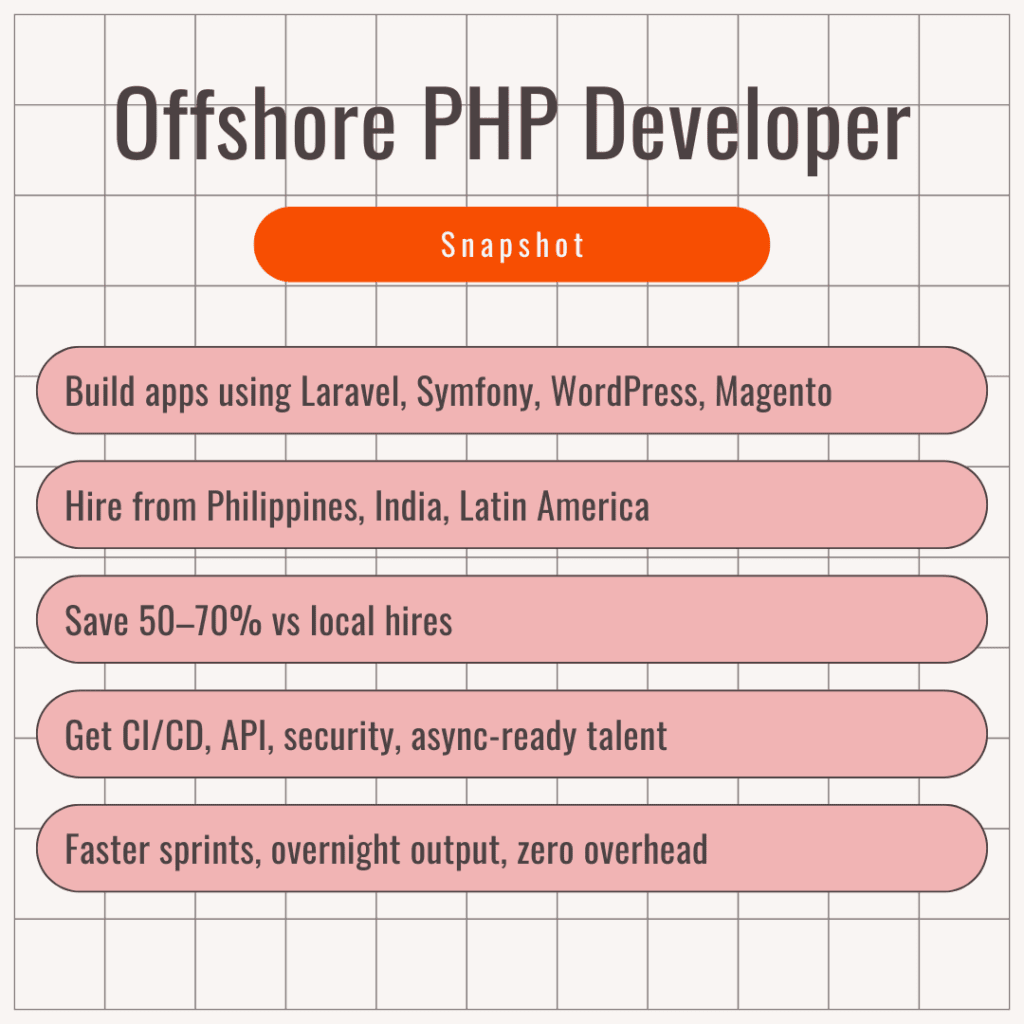
- Offshore PHP developers are full-time or project-based backend engineers in lower-cost regions like the Philippines, India, and Latin America.
- They build and scale apps using modern PHP frameworks like Laravel, Symfony, and CMS tools like WordPress or Magento.
- You cut 50–70% off costs without losing senior-level talent when you hire from vetted offshore pools.
- Most teams hire for delivery, not just code. CI/CD, API integration, security, and async collaboration are table stakes.
- Done right, you get faster shipping, overnight sprint coverage, and plug-and-play expertise without the overhead.
Check Out These Related Popular Reads
🔥 What Is An Offshore Development Center? Models, Pros, Cons
🎯 How To Hire A+ Angular Offshore Developers The SMART Way
📣 17 Best Sites To Hire iOS Offshore Development Experts 2025
What Is An Offshore PHP Developer & Why Should You Hire One?

An offshore PHP developer is a remote backend engineer based in a lower-cost region like India, the Philippines, Latin America, or Eastern Europe. They build, secure, and scale web applications using PHP and modern frameworks like Laravel and Symfony. Most are hired full-time or project-based through vetted recruitment partners.
Here are 5 primary reasons to offshore PHP development:
- Cut up to 70% of engineering costs without losing access to senior-level PHP expertise.
- Unlock talent pools in regions like Eastern Europe & Southeast Asia with deep experience in Laravel, Symfony, and CMS systems.
- Achieve 24/7 sprint cycles by leveraging time zone differences for overnight development and testing.
- Reduce hiring time by up to 60% with pre-vetted offshore candidates ready to onboard in under 2 weeks.
- Scale PHP teams faster without the overhead of local salaries, benefits, or compliance risks.
5 Easy-To-Follow Steps To Hire An A+ Offshore PHP Developer

Use these steps to plug the gaps that cost you every month.
Step 1: Lock In Your Scope Before You Touch Resumes
Do not browse candidates yet. Scope clarity beats speed every time. Without it, your hire will deliver guesswork instead of real features.
- Write a one-pager with your app type (SaaS, e-commerce, CMS), features, and codebase status.
- List your PHP stack (Laravel 11, Symfony 7, WordPress, etc.) in exact versions.
- Set a budget range based on benchmarks from India, Latin America, and Eastern Europe.
- Map time zone overlap (minimum 4 working hours with the US team = smoother delivery).
- Define what “success” means in week 1, sprint 1, and month 1 (feature, velocity, or test coverage).
Step 2: Choose A Model That Matches Your Urgency
The right hiring model saves you months. Freelancers work on tasks. Dedicated teams own the delivery. Staff augmentation bridges both. Pick what fits your growth stage.
- Use dedicated hires for ongoing builds and roadmap work (ideal for SaaS or product teams).
- Go project-based when you have clear scope and deadlines (e.g., WordPress migration).
- Try staff augmentation to plug gaps without long-term commitment.
- Avoid “hourly platforms” unless you can project manage daily.
- Compare agency vs direct hire to weigh speed, overhead, and control.
Step 3: Skip The Resume, Test the Code
Most hiring fails here. Good PHP developers can show real apps, not just list fancy terms. The goal is skill proof, not just interview charm.
- Give a real-world test (build a feature from your backlog or debug a sample legacy code).
- Ask for GitHub links showing Laravel routing, middleware, or Symfony controller logic.
- Request CI/CD configuration files to verify DevOps exposure.
- Reject any candidate who refuses to test work or reuses unrelated code.
- Check timezone reliability by running a simulated issue escalation test.
Step 4: Prep Your Toolstack For Remote Execution
Before you onboard, build the environment your offshore PHP developer will step into. Set it up like a product, not a guess.
- Provide Git access with clear branch rules and code ownership audit logs.
- Deploy CI/CD tools like GitHub Actions, Bitbucket Pipelines, or Jenkins.
- Use Slack + Loom for async check-ins, code reviews, and demo walkthroughs.
- Create a Sprint Zero document with timezone expectations, meeting cadence, and credentials.
- Install monitoring tools to track commits, test coverage, and velocity.
Step 5: Onboard, Monitor, & Scale Without Babysitting
Hiring is not the finish line. Onboarding and monitoring separate good teams from the ones who ghost mid-sprint.
- Walk through your Sprint Zero setup live and record it (Slack Huddle + Loom works well).
- Assign a shadow ticket for week 1 to help them learn your repository and QA process.
- Run daily standups with a fixed time block across both time zones.
- Track performance weekly (bug count, commit volume, issue resolution time).
- Set a review checkpoint every 2 weeks to reassess role fit, scope, and results.
“The biggest cost in software is delay, not salary. Offshore PHP development done right reduces payroll AND time-to-ship”
— Burkhard Berger, Founder & CEO
7 Essential Skills Your Offshore PHP Developer Should Have

Cross-check these skills against your current backlog to separate average offshore developers from experts.
- PHP 8.3 proficiency: This version introduces readonly classes, typed class constants, and better performance; test with logic-heavy scripts and reflection use.
- Laravel 11 or Symfony 7 experience: These frameworks dominate PHP development; ask for real code samples with Eloquent, middleware, or service containers.
- MySQL & PostgreSQL fluency: Both databases are used in modern PHP stacks; evaluate ability to write and optimize complex joins, indexes, and stored procedures.
- API integration & RESTful service design: Must handle token-based authorization, rate limits, and error handling; use a mock Postman collection to test implementation speed and accuracy.
- CI/CD setup & Git branching: Test for the ability to use GitHub Actions or Bitbucket Pipelines and follow trunk-based development without breaking your main branch.
- Cloud environment experience (AWS, GCP, or Azure): Look for skills in EC2 setup, S3 integration, or Cloud Functions tied to PHP backends; these directly impact your scaling and hosting cost.
- Timezone & async collaboration readiness: Strong English, written documentation skills, and async updates via Slack or ClickUp are essential for non-overlapping schedules.
7 Best Countries To Hire Offshore PHP Developers: Popular Frameworks + Timezone Overlap

Review this table and decide quickly based on key frameworks and timezone overlap.
| Region | Top PHP Frameworks Used | Timezone Overlap With The US (Hours) |
| Phillippines | Laravel, WordPress, CodeIgniter | 4–6 (East Coast), 2–3 (West Coast) |
| India | Laravel, CodeIgniter, Symfony | 3–4 (East Coast), 1–2 (West Coast) |
| Vietnam | Laravel, Yii, Symfony | 2–4 (East Coast), 1–2 (West Coast) |
| Ukraine | Symfony, Laravel, Zend | 4–6 (East Coast), 2–4 (West Coast) |
| Poland | Symfony, Laravel, Magento | 5–7 (East Coast), 3–5 (West Coast) |
| Mexico | Laravel, WordPress, Symfony | 6–8 (East Coast), 4–6 (West Coast) |
| Brazil | Laravel, Symfony, CakePHP | 5–7 (East Coast), 3–5 (West Coast) |
The Top 3 Platforms To Hire PHP Developers Offshore This Year
Compare these top 3 platforms side-by-side to lock in your next offshore PHP hire.
1. Genius: Hire Top-Tier PHP Developers From The Philippines & Latin America

Core services: Full-time offshore recruitment of pre-vetted PHP developers across Laravel, Symfony, WordPress, and CMS platforms.
Best for:
- US-based teams that need a 4–6 hour overlap
- SaaS and eCommerce product builds
- Long-term delivery with low turnover
- Roles from junior to senior level
- 3–6 month performance guarantees
Sources & vetting: Top 1% of developers from Genius’ private talent network; candidates pass resume screens, code tests, and async interviews.
Time-to-hire & hiring model: 7–14 days average; direct placement with a one-time 25% hiring fee.
Guarantees: Free developer replacement; 6-month performance protection available.
Avoid if:
- You need freelancers or part-time hires
2. RocketDevs: Get Senior PHP Developers From $8/Hour

Core services: Offshore hiring for full-time PHP developers at startup-friendly rates, with hands-on support and time-tracking tools.
Best for:
- Startups with budget caps
- Teams that need hands-on time tracking
- Mid-level to senior backend PHP work
- Short hiring timelines
- Transparent skill vetting
Sources & vetting: Developers vetted through 6–8 hour code assessments; backed by RocketDevs’ internal review board.
Time-to-hire & hiring model: 3–5 days; direct full-time contracts, starting at $8/hour.
Guarantees: 2-week no-risk trial for every hire.
Avoid if:
- You need project-based teams
- You want agency-level structure
- You require deep CMS specialization
3. MentorSol: Build Dedicated Offshore PHP Teams Fast
Core services: End-to-end team setup of full-cycle PHP development squads, including PMs, QAs, and CI/CD support.
Best for:
- SaaS or fintech startups building from scratch
- Mid-size companies scaling product delivery
- API-heavy or microservices work
- Agile-ready teams
- Full-cycle build-outs with CI/CD
Sources & vetting: PHP developers vetted via live technical interviews, architecture tests, and GitHub/codebase audits.
Time-to-hire & hiring model: 5–10 business days; dedicated team model or staff augmentation.
Guarantees: Trial period included; flexible team swaps within 30 days.
Avoid if:
- You only need 1–2 PHP roles
- You want to manage developers directly
- You are hiring for a single CMS migration
🚨 Did You Know?
Senior developers with 5+ years of experience cost $35–$85 per hour globally.
Offshore PHP Developer Salary Breakdown By Region: What You Should Expect To Pay

Check your current payroll against these real-world salary benchmarks before you make your next PHP hire.
| Region | Junior ($/Hour) | Mid-Level ($/Hour) | Senior ($/Hour) |
| Phillippines | 15 | 25 | 40 |
| India | 15 | 20 | 30 |
| Eastern Europe | 25 | 35 | 55 |
| Latin America | 20 | 30 | 45 |
| United States | 45 | 65 | 80 |
5 Strategies That Will Help Your Offshore PHP Developer Excel

Build these strategies into your process to enhance how your offshore PHP developer works.
1. Set Weekly Output Goals, Not Task Lists
Your developer does not need more to-do items. They need clear, measurable deliverables they can own from start to finish.
- Define sprint targets by feature completion, not effort hours.
- Use Git commit volume and closed ticket ratio to track velocity.
- Require demoable progress every Friday via Loom or live share.
- Create a shared Kanban board (ClickUp, Jira) to show blockers in real time.
2. Write Async-First, Timezone-Friendly Communications
Your developer should not guess what matters or wait for a meeting to unblock a task. Async communication fixes that.
- Use ClickUp or Notion for all task details and edge case notes.
- Replace check-in meetings with daily Loom video updates under 3 minutes.
- Set a 4-hour response rule for Slack or email updates.
- Post all change requests in writing before end-of-day US time.
3. Test In Hardware-Real Conditions
If your developer builds firmware-adjacent PHP, API bridges, or edge logic, test against real-world constraints, not just local emulators.
- Provide USB-over-IP or serial relays for remote device control.
- Require OTA rollback validation on staging environments.
- Enforce log checkpoints on every build: init, fail, OTA, timeout.
- Store logs in ring buffers to capture faults during brownouts or watchdog resets.
4. Use Development Metrics That Actually Predict Burnout
Velocity without quality is a trap. Track the real indicators of burnout before they hit your deadlines.
- Watch commit activity outside regular hours as a red flag.
- Review bug reopen rate per sprint per developer.
- Spot a drop in test coverage below 80% as a delivery risk.
- Run a monthly retrospective survey with 3 open-ended questions: blocker, friction, and morale.
5. Make Code Reviews A Two-Way Learning Loop
Reviews should not be one-sided corrections. Use them to boost accountability and peer learning.
- Set a 24-hour SLA on PR reviews using GitHub or Bitbucket.
- Assign every developer to review one peer PR per week.
- Tag common patterns or bugs in a shared doc (e.g., Laravel query leaks).
- Measure review-to-merge latency to catch approval bottlenecks.
“You are hiring for outcomes, not availability. Offshore PHP developers who own delivery, version control, and velocity are rare, but they exist.”
— Christian Cabaluna, Senior Recruiter
10 Offshore PHP Developer Interview Questions To Test Technical & Cultural Fit
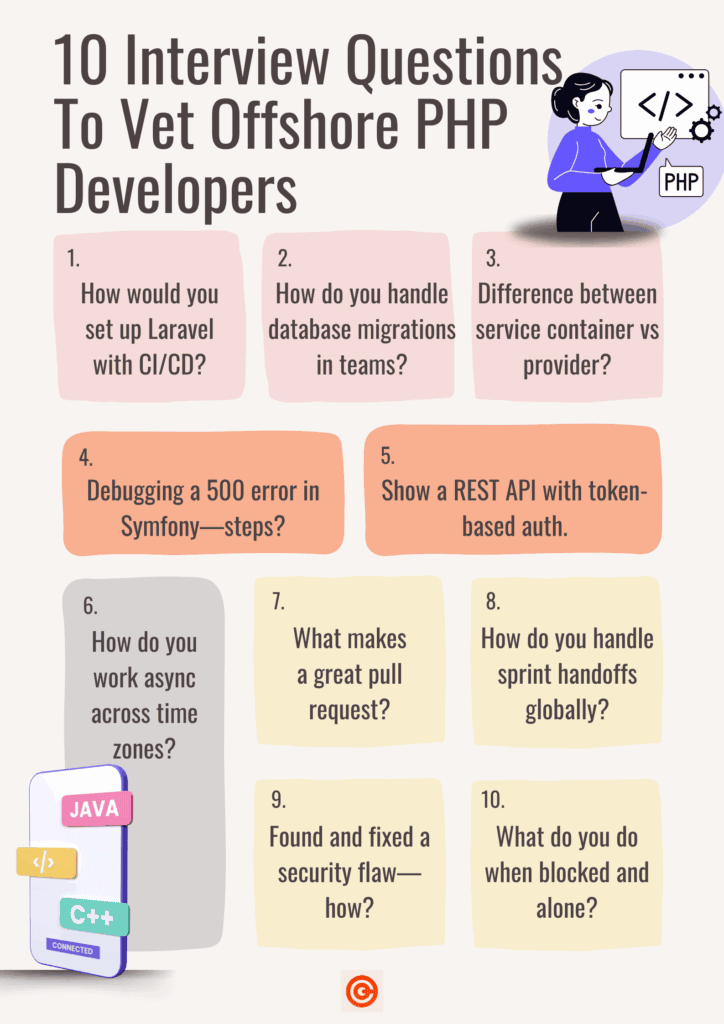
Use these 10 questions to validate what really matters.
1. Walk me through how you would set up a new Laravel project with CI/CD.
- Look for a clean repository structure, .env handling, GitHub Actions or Bitbucket Pipelines, and test automation setup.
2. How do you handle database migrations when multiple developers are working on the same project?
- Check if they mention sequential migration files, rollback handling, and conflict resolution strategies.
3. What is the difference between Laravel’s service container and a service provider?
- They should clearly explain dependency injection and when to bind services versus when to register them globally.
4. What is your process for debugging a Symfony controller that throws a 500 error?
- Top candidates mention enabling debug mode, checking logs in /var/log, and tracing the request/response lifecycle.
5. Show me an example of how you implemented a REST API with token-based authentication.
- Look for use of middleware, Laravel Sanctum or Passport, rate limiting, and proper HTTP status codes.
6. How do you manage async updates when your team is 10 hours apart?
- They should mention Loom updates, clear ticket documentation, and response time discipline.
7. What does a “good pull request” look like to you?
- Expect answers about atomic commits, descriptive PR titles, linked tickets, and added test coverage.
8. How do you manage timezone handoffs in a global sprint?
- Look for Git timestamp coordination, blockers documented in ClickUp or Jira, and async demo notes.
9. When was the last time you found a security flaw in your code, and how did you fix it?
- Listen for mention of input validation, XSS, SQL injection, and the use of security linters or code reviews.
10. What do you do when you’re blocked and no one is online?
- Look for proactive solutions like writing out context in comments, creating fallback versions, or escalating through async channels.
📢 Interesting Fact
49.6% of companies plan to expand their offshore software outsourcing.
5 Key Benefits To Expect With An Offshore PHP Developer On Your Team

Use these benefits to reframe how offshore PHP talent can transform speed, cost, and execution.
1. Cut 70% Off Payroll Without Downgrading Skill
You will pay $20 to $45 per hour for mid to senior offshore PHP developers in regions like the Philippines or Eastern Europe. That is up to 70% less than US-based engineers with the same skill set.
You also avoid benefits, infrastructure, and legal overhead. These savings do not come at the cost of quality. The best offshore developers pass the same code tests and vetting filters as top domestic candidates.
2. Ship Features While You Sleep
Offshore PHP teams extend your sprint cycles into the night. With 4 to 6 hours of daily overlap and 24-hour build loops, you ship faster and debug faster.
Work that starts in the US during the day gets picked up overnight in Asia or Eastern Europe. This shortens release timelines by 25% to 40% depending on handoff quality. It also lets QA and staging run while your core team is offline.
3. Get Specialists, Not Just Generalists
You are not hiring a “PHP developer.” You are hiring Laravel, Symfony, or CMS experts with real build experience. Top offshore candidates know routing, Eloquent, service containers, and CI/CD like they know their own IDE.
They also bring niche skills like WordPress plugin development, Magento customization, or API rate-limiting logic. You fill the exact stack gap instead of hiring someone to learn on the job.
4. Scale Without Restructuring Your Team
Whether you need 1 PHP backend expert or a full delivery pod, offshore setups grow with your roadmap. You can start with a dedicated hire and expand to a full team (PM, QA, CI/CD) in under 30 days.
There is no need to rework your org chart, apply for new office space, or train someone across time zones from scratch. You get speed and scale without structural overhead.
5. Build With Security & Compliance In Mind
The top 1% of offshore developers follow secure coding standards by default. They test for XSS, CSRF, and SQL injection before the code hits staging. They also work under HIPAA, GDPR, and SOC-2 protocols when needed.
Ask for CI/CD logs, secure Git audit trails, and staged rollback proof. You get delivery without compliance debt, not just speed.
5 Red Flags & Mistakes To Avoid When Hiring Offshore PHP Developers
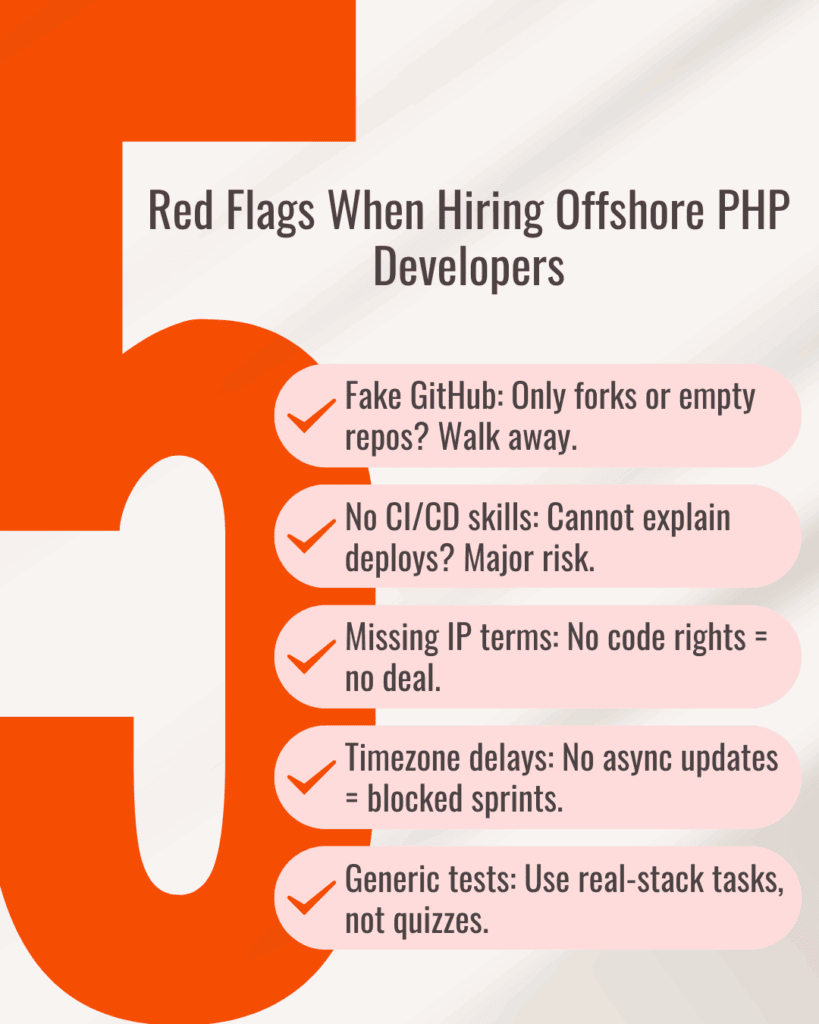
Review your current hiring flow for these traps.
- Fake portfolio artifacts: Flag any GitHub profile that only contains forks, empty README files, or low-effort commits. Ask for a full repository showing Laravel route setup or Symfony service binding from scratch.
- No CI/CD exposure: If a candidate cannot walk you through a deploy pipeline using GitHub Actions or Bitbucket Pipelines, skip them. You will spend 10+ hours per sprint fixing manual deployment mistakes.
- Unclear IP & NDA terms: Reject any agency contract that omits IP transfer clauses or has joint-ownership language. Use an IP checklist and ask for codebase access before payment milestones.
- Time zone handoff confusion: If your candidate replies with “I’ll check tomorrow” to urgent blockers, you have no async process. Enforce written updates every 12 hours and use ClickUp timestamps to trace work.
- Generic PHP tests: Avoid any technical test that does not reflect your real stack or architecture. Use repo-based assignments that mimic your API depth, controller logic, or CI logs instead.
💭 Food For Thought
Offshore development can accelerate product delivery by up to 40%.
5 Offshore PHP Developer Use Cases By Industry + When To Avoid

Cross-check these industry scenarios before your next hire to avoid rework, slowdowns, or compliance debt.
Offshore PHP Works Best When
- eCommerce platforms need custom checkout logic, Magento modules, or payment gateways built for $3,000–$4,000/month.
- SaaS tools run on multi-tenant Laravel, with offshore teams handling queues, jobs, and API tokens at 50% cost.
- Healthcare apps require HIPAA-safe backends, with PHI encryption, audit trails, and secure portals prebuilt by vetted teams.
- Fintech products demand PCI-compliant APIs, real-time alerts, and ledger systems with under 300ms latency.
- CMS-heavy sites need WordPress scaling, from multisite builds to plugin optimization, all under strict load speed targets.
Offshore PHP Fails When
- You skip HIPAA checks for healthcare apps and expect offshore teams to handle compliance untrained.
- Your backend connects to hardware, and no one provides the development team with real-time test access or simulators.
- You use legacy PHP and expect Laravel 11 developers to support broken 7.x code without a rewrite budget.
- You need daily overlap but hire from time zones with 1–2 hour windows, stalling QA and deploys.
- Your product is design-first, but you expect backend engineers to own UI/UX without frontend support.
Conclusion
Offshore PHP developers are not a shortcut. They are how smart teams build faster, scale leaner, and stop wasting payroll on output that does not move the needle. You now have the full playbook, from scoping and vetting to sprint-ready execution. If your current team feels too slow or too expensive, the fix is not more meetings. It is better hires.
Genius finds the top 1% of offshore PHP developers for companies that are done guessing. You tell us what you need—we hand you someone who can do it. Fast, vetted, full-time, and ready to deliver. Let us find the developer who ships it. Hire with Genius now.
FAQs
What is the typical contract length when hiring offshore PHP developers?
Most offshore PHP contracts run 3 to 12 months. Project-based hires may go shorter, but full-time roles often convert to multi-year tenures if performance stays strong.
How does code ownership work with offshore PHP developers?
You should always retain full IP rights. Use NDAs, clear IP clauses, and secure Git repository access controls to lock in ownership.
Can offshore PHP developers handle legacy codebases?
Yes, but only if scoped right. Developers skilled in PHP 7 or older need context documents and refactoring budgets. Expect slower velocity without modern frameworks.
Do offshore PHP teams follow US or EU data compliance rules?
Top-tier ones do. Ask for proof of HIPAA, GDPR, or SOC 2 familiarity. This usually includes audit logging, encrypted endpoints, and secure cloud workflows.