
Ever feel like you are paying way too much for way too little? $180,000 a year for a mid-level Angular developer who still needs hand-holding, another $50,000 on QA and PM support, and somehow… your roadmap is still delayed. It is painful. Angular offshore development flips the equation.
Done right, it gets you top-tier talent, baked-in support, and sprint-ready execution for the cost of one local hire’s bonus. This guide shows you exactly how. No fluff. Just a SMART-er, leaner way to build Angular teams that ship.
Hiring Angular Offshore Development Teams The SMART Way: Everything To Know In Under A Minute

- Scope first, not resumes: Write a one-pager with your modules, sprint flow, and team size before you start the search.
- Match model to timeline: Use delivery pods for speed, solo hires for support, and skip vendors who take 2+ weeks to deploy.
- Ask for Angular proof only: Demand real apps, code samples, and test tasks tied to routing, SSR, and version upgrades.
- Review output metrics, not personalities: Look for sprint velocity, bug rates, and release ownership, not just years of experience.
- Track full costs, not just rates: Add QA, PM, DevOps, onboarding, and support to get your real monthly spend.
Check Out These Related Popular Reads
🔥 ReactJS Offshore Development: Setup, Hiring, Best Practices
🎯 How To Hire Offshore Flutter App Development Experts: Guide
📣 Scrum Offshore Development: Setup, Process, Results Guide
What Is Angular Offshore Development & Who Needs It?

Angular offshore development is hiring full-time or contract Angular developers from lower-cost countries to build, scale, or support your web applications remotely. These developers work from professional environments outside your home country, but still function as integrated members of your team, as they handle everything from front-end UI to enterprise-grade app builds using Angular.
This setup gives companies access to global Angular talent without burning through domestic budgets or waiting months to hire locally. Here’s who benefits the most from Angular offshore development:
- Companies that scale Angular-based apps but struggle with local hiring timelines or costs.
- Startups that need rapid feature delivery on lean budgets.
- Enterprises that want to migrate from AngularJS to newer Angular versions.
- Agencies that handle multiple Angular projects and need overflow capacity.
- Product teams with long-term Angular needs but no in-house expertise.
Angular Offshore Development vs Nearshore Angular Teams: 8 Key Differences
| Offshore Angular Development | Nearshore Angular Development | |
|---|---|---|
| Location | Asia, Eastern Europe, Latin America | Mexico, Central America, Canada |
| Hourly rates (average) | $8–$25/hr | $20–$50/hr |
| Timezone overlap with the US (EST) | 0–4 hours | 4–8 hours |
| Typical use cases | Cost-driven scaling, full-time hires, and large builds | Faster collaboration, Agile delivery, and hybrid models |
| Communication fluency | Varies (English is often a second language) | Stronger fluency, especially in client-facing roles |
| Team availability | Larger talent pools, easier to scale quickly | Smaller pools, but easier real-time interaction |
| Legal/IP frameworks | Must define it in the contract (varies by country) | Often simpler due to regional agreements |
| Common risks | Timezone friction, async delays, and unclear handoffs | Higher cost, limited scale, and sometimes slower ramp-up |
The SMART Framework To Hire Angular Offshore Developers: 5 Core Strategies That Work

Walk through each SMART step below to fix what’s broken in your sprint cycles.
S – Set The Scope Before You Even Search
You do not need resumes yet. You need a one-pager that spells out what you are building, why, and how Angular fits in. This filters the noise before you even post a job.
- Write out your key modules, integrations, and Angular dependencies in plain English.
- Define sprint structure: weekly standups, 2-week cycles, or something else.
- Set the team size: developer, QA, PM, DevOps – estimate what you really need.
- Pick your priorities: speed to market, technical depth, and cost control.
- Use this scope to brief any recruiter or shortlist vendor partners.
M – Map The Hiring Model To Delivery Pressure
The tighter your timeline, the more support you need out of the box. Hiring a solo developer for a multi-sprint delivery is the fastest way to stall.
- Use full-cycle teams for delivery-led work or complex builds.
- Hire dedicated Angular developers when you already have PMs and QA in-house.
- Use staff augmentation only for 3-month-or-less scope gaps.
- Confirm time-to-deploy with each vendor (ideal: <5 business days).
- Ask if QA, PM, and DevOps are included in the model.
A – Ask For Proof Before You Even Say Hello
Every offshore Angular developer says the same thing. Great at Single-Page Applications (SPAs). Know TypeScript. Used RxJS. You need receipts, not promises.
- Request 2 live Angular apps with links to the App Store, Play Store, or public repositories.
- Ask to see Angular-specific code snippets: routing, services, and state management.
- Look for team portfolios, not just resumes.
- Ask for client references tied to Angular projects (not generic development).
- Test with a short, live task: SSR, lazy loading, or upgrade to Angular 17.
R – Review Delivery Metrics, Not Just Resumes
Your Angular team is either sprint-ready or dead weight. Skip the vibe check. Look at metrics.
- Ask for past delivery timelines across 3 Angular builds.
- Review bug rate, commit velocity, and sprint burndowns.
- Confirm which tracking tools they use (Jira, Linear, or ClickUp).
- Ask who owns testing, releases, and rollback protocols.
- Expect dashboards instead of spreadsheets.
T – Track Cost The Way You Track Code
Do not just ask about hourly rates. Ask where every dollar goes. That is how you avoid the “surprise” invoice at month-end.
- Build a total cost sheet: development hours + QA + PM + infrastructure + support.
- Check if they bill for onboarding, training, or idle time.
- Look out for developer buyout fees and 30-day quit clauses.
- Ask for monthly average costs across 3 client types (startup, scale-up, and enterprise).
- Use your sprint cost to map ROI: velocity gain vs spend.
🚨 Did You Know?
Junior developers with 0–2 years of experience charge $15–$40 per hour worldwide.
How Much Does Angular Offshore Development Cost? Price Breakdown + Hidden Fees

Offshore Angular development costs $8–$25 per hour in Asia, $20–$50 per hour in Eastern Europe, and $18–$40 per hour in Latin America. A full offshore team (developer, QA, PM) typically costs $4,800 to $11,200 per month, depending on region and experience level.
Here’s a regional breakdown to compare rates across key roles:
| Asia (USD/hour) | Eastern Europe (USD/hour) | Latin America (USD/hour) | |
|---|---|---|---|
| Angular Developer | $10 | $25 | $20 |
| QA Engineer | $8 | $20 | $18 |
| Project Manager | $12 | $30 | $25 |
| DevOps Support | $10 | $25 | $22 |
| Full Team (Developer + QA + PM) | $30 | $70 | $60 |
“The real cost of Angular development is in missed deadlines, unowned sprints, and fragmented codebases. Offshore solves that when done right.”
— Burkhard Berger, Founder & CEO of Genius
Angular Offshore Development Hidden Fees To Watch Out For
- Buyout clauses: Some firms charge up to 30% of the annual salary if you want to hire the developer directly.
- Idle time billing: You may still be charged if the developer is inactive due to internal handoffs or delayed feedback.
- Onboarding & training fees: Some vendors charge extra to ramp up developers, often 10 to 15 hours upfront.
- Tooling & infrastructure add-ons: Costs for test environments, premium tools, or CI/CD pipelines are sometimes passed on.
- Change requests & overtime: Anything outside the original scope may trigger extra billing, especially on fixed-bid contracts.
6 Strategic Angular Offshore Development Benefits You Should Know

Review these benefits to understand where offshore Angular teams deliver actual value.
1. Cuts 70% Of Your Burn Without Cutting Quality
You don’t need to spend $180,000 a year to build and maintain Angular apps. Offshore developers cost $8–$25 per hour in Asia and $18–$40 per hour in Latin America. That includes experienced engineers who work full-time, long-term, and handle real product work, not just code snippets. With the right vendor, you get full-cycle delivery support (QA, PM, DevOps) built in. Your engineering cost drops, but your output holds steady or even improves.
2. Helps You Hire A Full Team In 5–10 Days, Not Months
Hiring locally takes 3–5 months. Offshore vendors ship resumes in 48 hours and onboard in less than 10 business days. That includes Angular developers, testers, PMs, and DevOps support. You skip the interview loop, the internal approvals, and the 2-week resignation delays. This speed gives you room to start your sprints now, not next quarter.
3. Builds Around The Clock With 24/7 Development Cycles
Time zone gaps are not always a drawback. Smart teams use them to keep progress running outside US hours. Your US team reviews, the offshore team ships overnight, and your cycle loops daily. You cut development time by up to 30% with this handoff method. It works best when vendors follow async workflows and show task velocity in dashboards.
4. Let’s You Scale Fast Without Hunting For Talent
Need to go from 1 to 5 Angular developers? Offshore vendors already have the pipeline. You do not need to post, wait, or negotiate. Just request bandwidth and scale. This elasticity makes offshore Angular teams ideal for high-growth apps or agency models with fluctuating work volume. It also prevents delivery stalls during peak product cycles.
5. Owns Outcomes, Not Just Output
Most local hires clock hours. Offshore Angular teams work in delivery pods. That means QA, PM, and developers move in sync to complete modules, not just check tickets. These setups reduce rework, lower bug rates, and improve release velocity. You stop chasing people for updates and start seeing releases hit your roadmap on time.
6. Reduce Risk With Pre-Vetted, Long-Term Talent
The best Angular offshore vendors do not gamble on untested hires. They staff full-time engineers who pass 3–5 rounds of technical tests, communication checks, and cultural screening. You get engineers who stay with your project, not freelancers juggling 5 clients. That gives you fewer handoffs, better continuity, and lower team churn.
📢 Interesting Fact
92% of Fortune 2000 companies use offshore IT outsourcing.
7 Most Important Things To Look For In Your Offshore Angular Development Partner
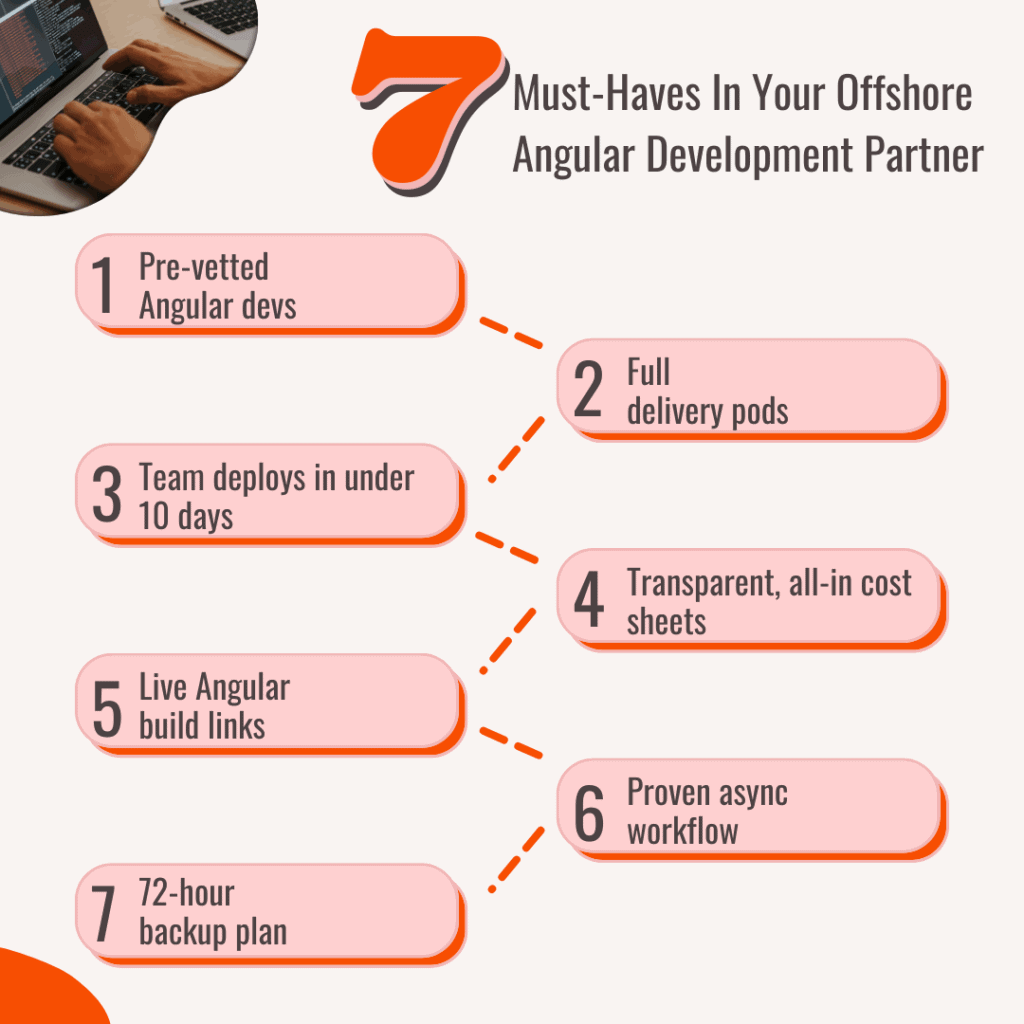
Look for these signs before you sign anything.
- Pre-vetted Angular talent, not bulk resumes: Confirm each developer cleared 3–5 rounds of Angular-specific testing, including routing, SSR, and state management.
- Delivery pods, not solo freelancers: Make sure QA, PM, and DevOps are part of the team, not billed separately later.
- Time-to-deploy in under 10 business days: Ask how long it takes to onboard a full team after contract signing. Skip anyone slower than 2 weeks.
- Transparent cost sheets with no surprise fees: Ask for a breakdown that includes QA, PM, infrastructure, support, and onboarding. Confirm there are no buyout traps or idle-time billing.
- Live Angular builds with public access links: Do not settle for mockups. Request working apps tied to Angular, with GitHub or store links.
- Async workflow maturity: Ask what tools they use to keep work moving across time zones. Look for ClickUp, Jira, or Linear with dashboard access.
- Backup talent within 72 hours: Confirm their process if a developer quits or underperforms. You need a written backup policy, not vague promises.
5 Best Regions To Hire Offshore Angular Developers This Year

| Region | Timezone Overlap With US (EST) | Best Use Case |
|---|---|---|
| Philippines | 10 am–2 pm | Full-time Angular teams with fluent English and strong support staff |
| India | 8 am–12 pm | Large-scale Angular builds and long-term delivery pods |
| Eastern Europe | 4 am–12 pm | Complex Angular migrations and mid-senior developer roles |
| Latin America | 6 am–2 pm | Real-time collaboration with Agile US teams |
| Vietnam | 9 pm–1 am | Async delivery for AngularJS-to-Angular upgrades with strong documentation |
“Angular offshore hiring is about assembling delivery pods that already know how to ship, scale, and own results.”
— Christian Cabaluna, Senior Recruiter
5 Angular Offshore Development Best Practices That Guarantee Success

Review your workflows, sprint metrics, and team handoffs against these best practices.
1. Set Your Sprint Cadence Before Developers Even Start
The best Angular teams do not wait for process clarity. They ship in short, structured sprints with clear accountability across roles.
- Use 2-week sprints with fixed standups, reviews, and retros.
- Lock sprint goals into ClickUp, Jira, or Linear.
- Assign QA, Dev, and PM ownership per sprint goal.
- Track burndown velocity and defect rate weekly.
- Cap sprint scope at 2–4 modules or feature sets max.
2. Use Delivery Pods, Not Solo Developers
1 Angular hire cannot drive sprint outcomes. You need pods that include PM, QA, and developers who ship together.
- Build pods around delivery, not billing.
- Confirm pod composition in the contract.
- Ensure the PM runs planning, reviews, and standups.
- QA must work inside sprints, not after.
- Track completion per pod, not per developer.
3. Set A Live QA Environment From The Start
Without a working QA setup, your Angular builds break silently. Testing should match production from the first sprint.
- Mirror production in staging with real data.
- Use Cypress or Jest for automated test coverage.
- Set coverage thresholds at 80%+ before release.
- Log test results to dashboards (not spreadsheets).
- Schedule weekly regression tests, not just on releases.
4. Track Output With Tools, Not Talk
Gut checks are useless. You need dashboards that show where your Angular team is stuck or sprinting ahead.
- Use Jira, ClickUp, or Linear with time tracking turned on.
- Create weekly burndown and throughput reports.
- Set weekly check-ins with PMs using delivery snapshots.
- Require branch-based commits linked to ticket IDs.
- Use tools like SonarQube to auto-flag code issues.
5. Lock Down Async Communication Systems
Timezone differences do not cause delays. Lack of async readiness does. Fix it before your Angular team starts.
- Use Loom, Notion, and Slack threads for async clarity.
- Require written updates before and after each sprint.
- Use Kanban boards to show task status in real-time.
- Build SOPs for handoffs across time zones.
- Record all reviews and decisions for team access.
💭 Food For Thought
74% of employers say offshore development addresses talent shortages.
5 Red Flags To Watch Out For When You Hire Offshore Angular Developers
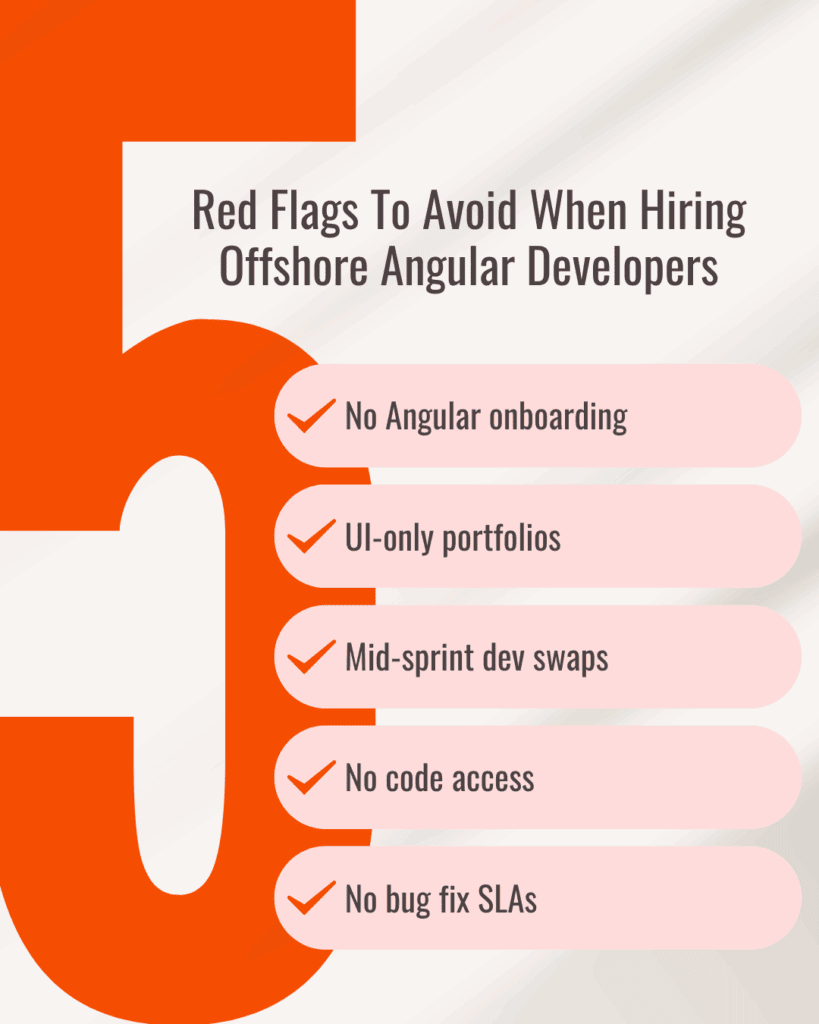
Check every one of these before you sign anything.
1. No Angular-specific Onboarding Process
If the vendor uses a generic onboarding deck or skips Angular app walkthroughs, your developer is guessing. Create a one-hour Angular repository demo + architecture briefing and record it. Share this before sprint one.
2. Frontend-Only Portfolios Without Angular Architecture Samples
If all they show are UI mockups or static dashboards, they probably never handled routing, state, or lazy loading. Ask for at least 2 GitHub repos or StackBlitz samples with module breakdowns and service logic.
3. Developers Rotate Mid-Sprint With No Backup Plan
If your Angular lead drops out and you get a “replacement” without notice, it kills delivery momentum. Ask for a pre-signed development backup plan with a 72-hour handover SLA and peer-reviewed handoff protocol.
4. Codebase Is Locked Behind Third-party Tools With No Export Policy
If the vendor uses private CI/CD tools or internal repositories and won’t export to your GitHub, you don’t own the code. Require GitHub or GitLab push access with weekly auto-backups and full export rights in writing.
5. No Fixed Window For Bug Resolution Or Rollback
If bug reports enter a queue with no time commitments, expect sprint bloat. Define SLAs: 48 hours for non-blocking bugs, 24 hours for blocking ones. Add rollback protocols and hotfix branch rules to every contract.
Conclusion
What used to take 5 months, $200,000, and constant follow-ups can now be done in 3 weeks at a fraction of the cost, with the right Angular offshore development setup. When you skip the fluff and optimize for delivery, the results speak for themselves: faster rollouts, cleaner code, and 0 midnight fire drills.
That’s exactly what we built Genius to solve. We do the grunt work for you—screening 250+ candidates to find ONE sprint-ready Angular expert. No generic resumes. No delays. Just full-time A+ talent with zero overhead and a 6-month guarantee.
Ready to skip the noise and hire smarter? Start with Genius.
FAQs
Is it better to offshore Angular development for long-term projects or short-term builds?
Offshoring works for both, but is most cost-efficient for long-term projects where developers can embed into your team. Short-term builds may need stricter controls to avoid rework or onboarding delays.
Do offshore Angular developers follow the same coding standards?
Not by default. Set expectations upfront by sharing your coding guidelines and requiring code reviews, linters, and CI/CD pipelines to maintain quality across teams.
Are offshore Angular teams suitable for migrating from AngularJS?
Yes, many offshore teams specialize in AngularJS-to-Angular upgrades. Just ensure they have experience with hybrid codebases and can document the migration path thoroughly.
What development tools should offshore Angular teams already know?
Look for familiarity with Angular CLI, RxJS, NgRx (or Akita), Jest or Cypress for testing, and project management tools like Jira or ClickUp. These signal production-level experience.