
Offshore development sounds great until you are juggling unclear timelines and sitting through 2 a.m. standups that go nowhere. Scrum offshore development is how smart teams stay sharp (even miles apart). It gives your offshore team a playbook, your onshore team clarity, and your entire project some actual rhythm.
In this guide, you’ll learn how to set up offshoring the right way, run the Scrum process without chaos, and get measurable results that don’t vanish into vague progress reports.
The Bottom Line On Scrum Offshore Development
| Setup Time | 2-4 weeks for proper team establishment and tool configuration |
| Cost Savings | 40-70% reduction compared to onshore development |
| Success Factors | Clear communication protocols, proper tool selection, cultural alignment |
| Essential Roles | Offshore Scrum Master, Product Owner, Development Team (5-9 members) |
| Key Metrics | Sprint velocity, story completion rate, defect density, team satisfaction |
| Common Challenges | Time zone differences, communication barriers, cultural misalignment |
| Best Practices | Daily standups, sprint planning overlap, asynchronous communication tools |
Your Next Must-Read Blogs
🌟 Offshore Java Development: Easiest Planning & Hiring Guide
🔥 How To Hire Offshore Software Development Project Manager
💯 Simple Guide To Offshore PHP Development For Startups
What Is Scrum? A Simple Breakdown
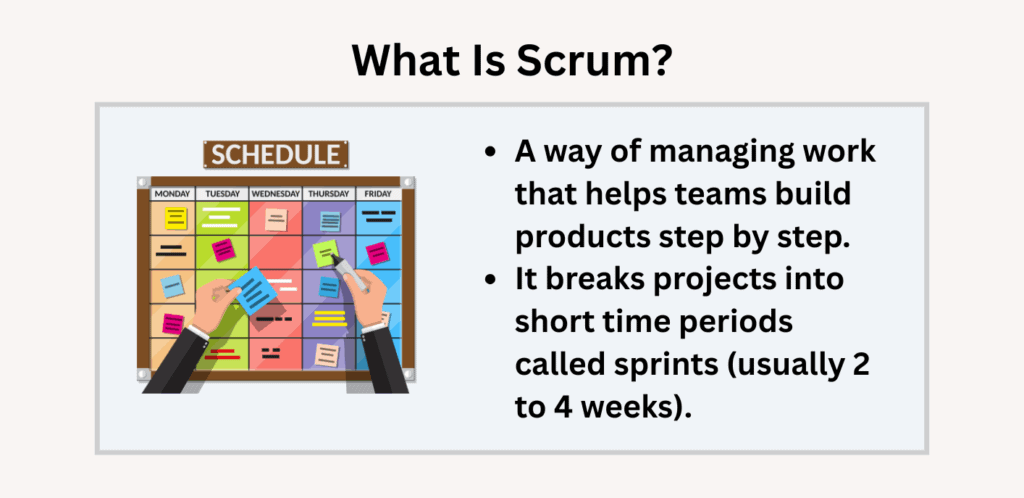
Scrum is a way of managing work that helps teams build products step by step, with constant feedback and improvements. It breaks projects into short time periods called sprints (usually 2 to 4 weeks) where the team works on specific tasks and delivers something usable at the end of each sprint.
Scrum has defined roles (Product Owner, Scrum Master, and Developers), meetings (daily standups and sprint reviews), and tools (like the product backlog) to keep everyone focused, organized, and aligned.
It’s used in software development but works for any project that benefits from fast delivery, teamwork, and ongoing adjustments.
What Is Scrum Offshore Development? Understanding The Framework Behind Agile Success

Scrum offshore development is when a company uses the Scrum framework with a remote team based in another country. These teams work in short cycles to build software step by step and get regular feedback.
Even though the team is offshore, they still follow all the key Scrum practices like daily standups, sprint planning, reviews, and retrospectives. This helps everyone stay aligned, move quickly, and deliver quality results.
🤔 Did You Know?
Companies that effectively implement Agile see a 60% increase in revenue.
Why Scrum Offshore Development Works: 6 Benefits That Matter
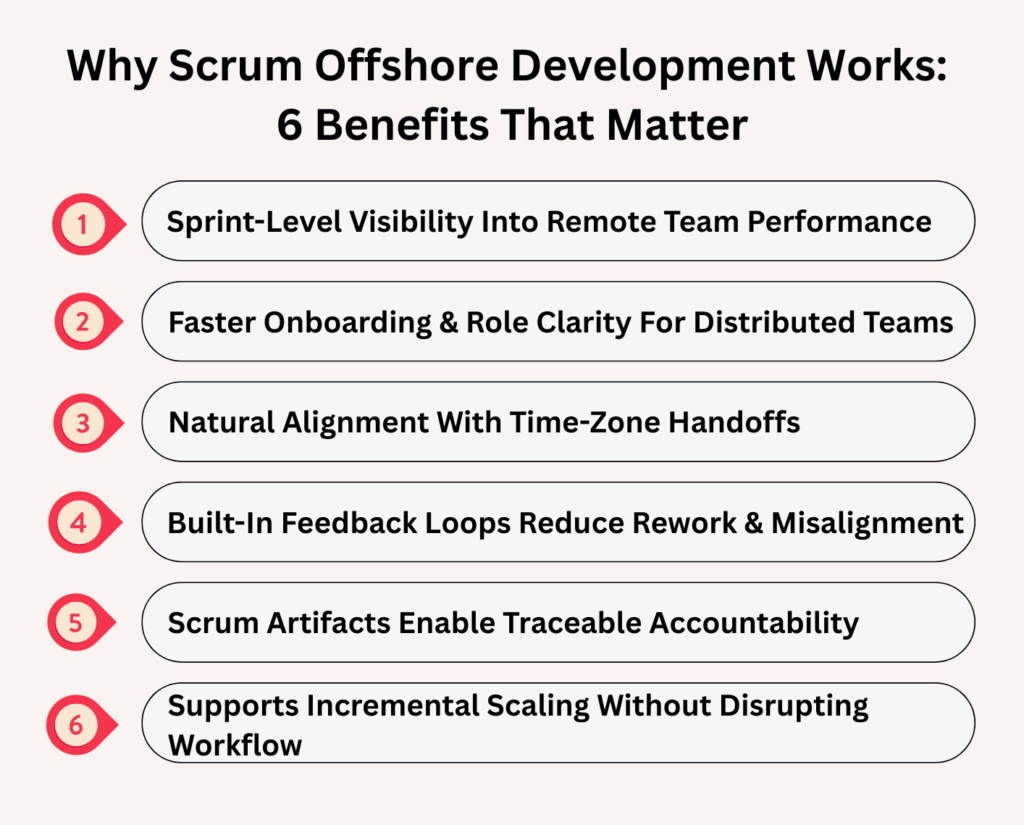
Below are the top reasons companies choose Scrum for their offshore development needs:
1. Sprint-Level Visibility Into Remote Team Performance
One of the biggest challenges with offshore teams is not knowing what’s actually happening day to day. With Scrum, that guesswork disappears. Each sprint starts with a clear plan and ends with a working result.
During the sprint, your offshore team holds daily standups, shares progress through tools like Jira or Trello, and delivers updates you can see and measure. At the end of the sprint, they demo what’s done and get your feedback immediately.
For you, this means:
- You always know what’s being worked on and why
- You can track progress without chasing updates or sitting through unclear reports
- You gain the ability to pivot quickly if priorities shift or issues arise
2. Faster Onboarding & Role Clarity For Distributed Teams
When working with offshore teams, the biggest time-waster is confusion about who’s doing what, when tasks are due, and how decisions are made. Scrum solves this by giving every team member a defined role from day one.
Each person knows where they fit:
- The Product Owner sets priorities and defines what needs to be built
- The Scrum Master keeps the team focused and removes blockers
- The Developers and QA team commit to sprint goals and deliver usable features
This built-in structure means new offshore team members don’t have to guess or wait around for direction. They plug into a clear process with defined responsibilities, scheduled meetings, and shared tools.
For you, this means:
- Faster onboarding with less hand-holding
- Immediate accountability across roles
- Fewer delays caused by miscommunication or duplicated work
3. Natural Alignment With Time-Zone Handoffs
Time zone gaps are seen as a problem, but with Scrum offshore development, they can actually become a strength.
Here’s how: when your onshore and offshore teams are set up correctly, work can progress around the clock. Your onshore team defines priorities and updates the backlog during their day. Then, as they wrap up, the offshore team begins their sprint work. The next day, you review progress, provide feedback, and repeat the cycle.
This creates a natural handoff rhythm where tasks move forward, even while you sleep.
For you, this means:
- Faster turnaround on features, fixes, and updates
- No wasted days waiting for feedback or direction
- Better use of global work hours without forcing odd-hour meetings
4. Built-In Feedback Loops Reduce Rework & Misalignment
One of the biggest risks in offshore development is spending weeks building the wrong thing because feedback came too late or wasn’t clear. Scrum solves this with built-in feedback loops that keep everyone aligned, every step of the way.
At the end of each sprint (usually every 2 weeks), your offshore team presents working features during a Sprint Review. This gives you and other stakeholders a chance to see real progress, give input, and request changes before more time and budget are spent.
In between, daily standups, backlog grooming, and sprint retrospectives create regular checkpoints to keep the team focused and priorities clear.
For you, this means:
- Less rework from miscommunication or misunderstood requirements
- Quicker course corrections when needs or priorities shift
- Ongoing alignment between business goals and technical output
5. Scrum Artifacts Enable Traceable Accountability
In offshore development, visibility and trust are everything. With teams working across borders, you need clear proof of progress. Scrum makes this possible through its built-in artifacts.
These artifacts include:
- The Product Backlog (your evolving list of priorities)
- The Sprint Backlog (what the team commits to each sprint)
- The Increment (working software delivered each sprint)
- Burndown charts and velocity reports (real-time progress tracking)
Each artifact shows who is doing what, what was delivered, and how fast things are moving. Everything is documented, measurable, and available in tools like Jira or Trello.
For you, this means:
- You can track progress without micromanaging
- You have a paper trail of decisions and deliveries
- You know what was promised, what was delivered, and when
6. Supports Incremental Scaling Without Disrupting Workflow
One major advantage of Scrum offshore development is how well it handles growth. As your product or business expands, you can add more team members or even entire teams without throwing your workflow into chaos. This is because Scrum provides a repeatable structure:
- Every team follows the same sprint rhythm
- Roles, responsibilities, and meetings are already defined
- Tools and processes stay consistent across teams
This means new developers, testers, or designers can plug into an existing system, get up to speed quickly, and start contributing without slowing everyone down. You don’t need to reinvent the wheel every time you grow.
For you, this means:
- You can scale fast without pausing development
- Your velocity increases without compromising quality
- You maintain control even as the team size expands
“Scrum gives offshore teams a clear rhythm to follow, which helps hiring align with real delivery needs.”
Burkhard Berger, Founder & CEO
Set Up Your Scrum Offshore Development Team In 5 Clear Steps

If you’re ready to get moving, here’s how to set up your Scrum offshore development team from the ground up:
Step 1: Define Your Product Goals, Backlog, & Internal Roles First
- Clarify the main problem your product solves and who it’s for.
- Identify the key features or outcomes you want to achieve.
- Group your vision into high-level epics for easier planning.
- Decide which features should be built first based on value and impact.
- Write everything down in a format you can easily share with your team.
Step 2: Choose A Partner With Proven Scrum Delivery
- Ask for real sprint artifacts like burndown charts, sprint plans, and review samples.
- Request a mock sprint planning session to observe how the team communicates and estimates work.
- Check if they have certified Scrum Masters and developers with experience in structured sprints.
- Review past projects that followed the full Scrum lifecycle.
- Confirm they use Scrum-compatible tools like Jira, Confluence, and Slack for transparency.
Step 3: Assemble A Cross-Functional Offshore Team With Full Sprint Capabilities
- Include all key roles: developers, QA testers, and a Scrum Master who understands the full Scrum process.
- Make sure the team can complete design, development, and testing within the same sprint.
- Verify that each member understands their responsibilities and how they contribute to sprint goals.
- Choose team members who can work autonomously and communicate effectively in a remote setting.
- Align everyone on the Definition of Done to maintain consistent quality across deliverables.
Step 4: Establish Scrum Cadence, Tools, & Time Zone Overlaps
- Set a fixed sprint length (usually 2 weeks) and keep it consistent across cycles.
- Schedule all Scrum ceremonies (standups, sprint planning, reviews, and retrospectives) in advance.
- Choose tools like Jira for backlog management, Slack for communication, and GitHub for code collaboration.
- Define daily overlap hours where both onshore and offshore teams can meet live or sync async updates.
- Document all workflows, meeting links, and responsibilities in a shared location like Confluence or Notion.
Step 5: Start With A Pilot Sprint & Continuously Improve
- Run a 1–2 week pilot sprint using real backlog items to test the team’s flow and communication.
- Track progress using burndown charts, velocity, and daily standups to identify early issues.
- Collect feedback during the sprint review to understand what worked and what needs adjustment.
- Use the retrospective to spot process gaps, communication delays, or role confusion.
- Apply those insights immediately in the next sprint to improve delivery and team performance.
The Complete Scrum Offshore Development Process Explained Step-By-Step

With your team and setup in place, let’s walk through how the scrum offshore development process actually runs:
1. Product Backlog Creation (Onshore or Internal Team)
This is where the entire process begins. Before your offshore team writes a single line of code, your Product Owner (usually someone from your internal or onshore team) creates the product backlog, which is a prioritized list of everything your product needs to do.
Each item in the backlog is written as a user story (“As a user, I want to…”), with clear acceptance criteria so the team knows what “done” looks like. This backlog is your roadmap, broken into features, fixes, and enhancements that deliver real value.
During this stage, you should:
- Define the product vision and target user
- Break down that vision into epics and user stories
- Prioritize the most important items to work on first
- Include enough detail so offshore developers can understand without follow-up calls
- Review and refine the backlog regularly to keep it aligned with business goals
2. Team Onboarding & Role Alignment
Onboarding is about making sure every team member understands the product, the process, and their role in delivering results. You introduce them to the product vision, walk through the backlog, and explain how sprints will run. This is also when you define communication norms, tool usage (like Jira, Slack, or GitHub), and meeting schedules.
During this stage, you should:
- Host an onboarding call to explain the product, sprint cadence, and workflows
- Share documentation, roadmaps, and any style or coding guidelines
- Confirm each team member understands their role and how it fits into the sprint
- Align on your Definition of Done (DoD) and how work will be reviewed and accepted
- Establish primary communication channels and time zone overlap hours
3. Sprint Planning

Sprint planning is where the real work begins. It kicks off each new sprint—usually every 1 or 2 weeks—and sets the direction for what your offshore team will build next.
In this meeting, the Product Owner presents the top-priority items from the product backlog. The team reviews these stories together, asks clarifying questions, and decides how much they can realistically commit to delivering during the sprint.
The goal is to end the meeting with a Sprint Backlog (a clear list of tasks the team agrees to complete), along with estimates and a shared understanding of the work involved.
During this stage, you should:
- Review and select the highest-value user stories for the sprint
- Break down each story into smaller, actionable tasks
- Estimate each task using story points or time-based effort
- Define the sprint goal (a short summary of what the team aims to achieve)
- Make sure everyone understands the scope and dependencies
4. Daily Standups (With Time Zone Consideration)
Daily standups are short, focused meetings (usually 15 minutes) held each working day of the sprint. The purpose is to keep everyone aligned, spot blockers early, and make quick adjustments if needed.
Each team member answers 3 simple questions:
- What did I work on yesterday?
- What will I work on today?
- Is anything blocking my progress?
In an offshore setup, time zone differences need to be handled thoughtfully. You may schedule the standup during a shared overlap window (even 30–60 minutes is enough), or run it asynchronously using tools like Slack threads, Loom videos, or Notion updates.
During this stage, you should:
- Choose a fixed time that works for both onshore and offshore teams, or use async updates when overlap is limited
- Keep the meeting short and focused to respect everyone’s time
- Make blockers visible immediately so the Scrum Master or team lead can resolve them fast
- Use the meeting to maintain team rhythm and accountability
- Post updates in a shared channel or dashboard for full visibility
5. Sprint Execution & Continuous Collaboration
This is where the work happens. After sprint planning, the offshore team begins building the selected features or fixes, following the plan laid out in the sprint backlog.
Each team member picks up tasks, writes code, runs tests, and pushes updates to shared code platforms. The Scrum Master ensures the team stays focused and removes any blockers that come up. If the scope needs adjusting, the Product Owner may reprioritize tasks, but only in a controlled way that doesn’t disrupt the sprint.
During this stage, you should:
- Make sure developers and testers are working together within the same sprint cycle
- Use tools like Jira, GitHub, and Slack to track progress and flag issues
- Encourage open updates on what’s done, what’s stuck, and what needs input
- Hold your team to the Definition of Done so nothing “half-finished” gets marked complete
- Monitor team velocity and task completion to ensure goals stay on track
😱 This Might Surprise You
84% of workers report higher engagement with fast feedback.
6. QA & Sprint Testing

In Scrum, testing happens within the sprint, so your offshore QA team works in parallel with developers. As features are completed, they’re immediately tested to catch bugs, confirm functionality, and make sure each user story meets its acceptance criteria and the Definition of Done.
Testing may include functional testing, regression testing, API checks, automated test scripts, and manual validation.
During this stage, you should:
- Make sure QA testers are involved in sprint planning so they understand what to expect
- Test features as soon as they’re ready
- Use tools like TestRail, Selenium, or Cypress to streamline test tracking and automation
- Flag any bugs early so developers have time to fix them within the same sprint
- Confirm that everything marked “done” has been tested, passed, and is ready for review
7. Sprint Review With Stakeholders
At the end of every sprint, the team holds a Sprint Review, which is a live or recorded session where completed work is presented to stakeholders. This is your chance to see exactly what was built, ask questions, and give feedback before the next sprint begins.
The offshore team walks through finished features, shows working demos, and explains what was delivered. The Product Owner confirms whether the sprint goals were met and opens the floor for feedback or discussion about what’s next.
This meeting is a key moment for alignment between business and development.
During this stage, you should:
- Invite relevant stakeholders from product, design, marketing, or leadership
- Ask the offshore team to demo completed features using real use cases
- Review which user stories were completed and which weren’t (with reasons why)
- Provide feedback or ask for changes while the context is still fresh
- Update the product backlog based on what was learned or decided
8. Sprint Retrospective
The Sprint Retrospective happens right after the Sprint Review and marks the official end of the sprint. It’s a private, team-only meeting focused on one thing: improving how the team works together.
Everyone on the offshore Scrum team reflects on the sprint and discusses what went well, what didn’t, and what could be done better. This is about learning and making the next sprint smoother and more productive.
The Scrum Master typically facilitates the session and helps the team turn feedback into actionable improvements for the next sprint. These might include fixing communication gaps, improving time estimates, or tweaking how tasks are divided.
During this stage, you should:
- Create a safe space for honest feedback, especially in remote or culturally diverse teams
- Use a simple structure like “Start, Stop, Continue” to guide the conversation
- Document key takeaways and agreed changes to apply in the next sprint
- Track recurring issues so they don’t get overlooked
- Continuously refine how your offshore team collaborates, communicates, and delivers
9. Backlog Refinement & Next Sprint Preparation
Backlog refinement or backlog grooming is the ongoing process of keeping your product backlog clean, prioritized, and ready for the next sprint. It usually happens between sprints but can also be a short, recurring session during the sprint.
In this stage, the Product Owner, often with input from the offshore team, reviews upcoming user stories to ensure they are well-defined, properly sized, and aligned with business goals. The goal is to avoid last-minute guesswork during sprint planning and ensure the team always has a clear set of tasks to pull from.
This step also helps surface new priorities, technical considerations, or missing details before work begins.
During this stage, you should:
- Review the top backlog items and ensure they’re still relevant and valuable
- Break down large epics into smaller, sprint-sized user stories
- Add clear acceptance criteria and effort estimates
- Adjust priorities based on business needs, feedback, or sprint review outcomes
- Clarify any questions or blockers with the team ahead of sprint planning
Measuring Results In Scrum Offshore Development: What To Track & Why

Let’s break down the key metrics that help you measure progress, performance, and value in Scrum offshore development:
| Metric | Description | Benefits |
|---|---|---|
| Sprint Velocity | Total number of story points (or tasks) completed by the team during a sprint | Assess team consistency and predict future delivery capacity by tracking story points marked “done” at sprint end |
| Sprint Burndown | Total time from when a user story is added to the backlog until completed and delivered | Visualize progress with daily plotting of remaining story points/tasks; healthy burndown slopes steadily downward to zero |
| Lead Time | Measures active development period only; lower cycle times show an efficient and focused offshore team | Track using project management tools like Jira; shorter lead times indicate faster delivery cycles |
| Cycle Time | Time for a story to move from “in progress” to “done” | Measures active development period only; lower cycle times show efficient and focused offshore team |
| Team Capacity Utilization | Percentage of available team hours spent on productive, sprint-related work | Compare total available hours vs. actual logged hours to identify underuse or overloading |
| Sprint Goal Success Rate | Whether the team met the goal set during sprint planning | Track goal achievement frequency and investigate misses to improve planning accuracy |
| Defect Rate (Post-Sprint) | Number of bugs or issues found after sprint completion | Use bug tracking tools to log defects by sprint; high rates may indicate quality issues or unclear acceptance criteria |
| Retrospective Action Closure Rate | Percentage of improvement actions from retrospectives that are actually completed | Track resolution of retrospective items by next sprint to measure commitment to continuous improvement |
These 8 metrics provide a comprehensive framework for monitoring and improving Scrum offshore development teams.
The metrics can be categorized into 3 main areas:
- Delivery Performance (Sprint Velocity, Sprint Burndown, Lead Time, Cycle Time): These metrics help assess how efficiently the team delivers value and can predict future capacity.
- Quality & Planning (Sprint Goal Success Rate, Defect Rate): These metrics evaluate the effectiveness of sprint planning and the quality of delivered work.
- Team Development (Team Capacity Utilization, Retrospective Action Closure Rate): These metrics focus on resource optimization and a continuous improvement culture.
By tracking these metrics consistently, teams can identify trends, bottlenecks, and improvement opportunities while maintaining transparency with stakeholders about offshore development progress and team performance.
“Scrum offshore development gives speed and clarity without sacrificing quality or accountability.”
Christian Cabaluna, Senior Recruiter
Scrum Offshore Development: 5 Real Challenges & How To Beat Them

These are the roadblocks you might encounter in Scrum offshore development:
1. Inconsistent Sprint Commitment Or Delivery
Offshore teams sometimes overcommit during sprint planning or underestimate the complexity of tasks. Add in time zone delays, unclear requirements, or mid-sprint scope changes, and the result is unfinished work by the sprint’s end. Without tight feedback loops, teams might not realize they’re off track until it’s too late to adjust.
Solution:
- Track and review sprint velocity over time to set realistic commitments based on past performance.
- Encourage open discussion during sprint planning so the team can push back on unclear or oversized stories.
- Use daily standups and burndown charts to monitor progress and catch delivery risks early.
2. Delayed Feedback From Stakeholders
In Scrum offshore development, stakeholders may not provide timely input after sprint reviews or during sprint execution. This delay stems from packed calendars, lack of technical context, or unclear review expectations. Without quick feedback, offshore teams can’t confidently proceed or may build features that need to be reworked, which wastes time and resources.
Solution:
- Set clear expectations and timelines for stakeholder feedback after sprint reviews or major deliverables.
- Use async-friendly formats like Loom videos, shared documents, or comment-enabled demos to gather input without live meetings.
- Assign a primary decision-maker on the stakeholder side to give timely approvals and unblock the team.
3. Lack Of Ownership Or Accountability
In offshore setups, team members may feel disconnected from the product, the users, or the company, resulting in minimal engagement, passive communication, and missed opportunities to catch issues early or suggest better solutions.
Solution:
- Tie sprint goals to real product outcomes so the team understands the value behind each task.
- Involve offshore team members in sprint planning, reviews, and retrospectives to create shared ownership.
- Assign clear task ownership in tools like Jira or GitHub so responsibilities are visible and trackable.
4. Low Retrospective Follow-Through
Retrospectives are great for surfacing issues, but in many offshore teams, the action items that come out of them are forgotten, deprioritized, or never tracked. This happens when no one owns the follow-up, improvements aren’t visible, or the team moves straight into the next sprint without reviewing what was agreed upon. Over time, this causes frustration and makes retrospectives feel pointless.
Solution:
- Document all retrospective action items in a shared tool and assign clear owners with due dates.
- Review the previous sprint’s action items at the start of each new retrospective to show continuity and accountability.
- Limit follow-up actions to 2–3 high-impact items per sprint to keep improvements focused and achievable.
5. Tool Fragmentation
Offshore teams use a mix of tools for task tracking, communication, documentation, code reviews, and testing. When these tools aren’t well-integrated, information gets scattered. This causes missed updates, duplicated work, and wasted time switching between platforms just to get a full picture of progress.
Solution:
- Standardize a core tool stack (Jira, Slack, GitHub, Confluence) and make it the default for all team activities.
- Set clear guidelines on how and where to document tasks, decisions, and updates to avoid duplication.
- Integrate tools wherever possible to sync data automatically and reduce manual tracking across platforms.
🔎 This Is Interesting
89% of remote and hybrid employees have the technology needed to work effectively.
8 Steps To Find The Right Scrum Offshore Development Partner
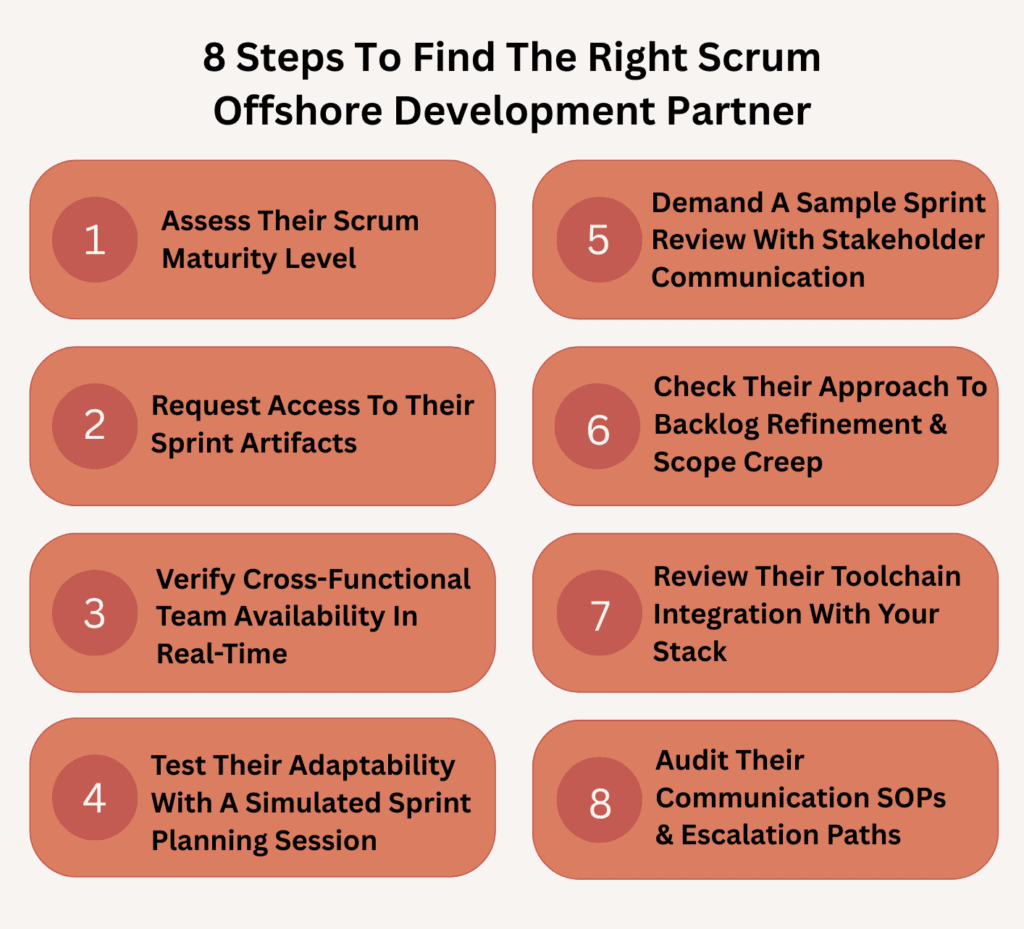
Now that you’ve got the process down, let’s break down how to choose the right partner to bring your Scrum offshore team to life:
1. Assess Their Scrum Maturity Level
To assess their Scrum maturity, start by asking how they handle mid-sprint blockers and whether a clear escalation process is in place. Check if they consistently use a Definition of Done to ensure task clarity and maintain quality. Finally, review how they conduct retrospectives and whether they follow through on improvement actions.
2. Request Access To Their Sprint Artifacts
Request anonymized velocity reports from recent sprints to evaluate how consistently the team meets its commitments. Ask for a sample sprint retrospective summary to understand how they reflect on challenges and implement improvements. Also, review a real or sanitized product backlog to assess how they prioritize tasks and manage ongoing refinement.
3. Verify Cross-Functional Team Availability In Real-Time
Confirm that developers, QA testers, and the Scrum Master are available during your required time zone overlap for essential meetings. Request a sample team schedule to validate their working hours and real-time responsiveness. Ensure the partner assigns dedicated team members who stay consistent across sprints to maintain strong collaboration and continuity.
4. Test Their Adaptability With A Simulated Sprint Planning Session
Present an unfamiliar user story and observe how the team asks clarifying questions and breaks it down into actionable tasks. Pay attention to how they handle ambiguity—do they take initiative or wait for guidance? Evaluate how they collaborate to estimate effort and commit to a realistic sprint scope.
5. Demand A Sample Sprint Review With Stakeholder Communication
Request a recorded or live demo where the team presents completed work and explains what was delivered compared to what was planned. Observe how they respond to feedback—whether they ask questions, take notes, and follow up with clear action items. Evaluate how effectively they communicate technical outcomes in a way that stakeholders can easily understand and act on.
6. Check Their Approach To Backlog Refinement & Scope Creep
Ask how often they conduct backlog refinement sessions and who is involved in shaping and clarifying user stories. Review how they handle mid-sprint changes—do they follow a formal process for re-prioritization or allow untracked work to creep in? Also, check whether they use a clear Definition of Ready (DoR) to ensure only well-defined and actionable stories are included in the sprint.
7. Review Their Toolchain Integration With Your Stack
Ask the team to demonstrate how their tools, like CI/CD pipelines, version control, and testing suites, integrate with your existing systems to ensure smooth collaboration. Confirm that they can operate within your preferred platforms without disrupting workflows or causing delays. Also, assess how they manage permissions, notifications, and real-time updates to maintain transparency and alignment between both teams.
8. Audit Their Communication SOPs & Escalation Paths
Request their internal communication SOP or playbook to understand how they manage updates, handoffs, and decision-making. Ask how they handle urgent issues—who gets notified, how quickly they respond, and which channels they use. Make sure there’s a clearly defined escalation path with named contacts so you’re not left chasing answers during critical moments.
Conclusion
If you are serious about getting Scrum offshore development right, find the right team. Ask the hard questions. Watch how they plan, deliver, and communicate. And remember—tools and titles are helpful, but what really matters is how people show up, own their work, and collaborate like they’re in the room with you (even if they’re halfway across the world).
At Genius, we’ve removed the guesswork from hiring Scrum offshore development experts. Our on-ground recruiters, university networks, and 12-step vetting process help you find top 1% talent in the Philippines and Latin America—fast. Every hire is backed by our culture fit guarantee. If you’re ready to scale with the right team, fill out this form now.
FAQs
How is Scrum different from general offshore development?
Scrum adds structure with defined roles, short sprints, and regular feedback loops. It emphasizes clear priorities, accountability, and continuous improvement, which makes offshore teams more aligned, responsive, and focused on delivering working software every sprint.
What tools are essential for Scrum offshore development?
Key tools include Jira (task tracking), Confluence or Notion (documentation), Slack (communication), and GitHub or GitLab (version control). These keep your team aligned, transparent, and able to collaborate across time zones efficiently.
Is Scrum offshore development suitable for startups?
Yes. Scrum’s iterative approach helps startups build fast, adapt quickly, and stay close to customer feedback. It’s ideal for limited resources, fast-changing priorities, and getting usable features out the door without overcommitting.
Can I start Scrum offshore development with just one developer?
You can start small, but Scrum works best with a cross-functional team. If you begin with one developer, treat it as pre-Scrum and scale into full roles (Scrum Master, QA, etc.) as your needs grow.