
Finding top tech talent is tough, and keeping projects on track without blowing the budget is even tougher. That is why more and more founders and business owners are turning to offshore IT development. It is like hiring a dream team across time zones, where your projects move while you sleep, and your budget finally breathes.
But offshoring sounds smart in theory, yet in practice, it can get messy. In this guide, we will break down what offshore IT development actually means, why so many businesses are turning to it, and how you can do it right from day one.
What You Need To Know About Offshore IT Development
| Cost Savings | 85% reduction in development costs |
| Top Destinations | Eastern Europe ($35-50/hr), India ($18-30/hr), Latin America ($32-45/hr) |
| Best For | Startups scaling rapidly, enterprises needing specialized skills, 24/7 development cycles |
| Main Benefits | Global talent access, cost optimization, faster time-to-market, scalability |
| Key Risks | Communication barriers, quality control, time zone challenges, cultural differences |
Your Next Must-Read Blogs
🌟 How To Build An Efficient Mobile App Development Offshore
🔥 Offshore WP Development: Benefits, Setup, Best Practices
💯 Offshore Drupal Development: Benefits & A+ Companies
What Is Offshore IT Development? Understanding The Basics

Offshore IT development means working with software teams based in other countries, where labor costs are lower and time zones differ significantly. Unlike traditional outsourcing, where you fully hand off a project, modern offshore development is more like a partnership. These remote teams act as extensions of your company, helping you scale faster without losing control.
This is best for:
- Startups that need to build fast without draining capital
- Growing companies looking to scale their development team quickly
- SaaS businesses with ongoing feature updates and technical demands
- Enterprises looking for hard-to-find or specialized tech talent
- Product teams that want full-time contributors without full-time overhead
Top 5 Benefits Of Choosing Offshore IT Development

Here are the biggest wins you can expect when you choose offshore IT development for your business:
1. Significant Cost Savings
Offshore IT development gives you access to skilled developers at a fraction of local hiring costs. By working with talent in regions like the Philippines or Latin America, you can avoid high salaries, overhead, and benefit expenses. Outsourcing IT can save you up to $6,474 per month, which is an 85% savings compared to hiring locally.
2. Faster Time To Hire
Offshore IT development lets you skip lengthy recruitment cycles and internal bottlenecks. You can tap into pre-vetted talent pools and established recruiting networks, which gives you instant access to skilled developers. You can spin up full teams in just 2 to 4 weeks without building HR teams.
3. Access To A Global Talent Pool
Offshore IT development opens the door to a much wider range of skills and experience than most local markets can offer. You’re not limited by geography, which means you can find the right expertise faster and more affordably. There are currently around 28.7 million software developers worldwide, which gives you a massive talent pool to choose from.
4. Around-The-Clock Development
Offshore teams work in time zones that complement your own, which means progress continues even after your local team signs off for the day. This follow-the-sun workflow speeds up delivery cycles, shortens feedback loops, and helps you move projects forward without downtime. It’s a powerful way to maintain momentum and hit deadlines faster.
5. Improved Focus On Core Business
By offloading development work to a trusted offshore team, your internal staff can concentrate on strategic priorities like growth, customer experience, and product vision. You spend less time managing day-to-day technical tasks and more time driving the business forward. Offshore support frees up both time and mental bandwidth for what matters most.
🤔 Did You Know?
66% of US businesses use offshore software development.
5 Offshore IT Development Challenges You’ll Face & How To Handle Them

Prepare for these offshore IT development hurdles and learn how to handle them confidently:
1. Communication Challenges
Offshore teams work across different time zones, languages, and cultural norms. This can cause delays, unclear instructions, and misaligned expectations, especially if there’s no structured communication process in place.
How to handle it:
- Set clear communication protocols using tools like Slack for async updates and Zoom for scheduled meetings.
- Define overlap hours and stick to them so both teams are available for real-time discussions.
- Document everything—use shared platforms like Notion or Confluence to track decisions, progress, and requirements.
2. Quality Control Issues
Quality can suffer when expectations aren’t clearly defined, testing is inconsistent, or developers work without ongoing feedback. Offshore teams may also follow different coding standards or skip thorough reviews to meet tight deadlines.
How to handle it:
- Set clear coding guidelines and acceptance criteria before development begins to ensure consistency.
- Implement peer code reviews and QA checkpoints as part of your workflow, not as an afterthought.
- Use automated testing and CI/CD pipelines to catch bugs early and maintain code quality throughout development.
3. Security & IP Risks
Working with offshore teams means sharing sensitive data and proprietary code across borders. Without strong legal protections, secure systems, and access controls, your intellectual property and customer data may be exposed to unauthorized access or misuse.
How to handle it:
- Sign NDAs and detailed contracts that clearly define IP ownership, confidentiality, and data protection terms.
- Use secure tools and access management like VPNs, encrypted storage, and role-based permissions.
- Work with partners in countries that honor international IP laws and have strong legal frameworks for data security.
4. Cultural Misalignment
Different countries often have varying norms around communication, hierarchy, deadlines, and feedback. Without awareness of these differences, teams may misinterpret tone, hesitate to raise issues, or clash over work expectations.
How to handle it:
- Invest time in cultural onboarding so both teams understand each other’s work styles and communication norms.
- Encourage open dialogue and psychological safety so offshore team members feel comfortable speaking up.
- Assign a cultural liaison or team lead to bridge gaps and ensure smooth collaboration between teams.
5. Lack Of Product Ownership Mindset
Some offshore teams focus only on completing assigned tasks rather than thinking about the bigger picture. Without deep context or a stake in the outcome, they may not proactively suggest improvements or flag potential issues.
How to handle it:
- Share your product vision, goals, and user impact so the team understands the “why” behind the work.
- Include offshore developers in planning sessions and retrospectives to encourage participation and accountability.
- Reward proactive thinking and solution-oriented input to reinforce ownership behavior over time.
“The best offshore IT talent aligns with your goals and contributes like they’ve been part of your team from day one.”
Burkhard Berger, Founder & CEO
8-Step Guide To Picking The Right Offshore IT Development Partner

Follow these steps to choose the best offshore IT development partner:
1. Review Their Developer Retention Rates
- Ask for their developer retention data to gauge team stability and long-term reliability.
- Schedule a call with their technical lead to understand how they approach architecture, timelines, and communication.
- Request a detailed walkthrough of their QA and DevOps process to see how they manage code quality and deployments.
- Run a small, paid pilot project to test real-world collaboration, delivery speed, and responsiveness.
- Request a sample sprint plan or delivery framework to evaluate how organized and transparent their process really is.
2. Request To Speak With Technical Team Leads
- Ask the vendor to arrange a call with the lead developer or architect before signing any agreement.
- Prepare 3–5 technical and workflow questions to assess how they approach problem-solving and communication.
- Request examples of how they’ve handled past project challenges or changing requirements in real-time.
- Listen for clarity, confidence, and collaboration style—not just technical jargon.
- Assess whether they proactively suggest improvements or simply wait for instructions, which reflects how they’ll perform long-term.
3. Evaluate Their Conflict Resolution Process
- Ask how they handle scope changes, missed deadlines, or quality issues, and request specific past examples.
- Request to see their escalation policy or dispute resolution flow, ideally in writing.
- Find out who your main point of contact will be during a conflict and how quickly they respond.
- Ask if they provide post-mortem reports after major issues or project setbacks.
- Check if contracts include clauses for revisions, penalties, or exit options in case expectations aren’t met.
4. Test Collaboration With A Paid Trial Project
- Define a small but meaningful task or feature that reflects real project needs and involves both design and development.
- Set a fixed budget, timeline, and clear success criteria to evaluate delivery accuracy and communication.
- Track how they manage the workflow using tools like Jira, Trello, or Slack during the trial.
- Assess their responsiveness to feedback and change requests throughout the project.
- Conduct a post-trial review with their team to discuss what went well and identify any concerns before scaling the relationship.
5. Examine Their Internal QA & DevOps Practices
- Ask for a demo or walkthrough of their QA process, including how they handle automated and manual testing.
- Request examples of their CI/CD pipeline setup, such as how they use tools like Jenkins, GitHub Actions, or CircleCI.
- Check if they use code review workflows and enforce peer reviews before merging code.
- Inquire about how they manage staging, testing, and production environments to prevent deployment issues.
- Review their bug-tracking and resolution workflow to see how quickly and thoroughly they fix issues.
6. Check How They Align With Your Time Zone & Work Hours
- Ask how many hours of overlap they offer with your working day and which team members are available during that time.
- Request a sample daily schedule showing when key activities like standups, reviews, and updates will happen.
- Clarify how urgent issues are handled outside of overlap hours, including availability for critical support.
- Confirm their flexibility for scheduled meetings in your time zone, especially for sprint planning or demos.
- Test responsiveness during your business hours during the trial phase to see how quickly they reply to messages or blockers.
7. Review Their Past Work For Product Thinking
- Request case studies or portfolio examples where the team contributed ideas or improved the original scope.
- Ask how they’ve helped past clients make product decisions, such as feature prioritization or UX improvements.
- Look for signs of proactive problem-solving, not just task execution—did they challenge unclear requirements or suggest better solutions?
- Check if they’ve worked on user-facing products, and ask how they measured success beyond just delivering code.
- Interview past clients or read testimonials that mention innovation, strategy, or product ownership, not just technical skills.
8. Ask For A Sample Sprint Plan Or Delivery Framework
- Request a real sample of their sprint plan, including timelines, roles, and deliverables from a past project.
- Ask how they handle sprint planning, daily standups, reviews, and retrospectives, and who participates in each.
- Check if their framework includes buffer time for testing, bug fixes, and last-minute changes.
- Review how they track progress and communicate updates, including tools used (e.g., Jira, ClickUp, Notion).
- Look for signs of adaptability, such as how they handle shifting priorities or scope changes mid-sprint.
😱 This Might Surprise You
India leads the global IT outsourcing market with over 55% market share.
Where To Find Offshore IT Development Teams: Top Destinations You Should Know

Here are the go-to hubs for offshore IT development:
1. Eastern Europe: Premium Quality At Reasonable Rates
Ukraine, Poland, Romania lead this region with 600,000+ developers combined.
Advantages:
- Excellent English proficiency (B2-C1 level)
- Strong technical education systems
- European time zone overlap
- Cultural alignment with Western business practices
Rates: $35-50/hour
Best for: Complex web applications, enterprise software, fintech
Challenges: Higher costs than Asia, ongoing geopolitical concerns in Ukraine
2. Asia-Pacific: Scale & Specialization
India dominates with 28+ million developers, followed by the Philippines and Vietnam.
Advantages:
- Largest talent pool globally
- Lowest costs
- Strong government support for IT
- Mature offshore industry
Rates: $18-30/hour (India), $25-35/hour (Philippines)
Best for: Large-scale projects, mobile apps, maintenance and support
Challenges: Significant time zone differences, cultural communication styles
3. Latin America: The Offshore Advantage Close To Home
Argentina, Brazil, Mexico offer proximity advantages for US companies.
Advantages:
- Similar time zones to the US
- Cultural alignment
- Growing tech ecosystems
- Competitive English skills
Rates: $32-45/hour
Best for: Startups needing close collaboration, rapid prototyping, US market-focused projects
Challenges: Smaller talent pools, economic volatility in some countries
3 Offshore IT Development Hiring Models: Find The Best Structure For Your Team
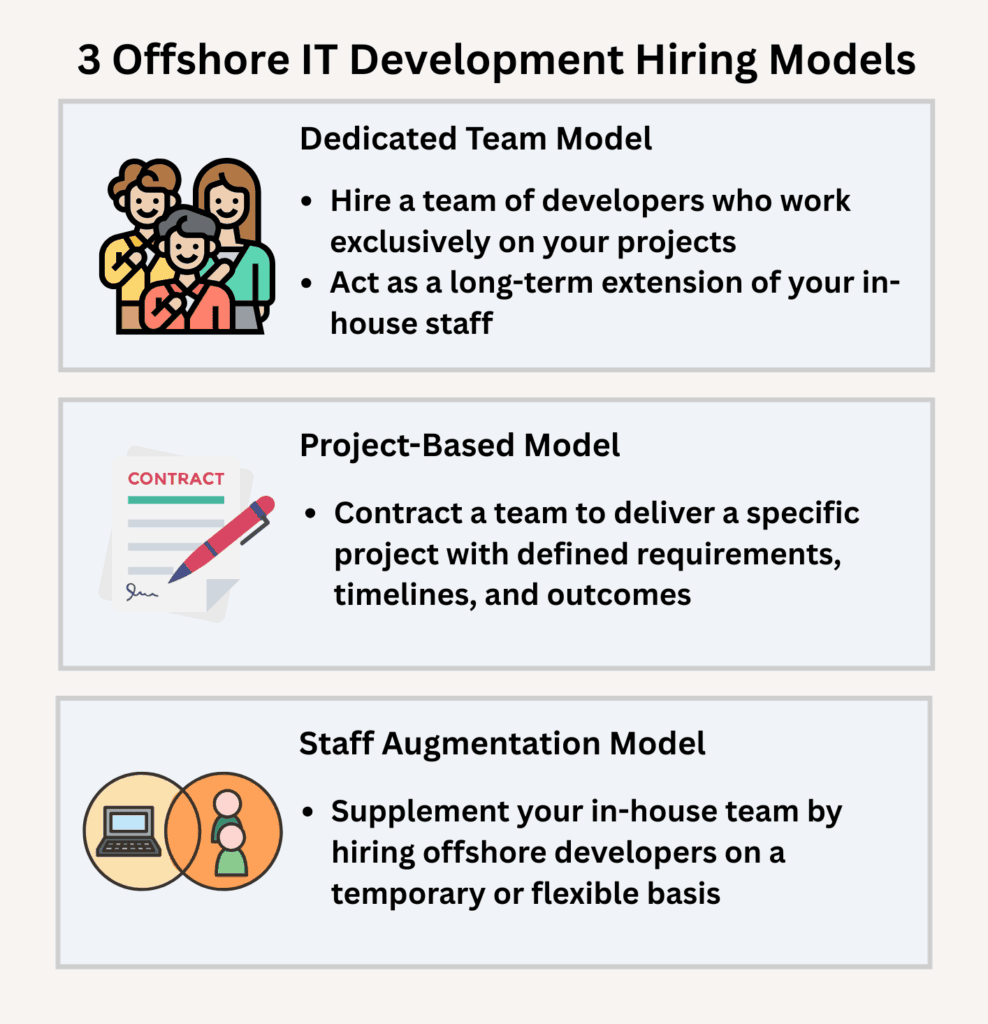
Here are the main hiring models to consider for offshore IT development:
| What It Is | Best For | |
|---|---|---|
| Dedicated Team Model | You hire a team of developers who work exclusively on your projects, acting as a long-term extension of your in-house staff. | – Long-term projects – Product-based companies – Startups scaling their tech team – Businesses needing full control and flexibility |
| Project-Based Model | You contract a team to deliver a specific project with defined requirements, timelines, and outcomes. | – Short-term or one-off projects – Fixed budgets and timelines – Clear project scopes – MVP development |
| Staff Augmentation Model | You supplement your in-house team by hiring offshore developers on a temporary or flexible basis. | – Filling skill gaps – Meeting urgent deadlines – Scaling teams quickly – Companies that already have in-house developers |
These 3 development team models offer different approaches to scaling your technical capabilities. The dedicated team model provides long-term partnership and deep project knowledge, making it ideal for ongoing product development.
The project-based model offers predictable costs and timelines for specific deliverables, perfect for well-defined initiatives. The staff augmentation model provides flexible scaling to address immediate needs or skill shortages within existing teams.
“Offshore development is most powerful when it’s built on trust, shared vision, and strong collaboration.”
Christian Cabaluna, Senior Recruiter
How Much Does Offshore IT Development Cost: A Realistic Look At Global Pricing
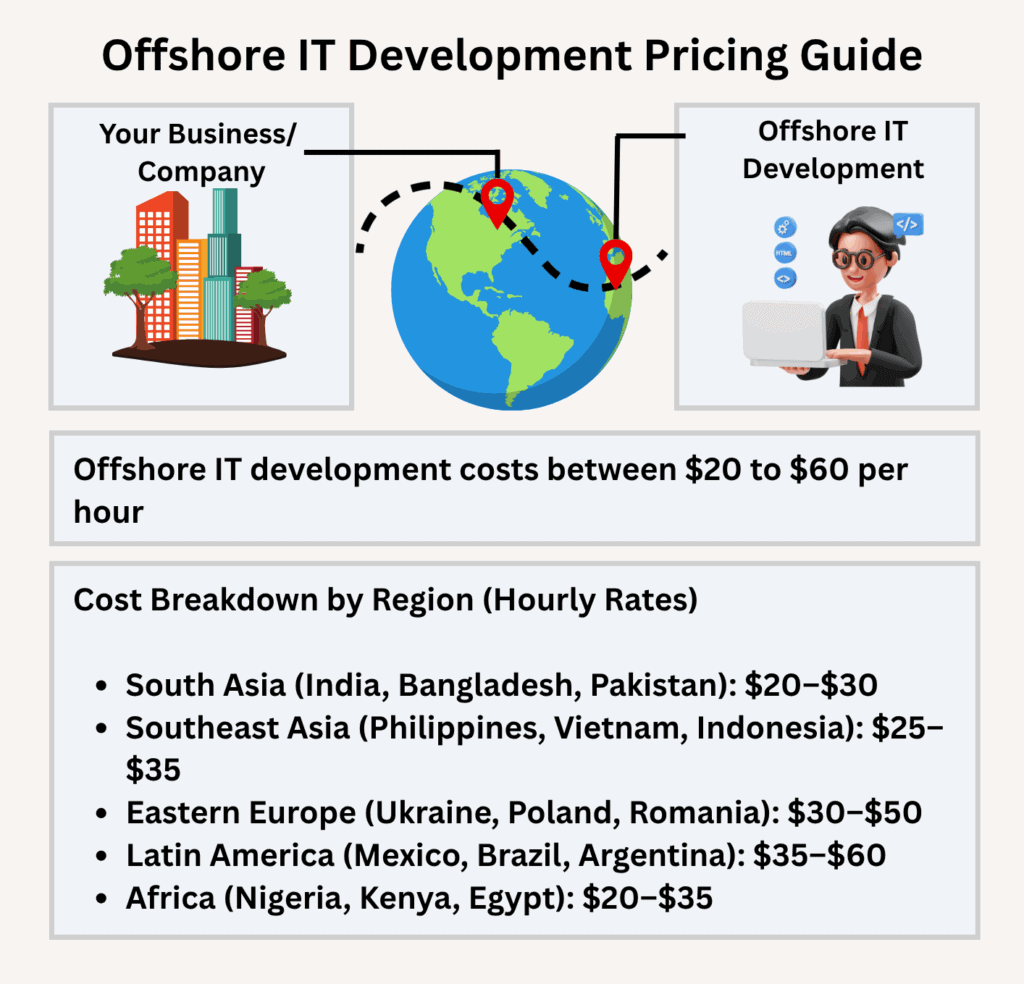
Offshore IT development costs between $20 to $60 per hour, depending on the region, developer experience, and project scope.
Factors That Influence Cost
- Developer seniority: Junior devs cost less, while senior or specialized roles charge more
- Technology stack: Niche skills (AI, blockchain) increase hourly rates
- Project complexity: Custom solutions or large-scale systems require more planning and resources
- Hiring model: Dedicated teams may cost more upfront, but offer better long-term efficiency
- Contract length: Long-term engagements often come with discounted rates
Cost Breakdown by Region (Hourly Rates)
- South Asia (India, Bangladesh, Pakistan): $20–$30
- Southeast Asia (Philippines, Vietnam, Indonesia): $25–$35
- Eastern Europe (Ukraine, Poland, Romania): $30–$50
- Latin America (Mexico, Brazil, Argentina): $35–$60
- Africa (Nigeria, Kenya, Egypt): $20–$35
Offshore IT Development Essentials: Tools & Systems That Make It Work

Use these tools to create a solid foundation for your offshore development efforts:
- Slack or Microsoft Teams – For fast, real-time communication and daily check-ins across time zones.
- Zoom or Google Meet – For scheduled video calls, sprint demos, and team alignment meetings.
- Jira or Trello – To manage tasks, track sprint progress, and keep everyone accountable.
- Confluence or Notion – For storing shared documentation, SOPs, and onboarding resources.
- GitHub or GitLab – For version control, code collaboration, and peer reviews.
- Figma or Sketch – For collaborative design work and sharing visual feedback.
- Clockify or Time Doctor – For tracking work hours and improving time management.
- CircleCI or Jenkins – For automating testing and deployment through continuous integration.
- Sentry or New Relic – To monitor application performance and quickly catch bugs in production.
- Loom or Vidyard – For sharing quick video walkthroughs when asynchronous communication is needed.
9 Best Practices For Offshore IT Development Success

Follow these tips and strategies for a successful offshore IT development:
1. Set Up Clear Communication Protocols
- Choose your primary communication tools early, like Slack for daily updates and Zoom for weekly calls.
- Define response time expectations so everyone knows how quickly to reply across different time zones.
- Create a shared communication guide that outlines meeting schedules, tools used, and preferred formats for updates.
2. Centralize Knowledge With Shared Documentation
- Use tools like Notion or Confluence to store processes, project specs, onboarding materials, and decision logs in one accessible place.
- Assign owners to keep documentation updated so information stays relevant and easy to find.
- Organize content by function or project to reduce confusion and help new team members ramp up faster.
3. Schedule Regular Check-Ins
- Set a consistent cadence for standups, weekly reviews, and monthly retrospectives to keep alignment across teams.
- Rotate meeting times when needed to share the time zone burden fairly between local and offshore teams.
- Use agendas and follow-up notes to keep meetings focused and ensure everyone stays accountable.
4. Use Agile With Distributed Teams
- Run 2-week sprints with clear goals and deliverables so offshore teams stay focused and aligned with your roadmap.
- Hold remote sprint planning, demos, and retrospectives using tools like Jira, Miro, or Zoom to support collaboration.
- Assign a Scrum Master or coordinator to bridge communication gaps and keep Agile practices consistent across locations.
5. Define Clear Task Requirements
- Write user stories with specific acceptance criteria so developers know exactly what success looks like.
- Include visuals, examples, and edge cases to eliminate ambiguity and reduce back-and-forth questions.
- Use task templates in tools like Jira or Trello to standardize how requirements are documented across the team.
6. Create Escalation Procedures
- Define what qualifies as an urgent issue and outline who should be contacted at each escalation level.
- Document escalation steps and response timelines in a shared workspace so everyone knows the protocol.
- Assign clear roles for issue resolution to avoid delays and ensure accountability during critical situations.
7. Enforce Peer Code Reviews
- Set a rule that no code gets merged without at least one peer review to ensure quality and consistency.
- Use tools like GitHub, GitLab, or Bitbucket to manage pull requests, comments, and approvals efficiently.
- Create a code review checklist that covers readability, security, testing, and adherence to project standards.
8. Automate Testing & Integration
- Set up CI/CD pipelines using tools like Jenkins, GitHub Actions, or CircleCI to automatically run tests and deploy updates.
- Integrate unit, integration, and end-to-end tests to catch issues early at every stage of development.
- Ensure every pull request triggers automated checks so bugs are flagged before they reach production.
9. Monitor Application Performance
- Use tools like New Relic, Datadog, or Sentry to track uptime, response times, and error rates in real time.
- Set performance benchmarks and alerts so your team is notified when systems slow down or behave unexpectedly.
- Review performance dashboards regularly to spot trends, optimize bottlenecks, and ensure a smooth user experience.
🔎 This Is Interesting
Average contract length for an IT outsourcing agreement is 5 years.
The Future Of Offshore IT Development: What Businesses Should Prepare For
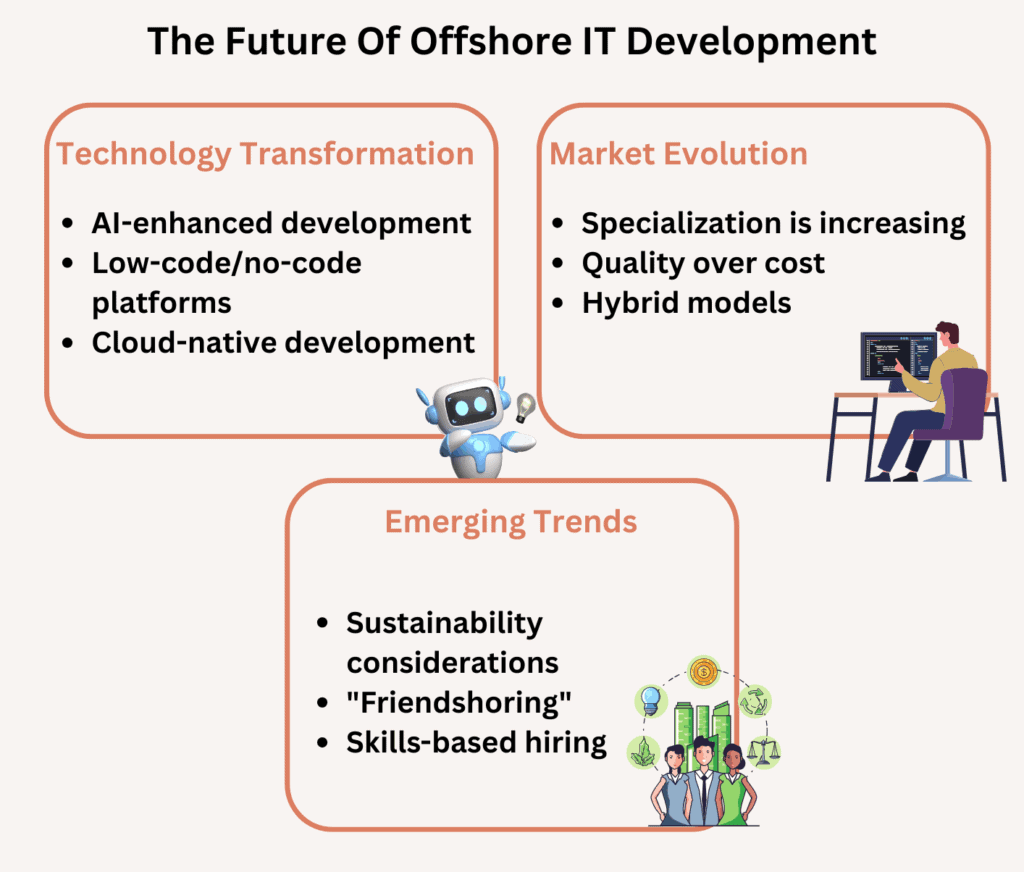
Here are the trends to look forward to with offshore IT development:
Technology Transformation
Offshore IT development is undergoing a major shift thanks to new technologies. AI-enhanced development using tools like GitHub Copilot to deliver code 25–40% faster without sacrificing quality. Low-code and no-code platforms are also gaining traction, which helps teams build solutions more quickly.
At the same time, cloud-native development is simplifying infrastructure and making it easier for offshore teams to collaborate across borders in real time.
Market Evolution
The offshore IT development market is becoming more specialized, with providers focusing on specific technologies, industries, or use cases rather than offering broad, general services.
Companies are shifting away from choosing vendors based solely on cost; instead, they prioritize high-quality skills and strong cultural alignment.
To strike the right balance, many of them are adopting hybrid models that blend offshore teams with local leadership, which offers both cost efficiency and strategic oversight.
Emerging Trends
Sustainability is becoming a key factor in offshore IT development, with businesses considering carbon footprint and environmental impact when choosing locations.
The rise of “friendshoring” also reflects a shift toward prioritizing politically stable and culturally aligned countries instead of making decisions based only on cost.
At the same time, improved remote collaboration tools are supporting skills-based hiring, where specific competencies matter more than where a developer is based.
Conclusion
Offshore IT development is about working smarter. If you’re thinking of diving in, don’t rush. Vet your partners like you would a co-founder. Start small, test real collaboration, and build trust before scaling. The best offshore teams think with you, move with you, and grow with you. So don’t just look for hands. Look for brains, curiosity, and alignment. That’s where the magic happens.
Genius helps you hire the top 1% of offshore talent from the Philippines and Latin America. We tap into local university networks and on-ground recruiters, run a 12-step vetting process, and screen over 250 candidates to find one who’s a true A-player.
For just $12K/year, you get US-quality talent with an 80% salary savings, no monthly fees, and a 6-month satisfaction guarantee. Build your offshore IT development team now.
FAQs
How is offshore IT development different from outsourcing?
Offshore IT development is a type of outsourcing focused on hiring teams in distant countries. Unlike traditional outsourcing, offshore teams often work as long-term partners, integrating more closely with your in-house operations and aligning with your business goals.
Is offshore IT development secure?
Yes, it can be secure when proper measures are in place. Use NDAs, strong contracts, access controls, and choose partners who follow international data protection standards to safeguard your intellectual property and sensitive information.
Is offshore IT development right for startups or only large companies?
Offshore development works for both. Startups use it to build quickly and affordably, while larger companies rely on it to scale, reduce costs, and access specialized talent they might not find locally.
Do I need to pay taxes or deal with legal issues when hiring offshore IT developers?
Generally, your offshore vendor handles taxes and local compliance. However, it’s wise to consult a legal advisor to ensure you’re protected and fully understand international contracts, IP ownership, and data privacy laws.