A hiring manager needs a computational chemist who has worked with one narrow simulation method. A profile search returns people who list “computational chemistry” and little else. The person who published three papers on exactly that method last year has a short profile with no keywords, so the search never shows them. That is an illustration, not a case study, but it describes why profile searches can miss the scientists a lab most wants.
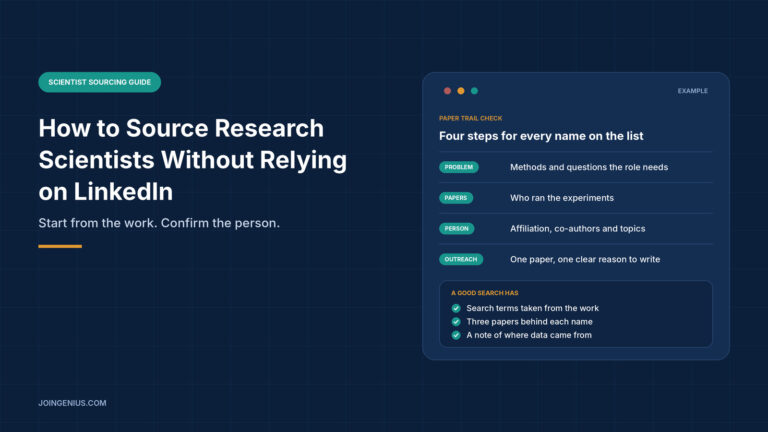
This guide explains how to source research scientists without relying on LinkedIn. It covers why profiles can understate a scientist, how to search through published work, how to confirm you have the right person, how to reach out and a table of warning signs. We found no study showing that LinkedIn under-represents research scientists, so the case for looking elsewhere rests on reasoning and on evidence about how scientific work is recorded. It is general information, not legal advice, and what works varies by field.
Why Profiles Understate Scientists
A professional profile is something a person writes about themselves. A paper is a record of work they did, reviewed and signed. For a scientist, the paper usually carries more detail about what they can do: the method, the data, the problem and who they worked with. A scientist may keep a short profile because their career runs through journals, conferences and grants. That is our reasoning, and plenty of scientists keep detailed profiles, but a search that begins and ends with profiles will not see the work.
Published work has gaps too, so the aim is not to swap one source for another. The aim is to start from the evidence of the work and use profiles to confirm and contact. Our guide to building a technical talent pipeline covers channels beyond job boards in general, and our guide to sourcing quantitative researchers covers a related search in finance.
Find Scientists Through Their Published Work, Not Their Profiles
Start from the problem, not from titles. Write down the methods, materials and questions the role needs, such as a technique, an instrument or a type of data. Then search papers, preprints, conference proceedings, patents and grant records for people working on those exact things. Open catalogs such as PubMed, arXiv and OpenAlex let you search by topic, and ORCID can confirm an identity when a researcher has registered.
Read enough of each paper to see what the person did. Authorship conventions vary by field. In some fields the first author did most of the hands-on work and the last author leads the lab, in others authors are listed alphabetically, so check the contribution statement where there is one, and ask the person later what they did. Look at recent work, not only the most-cited paper, because a scientist’s focus can change.
Papers also lead to people you did not search for. The authors who cite a key paper are working on the same problem, a recent review article names the groups active in a field, and conference programmes and poster sessions list who is presenting current work. Doctoral students and postdocs in a lab often move on within a few years, so the co-authors on a strong paper are worth a look, not only the senior name. That is practical reasoning, not a finding, and the right route differs between a university lab, an industry team and a public research institute.
Aggregators that list researchers can speed up a first pass. Expertini Research is one example. We did not find an independent evaluation of how complete or accurate its researcher pages are, so treat any such page as a lead to check against the papers themselves, not as proof of what someone has done.

Check You Have the Right Person
Names are a weak identifier. A 2017 arXiv analysis of about six million publications in Web of Science and Scopus, covering January 1996 to April 2014, found that ORCID appeared on between 1.4% and 2.9% of authors depending on the year, and concluded that “the majority of researchers do not use ORCID or ResearcherID.” The data is old and registration has grown since, and we did not find a current figure. It shows why a name search alone cannot be trusted.
OpenAlex, an open catalog of scholarly works, explains the problem from the inside. It uses machine learning to group author names into people, weighing six signals: name similarity, shared co-authors, affiliations, research topics, citation patterns and ORCID. It says ORCID is “present far less often than people assume,” and that two kinds of error occur. A person’s works can be split across several profiles, or works from different people can be merged into one. As OpenAlex puts it, “a profile is built from its works.”
A study that built labelled data by linking records to ORCID profiles adds a note on difficulty. Its authors say human coders can disagree on up to 25% of cases when deciding whether name instances belong to the same author. That is about research labelling, not recruiting, but it suggests that you should not expect certainty from a quick look.
So confirm before you write. Check that the affiliation, co-authors and topics line up across at least three papers, and use an ORCID record where one exists. Be extra careful with common names and with names that can be transliterated several ways, which the 2017 analysis linked to matching errors among its busiest author IDs. Our guide to auditing your recruiting pipeline for demographic blind spots is a reminder that who gets found depends on how you search.
Reach Out With Their Work in Hand
A scientist who receives a message that mentions one specific paper, and says why it matters to your role, has a reason to answer. A generic message asking about “opportunities” does not, and it reads like mass mail. Say how you found them and why you are writing, keep the first message short and make it easy to say no. If you know someone in their lab or a co-author, an introduction can carry more weight than a cold message, and it gives you a person who can tell you whether the fit is real. Our guide to cold email outreach covers the mechanics.
Data protection rules apply when you collect details from public sources. The UK Information Commissioner’s Office says in its guidance on information provided by candidates that “it is important that you are transparent with candidates about how you use their personal information,” and that you should securely delete personal information you do not plan to use. That guidance is UK only, dated November 2024 and marked as under review, and it does not set out a lawful basis for sourcing from public sources. Check the rules in each country where you contact people, and take advice if you are unsure.
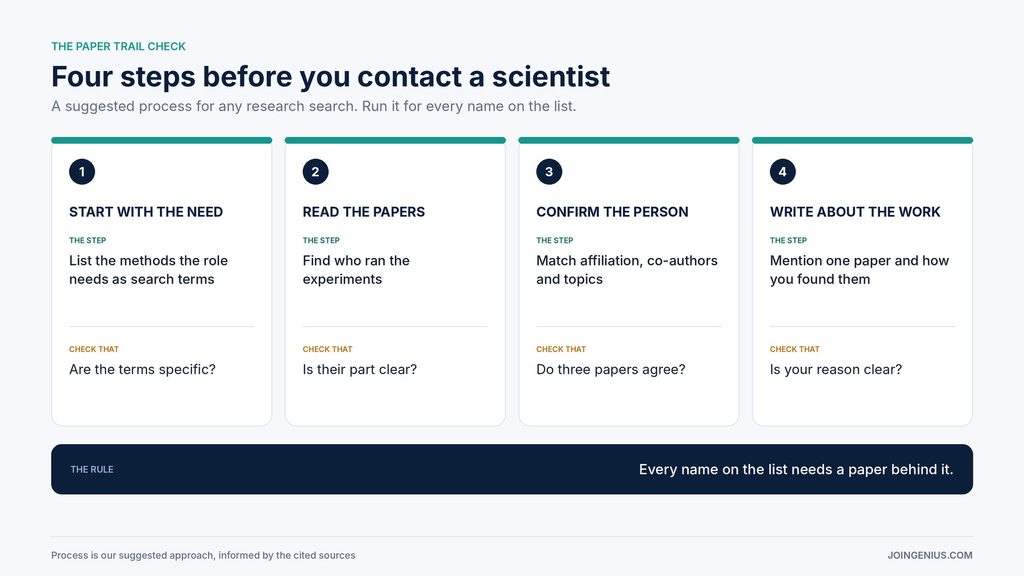
Use this four-step paper trail check to keep a search honest.
- Start with the need. List the methods and questions the role needs and turn them into search terms.
- Read the papers. Find who ran the experiments and what each person’s part was.
- Confirm the person. Match affiliation, co-authors and topics across several papers.
- Write about the work. Mention one paper, say how you found them and why you are writing.
Measure Whether It Works
Track how many people you contacted who matched the role on review, how many replied and how long it took to reach a shortlist the hiring manager accepts. Compare replies to paper-based messages with replies to generic ones, but avoid reading too much into a small number of messages. Our overview of talent sourcing tools lists options for managing the search, and the guide to building a hiring pipeline covers what happens after the first reply. If your search leans on automated ranking, our piece on why AI job boards miss niche technical candidates explains how to test it.
Warning Signs Your Scientist Search Is Too Profile-Led, and What to Do About Each
Check this table before you start a search and again before you send outreach. One sign means fix one thing. Three or more mean pause and rework your approach before you contact anyone.
| Warning sign | What it may mean | What to do |
|---|---|---|
| Search starts from job titles | Strong researchers may be missed | Search by method and topic |
| Profile is the only evidence | Skills may be overstated | Read at least one paper |
| Authorship order is ignored | Credit may be misread | Ask what the person did |
| Name match is the only check | Two people may be merged | Confirm affiliation and co-authors |
| Outreach never mentions the work | It may read as mass mail | Cite one specific paper |
| No note of where data came from | Privacy duties may be missed | Record source and purpose |

Start From the Work, Then Find the Person
The best evidence of what a scientist can do is usually the work they published, so start there and use profiles to confirm and to make contact. Search by method, read enough to see what each person did, confirm you have the right one and write about their paper. If your search can show, for each name on the list, which papers put them there, you have a shortlist you can defend.