A company needs someone to brief leaders on geopolitical risk. It posts a role for a former government intelligence officer and gets a handful of applicants. Meanwhile a journalist who verifies footage for a living and a researcher who tracks shipping data never apply, because the posting does not describe them. That is an illustration, not a case study, but it shows the cost of treating a government background as the only proof of skill.
This guide explains how to hire intelligence analysts without relying on government talent pools. It covers what the job involves outside government, what research says about judgment, how to test candidates, where to find them and a table of warning signs. We found no study showing what predicts a good intelligence analyst outside government, or which sourcing channel works best. The advice rests on forecasting research, selection research, public analytic standards, a publicly hosted tradecraft primer and our reasoning. Roles that legally require a security clearance work differently, and this guide does not cover them.
What an Intelligence Analyst Does Outside Government
Outside government the title varies. You may see geopolitical risk analyst, threat intelligence analyst, OSINT researcher or market intelligence analyst. We found no standard definition, so treat this split as ours. The work has three parts: collecting and checking information from open sources, judging what it means and how sure you are, and explaining it to a reader who must decide something.
A candidate can be strong at one part and weak at another. A journalist may verify well and have little practice stating probabilities. A data analyst may model well and never have judged a source. Our guide to hiring a data analyst covers the modelling side, and our piece on sourcing quantitative researchers covers a related profile.
What Forecasting Research Suggests About Judgment
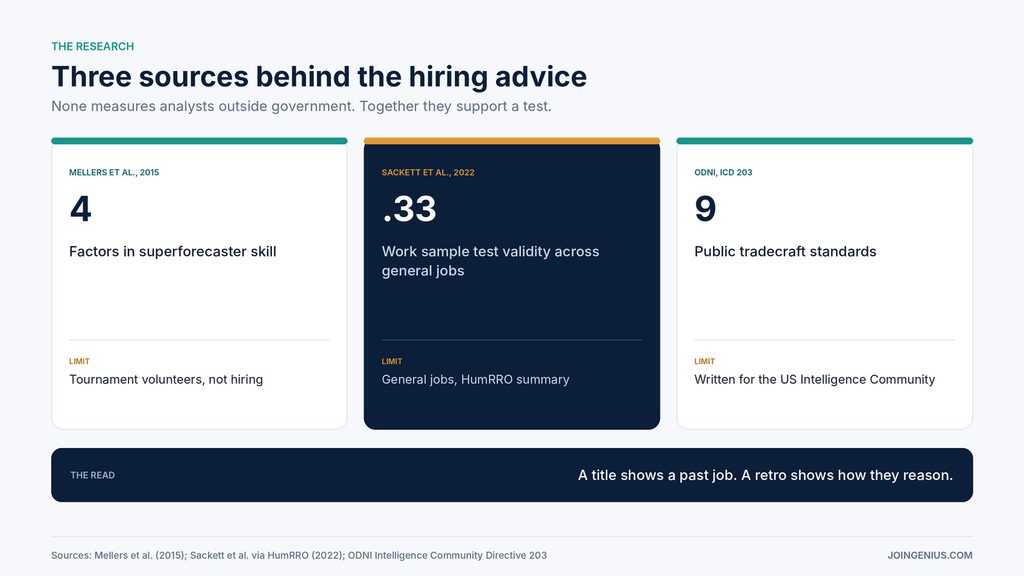
The strongest research we found on judging world events comes from forecasting tournaments sponsored by the US Intelligence Community. Barbara Mellers and colleagues, in a 2015 paper in Perspectives on Psychological Science, report that the winning strategy was to identify each year’s top performers and place them in elite teams called superforecasters. Those teams stayed accurate across hundreds of questions and many topics. The authors point to four reinforcing factors: cognitive abilities and styles, task-specific skills, motivation and commitment, and enriched environments. They conclude that superforecasters are partly discovered and partly created.
There are limits. We could read only the abstract, the participants were tournament volunteers and not job applicants, and the paper does not test a hiring method. Our reasoning is that if judgment is partly learned, you can test for it and train it, which is better than assuming a former title proves it.
Test Candidates With a Retrospective on a Real Past Event
A retrospective shows how a candidate reasons when the outcome is known to you and hidden from them. World Monitor, a free open-source dashboard of live geopolitical data, publishes a 72-hour retrospective template that fits this purpose. It asks an analyst to define the event boundary with a time, a decision and a reason, build a timeline in four bins from 72 hours before the event to 24 hours after, and separate signal families before comparing them. Each observation is recorded with its timestamp, source and the interpretation held at the time, and the page says to record only what was visible at that time. Evidence is scored on a three-point scale, and a missed-signal section classifies each miss.
The page is candid about hindsight. It says retros “should reduce hindsight bias, not manufacture certainty.” It is also a company blog post by World Monitor’s founder, its examples use the company’s own dashboard, and it offers no evidence that the exercise predicts job performance. We borrow the method, not the product.
Selection research supports the general idea, with a limit. A HumRRO summary of Sackett, Zhang, Berry and Lievens (2022) reports revised validity estimates in which structured interviews were highest at .42 and work sample tests were .33. The authors argue that earlier estimates were inflated by range restriction corrections, and they note that structured interview validity varies considerably. These figures concern job performance in general, not analysts. They support a modest point: giving every candidate the same realistic task and scoring it the same way beats improvising. Our interview guide covers how to structure the conversation.
To run the test, pick a past event with a well documented timeline. Give every candidate the same packet of dated public sources, a time limit such as two hours and the same question, for example what an analyst could have flagged three days earlier. Pay for the time, since unpaid tests ask people to work for nothing and may put off experienced candidates. That is our view, not a finding. Then ask each candidate to say what they would still not claim to know.
Use Public Tradecraft Standards as Your Rubric
You do not need an insider to write a rubric. The Office of the Director of National Intelligence published Intelligence Community Directive 203 on analytic standards, signed in January 2015. It lists nine tradecraft standards. Among them are properly describing the quality and credibility of underlying sources, properly expressing and explaining uncertainties, properly distinguishing underlying information from analysts’ assumptions and judgments, and incorporating analysis of alternatives.
The directive applies to the Intelligence Community and was written for it, so we borrow the criteria and not the authority. Turning them into questions gives a usable score sheet: did the candidate date and rate each source, mark which statements are fact and which are judgment, say how sure they are and offer a rival explanation. Our reasoning is that these criteria suit private-sector work too, since a risk brief has the same weak points.
The CIA also hosts its Tradecraft Primer publicly. Its introduction says the structured techniques are meant to help analysts with the perennial problems of intelligence, such as complex developments, incomplete or ambiguous information and the limits of human cognition. Our inference is that this makes structured technique something you can teach a new hire, not a credential only former officers hold.
Where to Find Candidates Beyond Government Pools
We found no study comparing sourcing channels for analysts, so these are our suggestions. Look at people whose daily work already trains the three parts of the job. Journalists and fact-checkers verify claims against sources. Academic and think tank researchers weigh evidence and write for readers. Risk, compliance and supply chain analysts judge exposure under uncertainty. Describe the task in the posting and not only the credential. A line such as “you will write a weekly brief that states what is known, what is judged and how sure you are” attracts people who do that work and puts off people who only want the title. Our guide to the technical talent pipeline covers building a steady source of candidates, and the piece on internal versus external recruitment helps you decide whether to train a current employee.
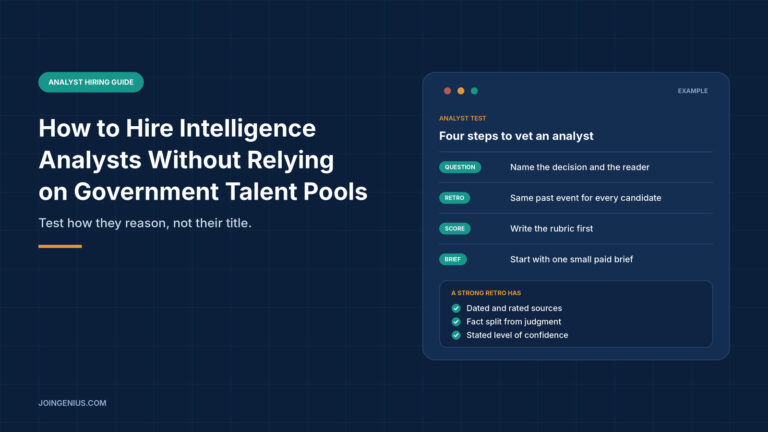
A Four-Step Plan to Hire an Analyst
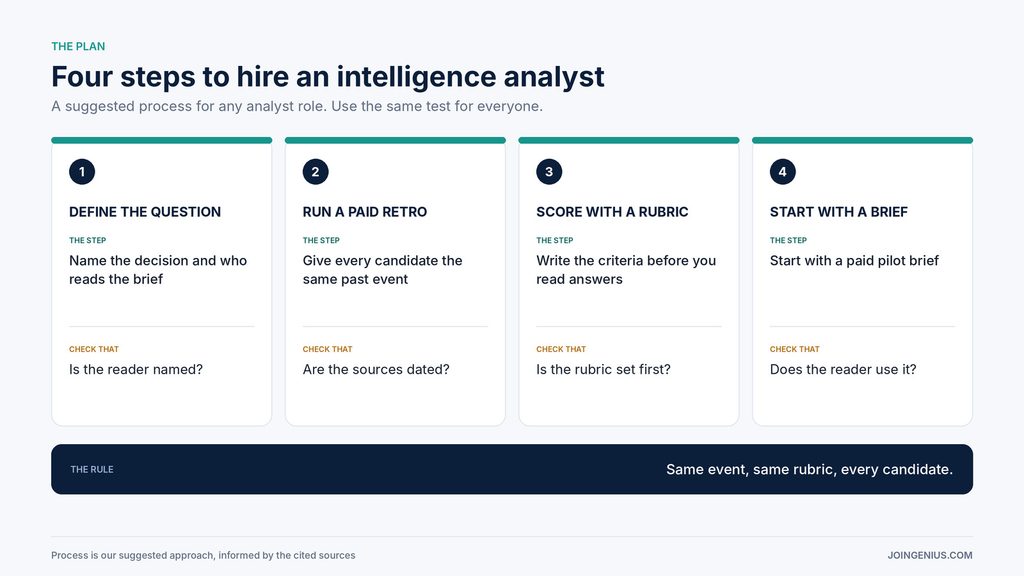
Use this four-step plan for every analyst role. It is our suggested process, informed by the sources above.
- Define the question. Name the decision the analyst supports and who reads the brief.
- Run a paid retro. Give every candidate the same past event and dated sources.
- Score with a rubric. Write the criteria before you read any answers.
- Start with a brief. Begin with one small paid briefing before a longer commitment.
The last step matters because a retro shows how someone reasons about the past, and a first live briefing shows how they handle a reader, a deadline and feedback.
Measure Whether the Hire Works
Track whether the analyst’s briefs state what is known, what is judged and how sure they are, whether readers use them in decisions, how often the analyst logs a correction and how quickly. We suggest asking for probabilities on a few judgments and checking them against outcomes later, because the forecasting research above turns on that kind of scoring. One wrong call proves little, so judge over several quarters. These measures are our suggestions, not findings.
For wider context on running the hire, our guide to vetting executive candidates covers checks for senior roles, and the piece on hiring regulatory specialists covers another judgment-heavy profile.
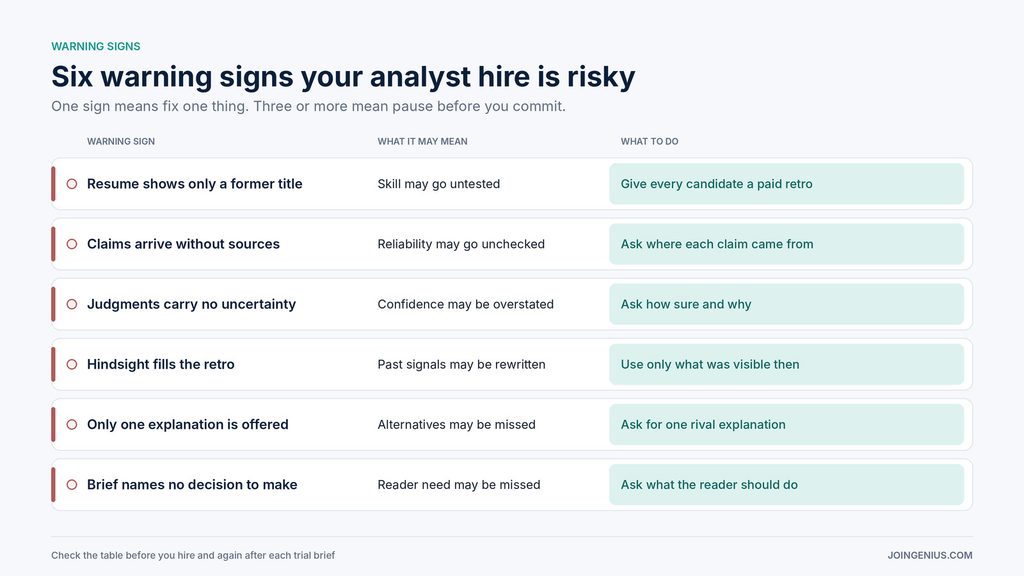
Warning Signs Your Intelligence Analyst Hire Is Risky, and What to Do About Each
Check this table before you hire and again after each trial brief. One sign means fix one thing. Three or more mean pause before you commit.
Test the Judgment, Then Teach the Tradecraft
A good analyst is one who checks sources, separates fact from judgment, says how sure they are and tells the reader what to do. Define the question first, give every candidate the same paid retrospective, score the answers against a rubric written in advance and start with one small brief. We found no study proving that this method picks better analysts, but each step replaces a guess about a background with evidence of how the person reasons. If the first brief holds up, you have a better reason to keep the analyst than any former title.