On a growing Shopify store the top ten SKUs are usually five base products plus their personalized versions. The personalized products outsell the plain ones two to one, and the dashboard still names the plain SKU as the conversion leader. Growth stops at the exact point in the catalog where most Shopify stores plateau.
Below, we cover the four things a personalized product pulls through the funnel that a static SKU cannot, and why the catalog report hides it. Then we get into the build layer that makes personalization scale. We finish with a before and after, plus the four fixes for stores already selling it.
The Four Things A Personalized Product Pulls Through The Funnel That A Static SKU Can’t
A product page for a plain SKU asks the buyer to decide in seconds. The page for a personalized item asks for a design, and that shift changes the economics in four ways.
Longer Time On The Product Page Becomes A Buying Signal
A buyer typing their own name into a preview is not browsing. They are already committing, so the long sessions that look wasteful on a static SKU are the exact sessions that close on a personalized one. The personalized version of the same item usually produces a larger average order value at the same base cost.
The Gift-Receiver Logic That Doubles The Audience
A plain mug is bought by one person for themselves. A mug with a name on it is bought for a specific recipient, so the buyer’s whole social graph becomes the catalog’s addressable market. One SKU then covers Mother’s Day and anniversaries as separate search intents, with pet birthdays later in the year.
Price Resistance Softens When Each Item Is Unique
Price comparison goes away when the item does not exist anywhere else. A black ceramic mug has a price range the whole internet knows, so the buyer anchors on the cheapest version. A mug that reads “Nora, World Champion Of Mondays, 2027” has no reference price, so the personalized products sell at a 30 to 50 percent premium.
Returns Drop Because The Buyer Approved The Design
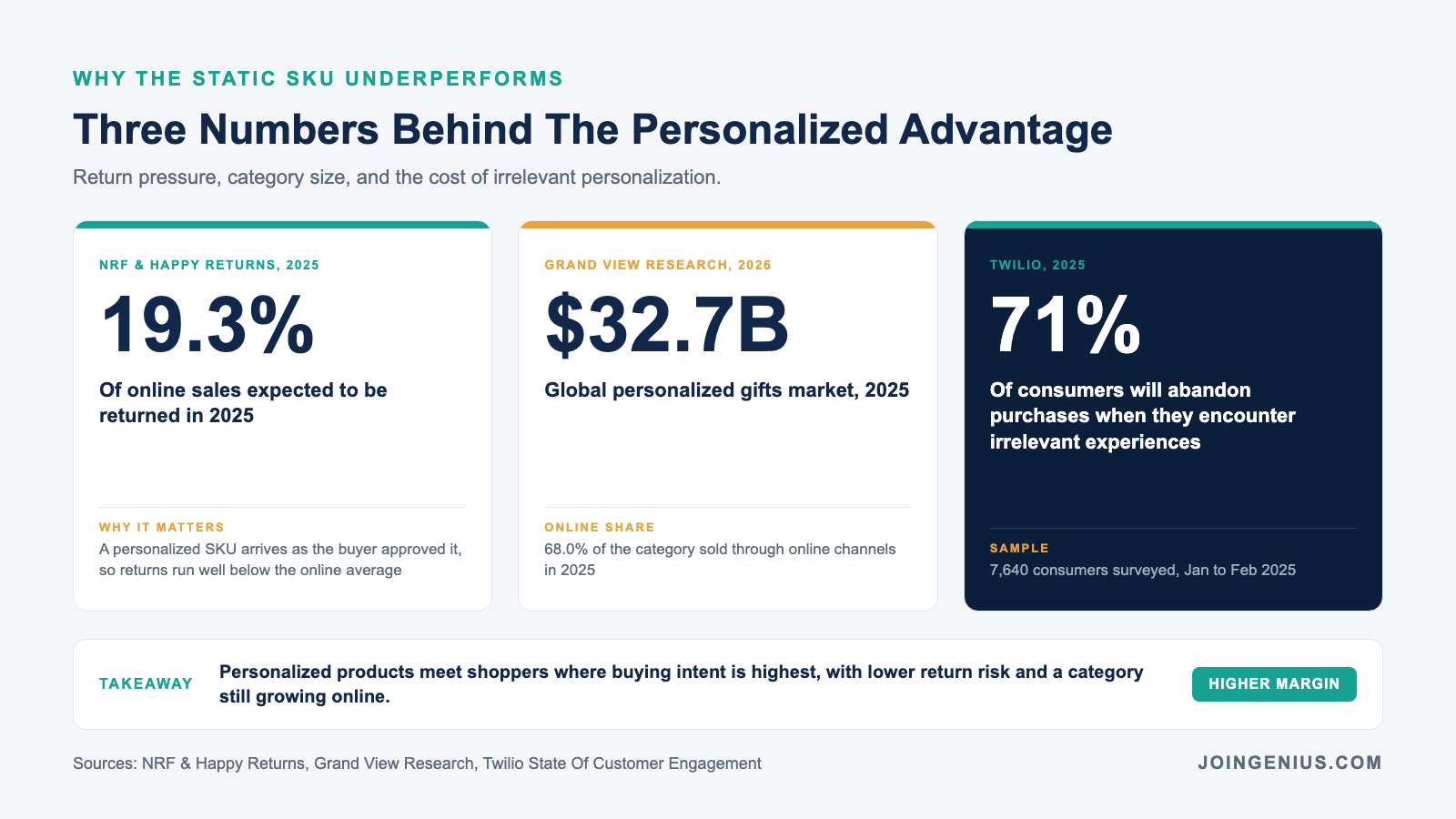
NRF and Happy Returns reported in their 2025 Retail Returns report that an estimated 19.3% of online sales will be returned in 2025. A personalized product arrives with the exact design the buyer approved at checkout, so the most common return reasons cannot apply.
A return policy that reads “no returns on personalized items except for defects” raises customer satisfaction, because the buyer never sees a surprise. Return rates on a well-built personalized SKU usually run below 5 percent.
Why The Shopify Catalog Report Says The Static SKU Is Fine
Most catalog dashboards rank SKUs on conversion rate first. Unit orders are the second signal, with inventory turns as a third. Each of those metrics treats a personalized SKU unfairly, so the report keeps recommending the plain one.
Conversion rate drops because buyers of personalized products spend longer deciding. The static SKU converts faster per visit, but the personalized SKU converts fewer visits into a larger revenue number. The dashboard never divides revenue by sessions, and the “unit orders” sort below it puts the cheaper plain variant on top.
Inventory turns do not apply to personalized items at all, because a personalized SKU is produced after the sale. The dashboard treats it as if it had infinite stock, which is technically true but also removes it from the stock-turn ranking a buyer uses to shortlist.
Grand View Research’s 2026 Personalized Gifts Market report put the global personalized gifts market at $32.7 billion in 2025, with online sales accounting for 68.0 percent of the category. The pattern surprises the dashboards built before the category was this big, not the buyers.
The Build Layer That Turns A Static SKU Into A Personalized Product
A store cannot sell personalized products through a text box. The build layer has three pieces, and getting all three in place is what separates a store that scales from one that burns out its designer.
Live Preview Is The Buyer’s Approval Mechanism
The preview is why returns drop, because the buyer sees the final design on the product page and clicks buy on the version in front of them. It is also why the page converts, because the preview is the moment of attachment. Without a live preview, personalization is a form field, and a form field does not sell.
Design Rules That Keep The Brand In Every Variant
The buyer should change only the parts that make the design theirs. Fonts and color palettes stay locked, as do the layout bounds. The variable field is free: a name, or a photo of a pet. A store that lets buyers change the brand font ends up with 200 off-brand variants by week three.
Ready-To-Print Files So Volume Doesn’t Equal Design Hours
Every order needs a print-ready file at the correct size and resolution, with the bleed the provider requires. A small store does this by hand and tops out around 30 orders a day. A store that generates the file automatically ships 300 orders a day with no extra headcount. The same compounding applies to 3D-printed custom orders.
A live preview configurator like Customily handles the three pieces in one app. The preview renders as the shopper types or uploads, and the admin side locks the design rules. Every order writes a print-ready file the POD provider accepts over API. Stores ship the same SKU on Shopify and Etsy with Amazon on the same configurator.
One Mug, Two Launches
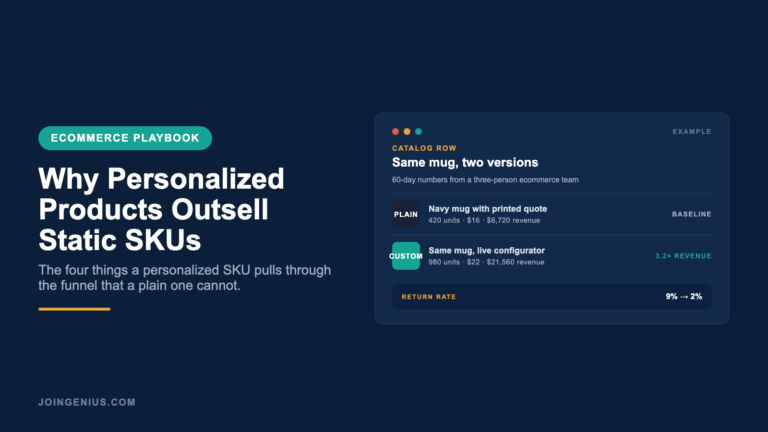
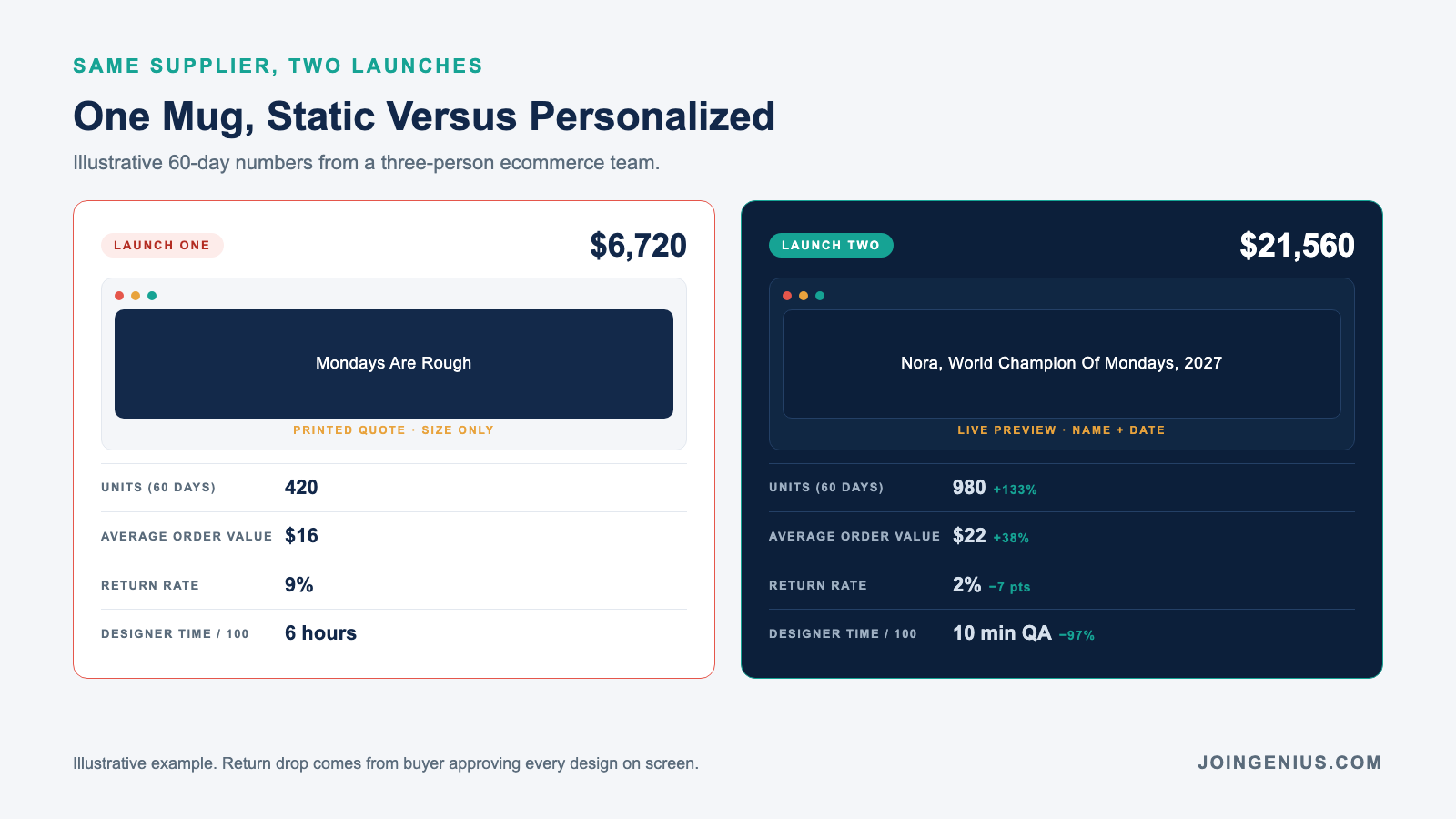
Here is an illustrative example from a three-person ecommerce team. The same mug shipped twice, four months apart, once as a static SKU and once with live personalization.
The first launch was a plain navy mug with a white quote printed on it. The product page loaded a clean photo and two variant buttons for size. It sold 420 units in the first 60 days at $16 each, for $6,720 in revenue. Returns came back at 9 percent.
The second launch was the same mug from the same supplier, with a live configurator on the page. Buyers typed a name into the first field and a date into the second. It sold 980 units in 60 days at $22, for $21,560 in revenue. Returns came back at 2 percent.
| Metric | Static SKU | Personalized SKU |
|---|---|---|
| Units sold in 60 days | 420 | 980 |
| Average order value | $16 | $22 |
| Revenue in 60 days | $6,720 | $21,560 |
| Return rate at 45 days | 9% | 2% |
| Designer time per 100 orders | 6 hours | 10 minutes QA |
| Ad budget allocated | Primary | Secondary |
The number that moved most was return rate, from 9 percent down to 2 percent. The buyer approved every design on screen, so returns clustered on actual defects. Designer time per 100 orders dropped from 6 hours of manual prep to 10 minutes of QA, which keeps the ops team from capping out at launch three.
The Four Fixes For Stores Already Selling Personalized Products That Aren’t Scaling
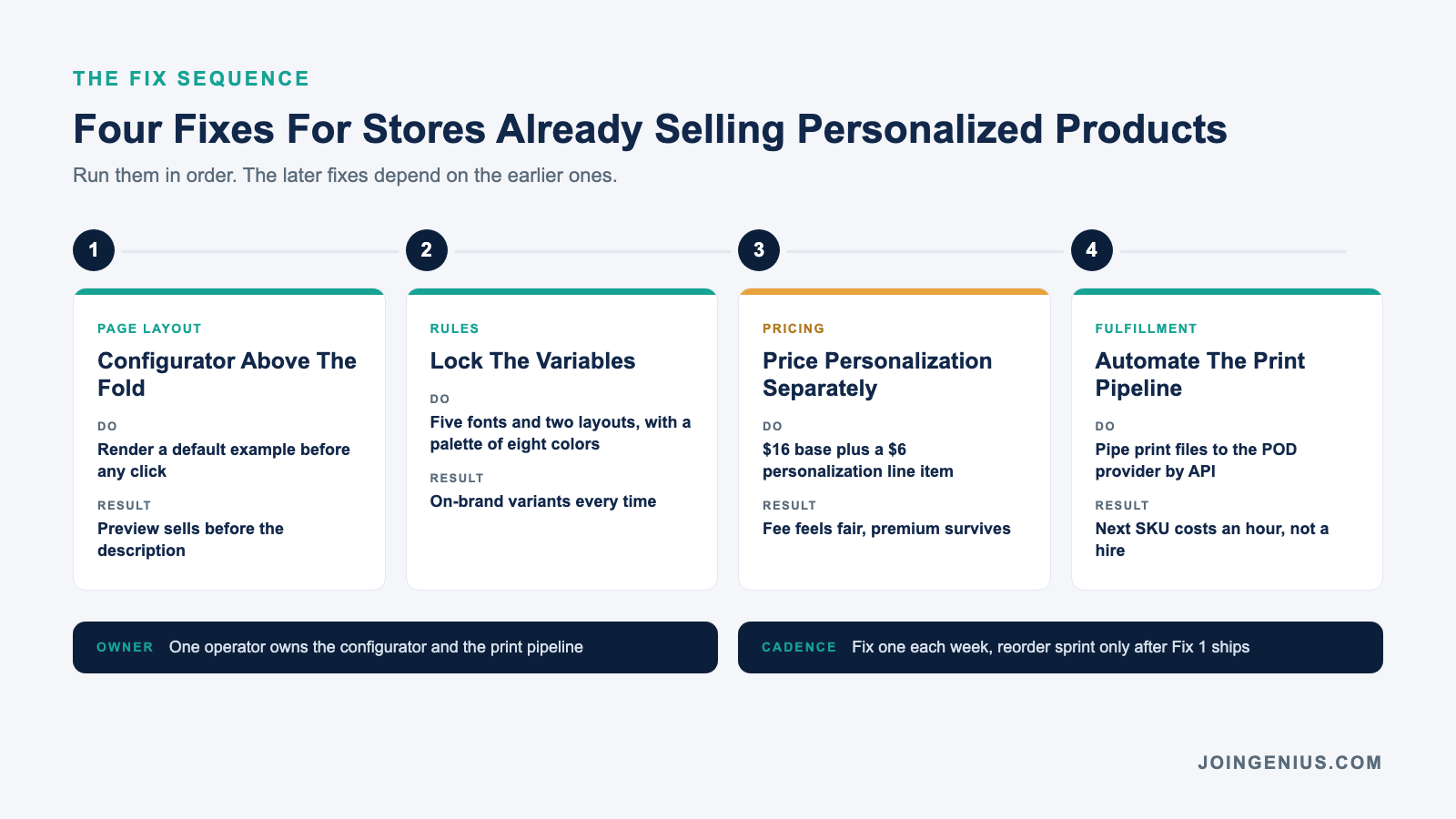
Many stores already offer a personalized SKU somewhere in the catalog, and it still underperforms the plain one. Four fixes cover almost every case.
Fix 1: Put The Configurator Above The Fold
Most stores hide the personalization option behind a radio button or a separate “customize” tab, so visitors never see the item with their name on it. Move the configurator above the add-to-cart button, with a default example already rendered. The preview then sells the item before the buyer reads the description.
Fix 2: Lock The Variables The Brand Cannot Flex On
Twilio’s 2025 State of Customer Engagement Report surveyed 7,640 consumers and found 71 percent will abandon purchases when they encounter irrelevant experiences. In personalization, that includes 40 fonts and 60 clipart options that never fit together. Narrow the choices to five fonts that match the brand and two layout templates, plus a palette of eight colors.
Fix 3: Price The Personalization, Not The Base
The personalized SKU should carry its premium as a line item, not hidden in a higher base price. A $16 base plus a $6 personalization fee reads as fair, because the buyer sees what they are paying for. A flat $22 reads as expensive. The fee scales with complexity, so an uploaded photo costs more than a name.
Fix 4: Automate Fulfillment Before You Add The Next SKU
Adding a second personalized SKU on top of a manual print-file workflow doubles the manual work. Pipe the print files straight to the print-on-demand provider by API, or to an in-house queue with a QR scan. The next SKU then costs an hour of setup, not a hire.
For stores on more than one platform, the API also keeps design parity across channels so the multichannel inventory stays consistent.
Hire The Operator Who Runs Personalized SKUs
Stop treating the SKU count as the thing that moves growth. The cap is set by whoever owns the configurator and the print pipeline, with the merchandising rotation as the third part of the job. Promote one operator into that role and write the interview rubric around the four fixes above. Most stores never build this role.
Genius can staff it. We hire top 1 percent ecommerce and personalization operators from the Philippines and Latin America at roughly 80 percent less than local salaries. There are no monthly fees, and every placement comes with a six-month talent guarantee. The one you hire will price every personalized SKU as a line item from day one.