
Offshore C development sounds complicated. You are handing over your C++ codebase (which already feels like a Rubik’s Cube with a bad attitude) to a team halfway across the world, and somehow, it is supposed to go… smoothly? No wonder people hesitate.
But it can work—really well, actually—if you follow the right steps. This guide walks you through 12 smart practices that take the chaos out of offshore development. We will also point you to reliable hiring countries, because nobody has time to play hiring roulette with the wrong regions.
Offshore C++ Development At A Glance
| Cost Savings | 85% reduction compared to local hiring; rates range from $25-70/hr globally |
| Top Destinations | Eastern Europe (technical excellence), Latin America (time zone alignment), Asia (cost efficiency) |
| Best For | System programming, embedded development, game engines, high-performance applications |
| Hiring Timeline | 2-4 weeks with proper vetting vs 12+ weeks for local hiring |
| Success Factors | Technical assessment, clear requirements, communication protocols, IP protection |
| Team Models | Dedicated teams for long-term projects, project-based for specific deliverables |
Your Next Must-Read Blogs
🌟 Offshore Embedded Firmware Development: Full Guide
🔥 12 Top Offshore Development Risks & How You Can Avoid Them
💯 The Complete Guide To Hiring An Offshore PHP Developer
What Is Offshore C++ Development? Understanding The Basics
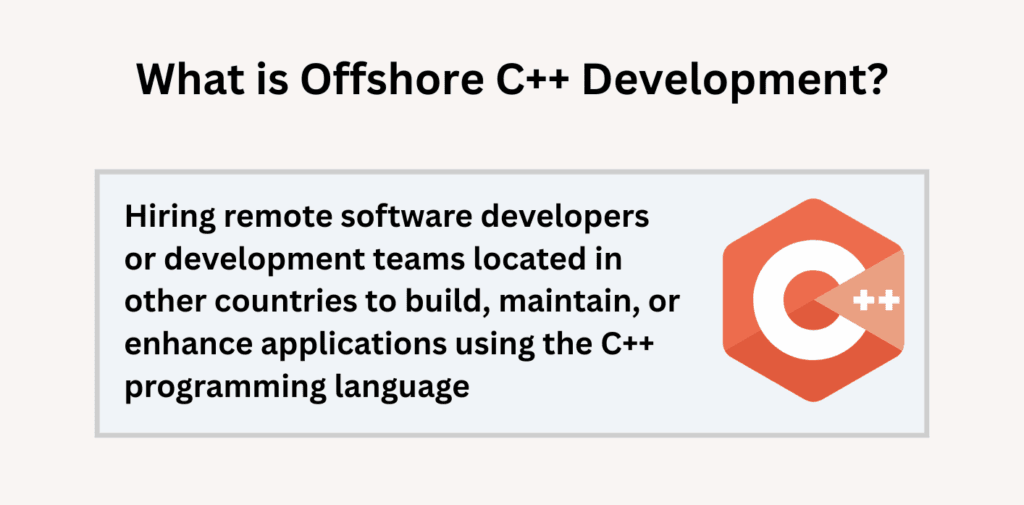
Offshore C++ development is the practice of hiring remote software developers or development teams located in other countries to build, maintain, or enhance applications using the C++ programming language. These offshore teams work outside your home country but function as an extension of your in-house resources.
C++ projects suited for offshore development include:
- Embedded systems and IoT devices
- Game engines and graphics programming
- High-frequency trading systems
- Database management systems
- Operating system components
- Real-time applications and drivers
12 Best Practices For Offshore C++ Development Success

To make your offshore C development experience efficient and hassle-free, keep these proven tips and strategies in mind:
Technical Assessment & Skills Evaluation
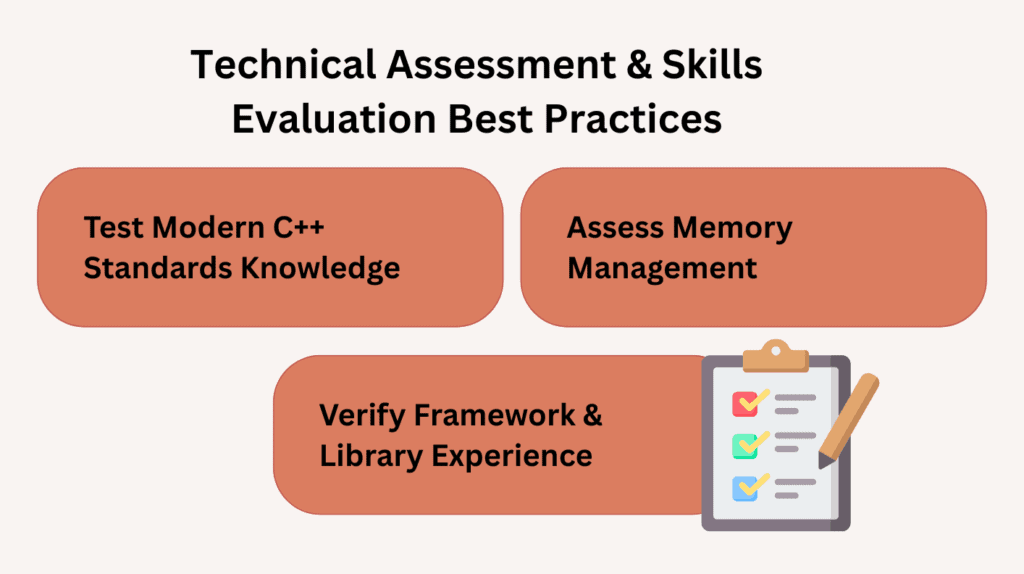
1. Test Modern C++ Standards Knowledge
- Ask candidates to complete a short coding task using C++17 or C++20 features. This reveals real-world familiarity with newer standards.
- Include technical interview questions that compare older C++ approaches to modern alternatives. It helps assess whether the developer can write clean, efficient, and maintainable code using best practices.
- Review their GitHub or previous project code for the use of modern C++ patterns and libraries. Looking at the actual code shows how they apply modern concepts in real projects, not just in test environments.
2. Assess Memory Management
- Give a task that involves dynamic memory allocation and deallocation (using
new/delete,unique_ptr, orshared_ptr). This tests the developer’s understanding of resource handling and their ability to avoid memory leaks or dangling pointers. - Ask candidates to identify and fix memory-related issues in a code snippet. It shows their ability to detect subtle bugs like memory leaks, buffer overflows, or improper pointer usage.
- Evaluate their knowledge of RAII (Resource Acquisition Is Initialization) and how they use it in practice. Proficiency with RAII demonstrates that the developer can write safer, more maintainable code without manual cleanup logic.
3. Verify Framework & Library Experience
- Ask which C++ libraries and frameworks they’ve used and for what purpose (Qt for GUI, Boost for data structures, Poco for networking). This helps you confirm not just name recognition, but actual hands-on experience relevant to your project.
- Review past project samples or GitHub repos to see how external libraries are integrated. It reveals their ability to manage dependencies, structure code modularly, and follow best practices when using third-party tools.
- Present a small task that requires choosing and using an appropriate library. This tests if they can make smart decisions on tooling based on the problem at hand (not just rely on default choices).
Project Management & Quality Assurance
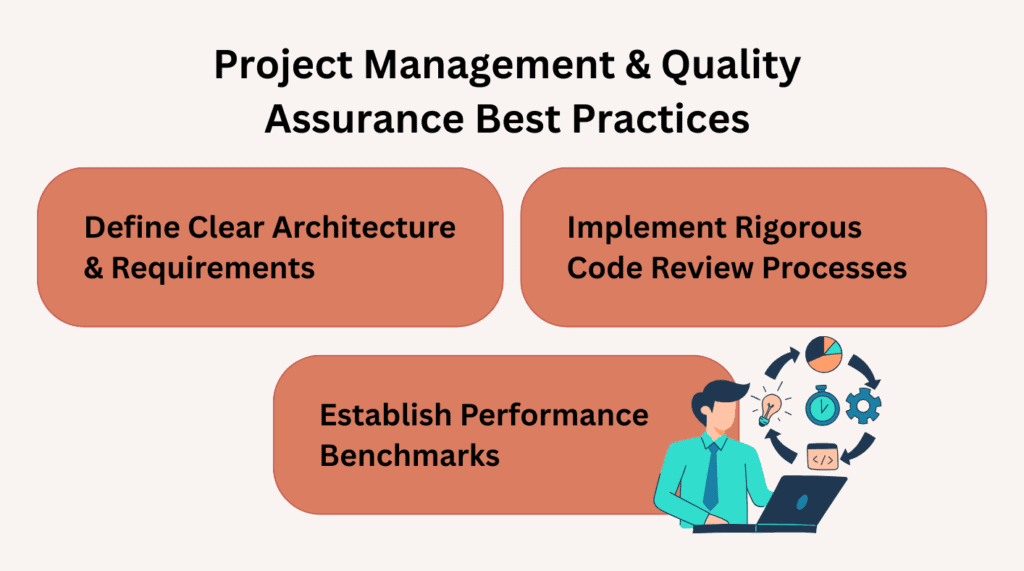
4. Define Clear Architecture & Requirements
- Create and share a high-level architecture diagram before coding begins. Visualizing the system structure helps offshore developers understand component relationships, data flow, and scope up front.
- Document technical requirements using clear, concise language and real examples. Detailed and unambiguous requirements reduce miscommunication and prevent rework caused by misunderstood expectations.
- Break large tasks into modular, trackable units with defined inputs and outputs. This allows developers to work independently, reduces bottlenecks, and makes progress easier to track and review.
5. Implement Rigorous Code Review Processes
- Set clear code review guidelines (style, structure, naming, documentation) and share them with all developers. Standardizing expectations keeps code quality consistent and makes reviews more objective and efficient.
- Use tools like GitHub, GitLab, or Bitbucket with mandatory pull request reviews. Built-in code review features help catch bugs early, enforce accountability, and maintain a strong commit history.
- Assign senior developers or domain experts to review critical sections of code. Experienced reviewers can spot deeper logic flaws, security risks, or architecture missteps that junior reviewers might miss.
6. Establish Performance Benchmarks
- Define specific performance metrics early (e.g., memory usage, execution time, CPU load). Clear targets help offshore developers optimize code from the start and avoid guesswork during tuning.
- Use profiling tools like Valgrind, gprof, or Perf to measure baseline performance. These tools provide concrete data to identify bottlenecks, inefficient loops, or memory-heavy operations.
- Run regular performance tests during development, not just at the end. Continuous performance tracking allows you to catch regressions early and make incremental improvements without costly rewrites.
🤔 Did You Know?
96% of businesses using cloud infrastructure can recover from a disaster in under four hours.
Communication & Team Integration
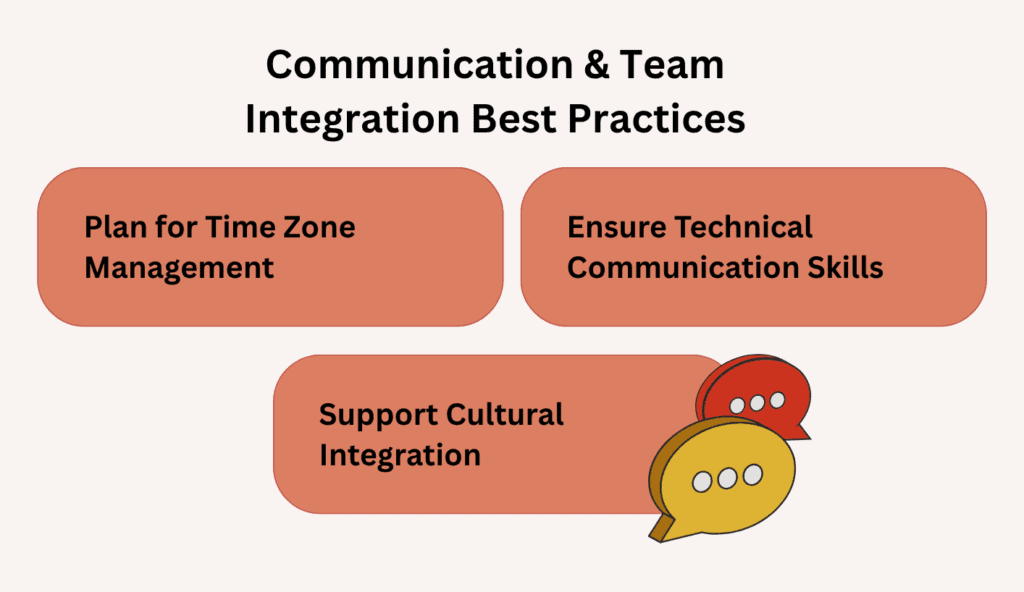
7. Plan for Time Zone Management
- Set overlapping working hours between your local and offshore teams (2–4 hours minimum). Shared hours make it easier to hold meetings, review progress, and resolve issues in real time without waiting a full day.
- Use shared calendars with time zone conversions (e.g., Google Calendar, World Time Buddy). This avoids confusion when scheduling and ensures that everyone knows when others are available, reducing delays and miscommunication.
- Establish clear async communication practices using tools like Slack, Loom, or Notion. Async updates help keep work moving forward even when teams aren’t online at the same time, especially for task handoffs and code reviews.
8. Ensure Technical Communication Skills
- Ask candidates to explain their past projects in writing or on a call. This reveals their ability to clearly communicate technical concepts, which is critical for alignment and collaboration in distributed teams.
- Include a task that requires writing code comments or brief documentation. Well-written comments and docs show they can make their work understandable for others.
- Evaluate how they respond to feedback or clarify requirements during the interview process. Good communication is about asking questions, listening, and adjusting based on input.
9. Support Cultural Integration
- Encourage casual team interactions through virtual coffee chats or informal Slack channels. Light, non-work conversations help build trust, reduce formality, and create stronger bonds across cultural lines.
- Acknowledge holidays and cultural events in your offshore team’s region. Recognizing important dates shows respect, boosts morale, and makes offshore team members feel included and valued.
- Assign cross-cultural buddies or mentors during onboarding. Pairing team members fosters faster integration, smoother communication, and better mutual understanding from day one.
Security & Legal Protection
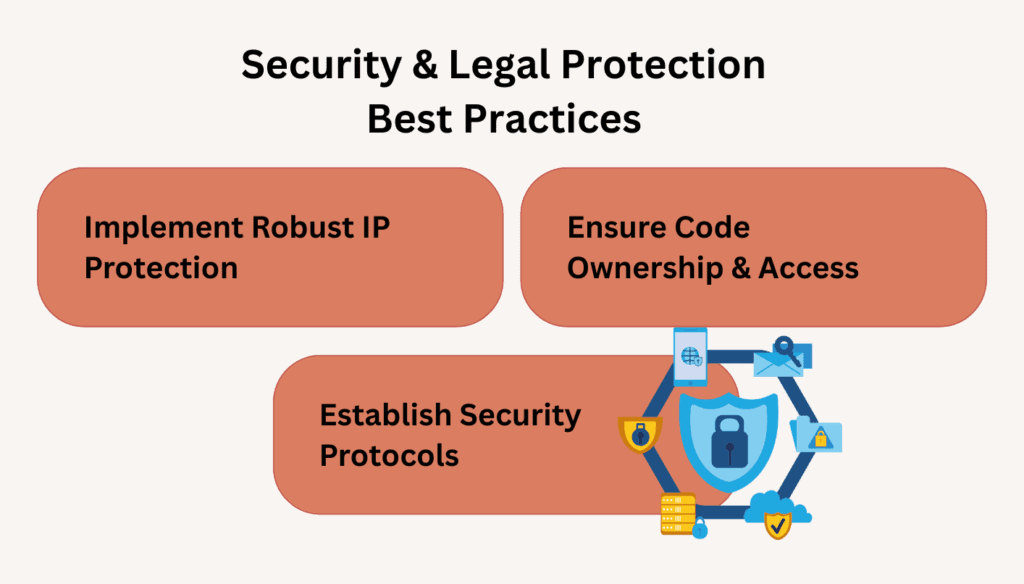
10. Implement Robust IP Protection
- Use NDAs and IP ownership clauses in all contracts with offshore developers. Legal agreements clearly define who owns the code and protect your business from future disputes or misuse.
- Restrict access to sensitive data and code repositories based on roles. Limiting access reduces the risk of accidental or intentional data leaks and ensures only authorized team members handle critical assets.
- Work with vendors or developers in countries with strong IP enforcement laws. Choosing jurisdictions with clear legal frameworks makes it easier to enforce your rights if a breach occurs.
11. Ensure Code Ownership & Access
- Host all code in repositories you control (e.g., GitHub, GitLab, Bitbucket). Keeping repositories under your organization’s control ensures that you retain full access and ownership, even if the developer leaves.
- Use access management tools to assign, monitor, and revoke permissions as needed. Role-based access control protects your codebase and prevents unauthorized changes or data exposure.
- Clearly state code ownership terms in contracts and SOWs (Statements of Work). Legal clarity prevents disputes and guarantees that all code produced during the engagement belongs to your company.
12. Establish Security Protocols
- Enforce the use of VPNs, firewalls, and encrypted communication tools. These tools protect sensitive data during transmission and reduce the risk of breaches, especially when working with remote offshore teams.
- Set up secure development environments with access controls and activity logs. Controlled environments help prevent unauthorized access and allow you to track changes or suspicious behavior in real time.
- Require regular security training for offshore developers. Educating developers on secure coding practices and threat awareness reduces vulnerabilities from human error or outdated habits.
Why Choose Offshore C++ Development Services: 5 Key Reasons
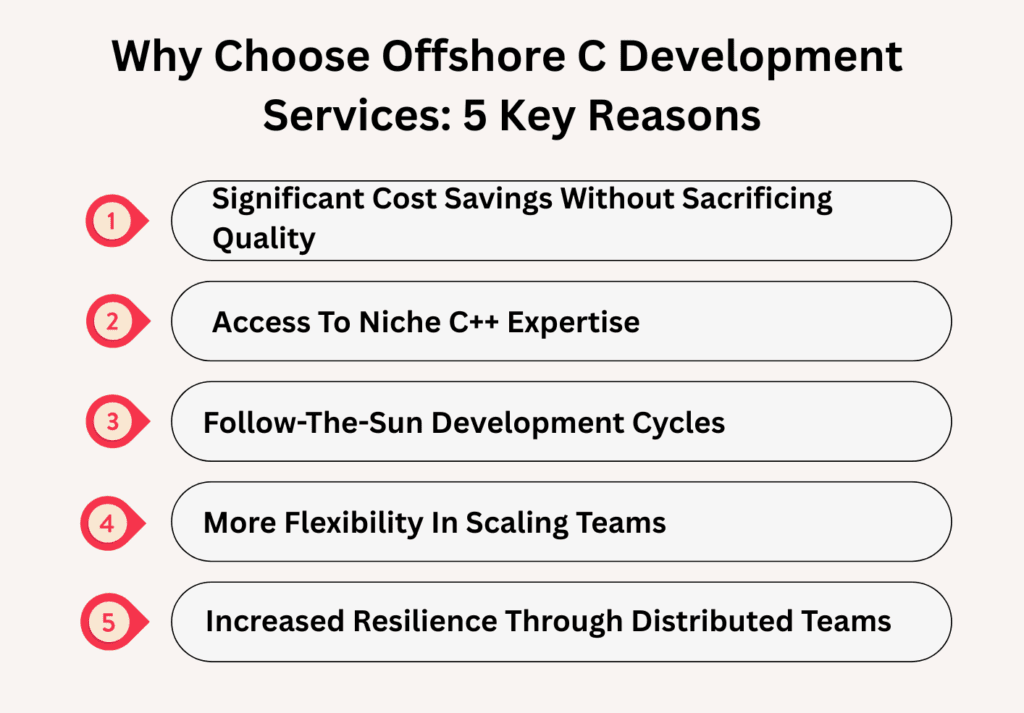
Let’s break down why so many companies are making the switch to offshore C development:
1. Significant Cost Savings Without Sacrificing Quality
Offshoring software development can reduce operational costs by up to 85%. The savings happen across multiple areas:
- Hiring offshore developers through agencies or outsourcing partners cuts costs associated with recruitment fees, job ads, onboarding, and lengthy interview cycles.
- In countries like India, Vietnam, and the Philippines, skilled C++ developers charge less than their counterparts in the US, Canada, or Western Europe (40–70% lower for comparable skills).
- Offshore teams work remotely. This eliminates expenses tied to office space, equipment, local benefits, and in-house HR support.
- Offshoring lets you scale teams up or down based on project needs. That means you only pay for the talent you use (no long-term commitments or underutilized staff).
2. Access To Niche C++ Expertise
The global number of software developers has reached 28.7 million. Offshore regions like Eastern Europe, India, and Southeast Asia have become hubs for C++ development. They produce engineers with strong backgrounds in mathematics, systems programming, and performance optimization.
You gain access to developers with hands-on experience in areas like memory management, multithreading, and hardware-level optimization, without having to train them from scratch or pay premium local salaries. This broader reach means you can build better systems faster, with engineers who already understand the complexities of C++ at a deep level.
3. Follow-The-Sun Development Cycles
Offshore C development supports the “follow-the-sun” model, where work is passed between teams in different time zones to create near-continuous development. While your local team ends their workday, your offshore developers are just getting started. This drives faster iteration, quicker bug fixes, and shorter development cycles.
Here’s a simple guide to help you coordinate C++ development smoothly across different time zones:
| Country | Time Zone | US Time Overlap (EST) | Benefit |
|---|---|---|---|
| India | IST (UTC+5:30) | 2–4 hours early morning | Ideal for overnight progress |
| Ukraine | EET (UTC+2) | 4–6 hours overlap | Good daytime collaboration |
| Poland | CET (UTC+1) | 5–7 hours overlap | Strong overlap for agile teams |
| Vietnam | ICT (UTC+7) | 1–3 hours early morning | Effective overnight handoffs |
| Philippines | PHT (UTC+8) | 0–2 hours early morning | Works well with night shifts |
| Mexico | CST (UTC-6) | Full overlap | Syncs fully with US teams |
| Brazil | BRT (UTC-3) | 2–4 hours overlap | Smooth real-time coordination |
4. More Flexibility In Scaling Teams
Offshore C++ development gives you more control over your team size because most offshore providers offer on-demand access to developers without long-term commitments. This means you can scale your team up when workloads spike (during new feature development or system migrations), and scale down during slower periods without the legal, financial, or logistical complications of hiring or letting go of full-time staff.
Here’s how this flexibility works in practice:
- Many offshore firms offer flexible engagement models like hourly, monthly, or project-based contracts, so you only pay for what you need.
- Reputable providers maintain a bench of vetted C++ developers they can deploy quickly. This lets you add specialized skills without lengthy recruitment cycles.
- Because offshore vendors have standardized onboarding processes, you can get new developers productive within days (not weeks).
- You avoid overhead costs like office space, benefits, and full-time salaries. This lets you budget more accurately and shift resources where they’re needed most.
5. Increased Resilience Through Distributed Teams
When you rely solely on a local team, your entire development operation is vulnerable to regional disruptions like power outages, extreme weather, political instability, or health emergencies. Offshore C++ development helps mitigate this risk by distributing your team across multiple locations and increasing your operational resilience.
Here’s how this added resilience happens:
- With developers working from different parts of the world, disruptions in one region don’t bring your entire project to a standstill. Work can continue from another location with minimal delay.
- Distributed teams naturally spread risk across time zones. If one team is offline or delayed, another can pick up the slack and keep the project moving.
- If an urgent bug or system issue arises outside your local business hours, offshore developers in different time zones can handle it in real time. This reduces downtime and avoids delays.
- Offshore vendors often have built-in disaster recovery processes, including backup teams and remote access tools, so work can continue even during local crises.
“Great C++ talent is everywhere—offshoring just gives you a smarter way to access it faster.”
Burkhard Berger, Founder & CEO
Where To Hire C++ Developers Offshore: 8 Top Countries

Here are the best destinations for offshore C development:
1. India: Large Talent Pool With Cost Advantages
India is a global leader in offshore software development and offers a deep bench of experienced C/C++ developers at highly competitive rates. With over 5 million software professionals and a steady pipeline of 1.5 million engineering graduates annually, India provides unmatched access to skilled talent for complex, performance-critical projects.
English Proficiency: High
Best For: Enterprise systems, embedded development, backend infrastructure, telecom, and industrial software.
Infrastructure Strengths:
- Cities like Bangalore, Hyderabad, and Pune are home to global R&D centers and specialized C++ talent hubs.
- Tier 1 tech cities offer high-speed internet, redundant power supply, and modern co-working setups.
- Programs like “Digital India” and SEZ incentives make it easy to work with Indian outsourcing partners.
2. Ukraine: Skilled Engineers With System-Level Expertise
Ukraine has built a strong reputation for delivering high-quality C and C++ development, especially in areas like embedded systems, gaming engines, and cybersecurity. It consistently ranks as one of Europe’s top software outsourcing hubs because of its pool of 285,000 tech professionals and a focus on STEM education.
English Proficiency: Moderate to High
Best For: Embedded systems, real-time applications, high-performance computing, game development, and telecom software.
Infrastructure Strengths:
- Cities like Kyiv, Lviv, and Kharkiv house mature IT ecosystems with access to top universities and R&D centers.
- Offers 4–6 hours of overlap with Western Europe and partial overlap with the US for real-time collaboration.
- A wide range of vetted developers and outsourcing firms with proven track records in C++ development.
3. Poland: EU-Based Talent With Strong C++ Foundations
Poland is a premier destination for offshore C and C++ development, combining technical excellence with the regulatory protections of the European Union. With over 300,000 IT professionals and a strong emphasis on math, engineering, and computer science education, Poland produces developers known for precision and deep system-level expertise.
English Proficiency: High
Best For: Fintech platforms, cybersecurity, enterprise software, embedded and automotive systems, and cross-platform desktop applications.
Infrastructure Strengths:
- Cities like Warsaw, Kraków, and Wrocław are home to global R&D centers, IT parks, and a thriving startup ecosystem.
- Developers are trained to meet GDPR and other European data and IP security standards.
- Access to EU-funded tech programs and innovation incentives strengthens outsourcing infrastructure and service quality.
4. Vietnam: Affordable Option With Growing C++ Specialization
Vietnam is quickly becoming a go-to choice for offshore C and C++ development, thanks to its fast-growing tech talent pool, competitive pricing, and a strong government push for digital transformation. Thanks to over 600,000 STEM graduates annually and a rapidly maturing IT outsourcing industry, it offers reliable C++ talent for both startups and enterprise-level projects.
English Proficiency: Moderate
Best For: Mobile and desktop apps, embedded systems, IoT development, and performance-optimized backend services.
Infrastructure Strengths:
- Cities like Ho Chi Minh City and Hanoi have seen major investments in IT parks, accelerators, and developer communities.
- Policies like “Make in Vietnam” and major digital economy goals support outsourcing and tech exports.
- Strong BPO and software export track record with increasing adoption of international data security standards.
5. Philippines: Communicative Teams With BPO Backing
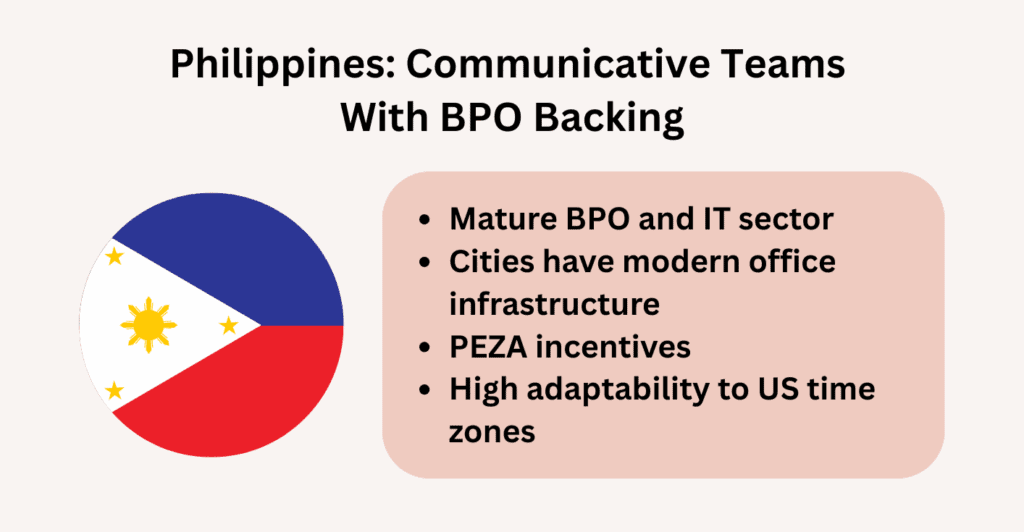
The Philippines is a trusted offshore destination known for its strong English proficiency, cultural compatibility with Western clients, and growing pool of skilled C++ developers. With a mature BPO and IT sector employing over 1.5 million professionals, the country offers a stable and service-oriented environment for software development.
English Proficiency: Very High
Best For: Backend systems, mobile and desktop apps, embedded software, and maintenance or support of existing C++ codebases.
Infrastructure Strengths:
- Cities like Manila, Cebu, and Davao have modern office infrastructure, tech parks, and a well-trained workforce.
- PEZA incentives and strong government backing support the IT outsourcing sector.
- High adaptability to US time zones, business practices, and communication styles.
😱 This Might Surprise You
68% of security breaches in offshore software development involve non-malicious human elements.
6. Romania: Reliable EU Outsourcing With R&D Focus
Romania has become a key player in offshore C and C++ development, especially for companies seeking EU-aligned security, skilled engineers, and cultural proximity to Western Europe. With over 190,000 IT professionals and a strong track record in low-level and embedded systems, Romania combines technical depth with legal and operational stability.
English Proficiency: High
Best For: Embedded software, automotive systems, telecom infrastructure, cybersecurity, and industrial automation.
Infrastructure Strengths:
- Bucharest, Cluj-Napoca, and Iași are major IT hubs with strong university pipelines and multinational R&D centers.
- Offers GDPR compliance, strong IP protection, and stable legal frameworks for international collaboration.
- Among the fastest internet speeds in Europe, with robust infrastructure for remote teams.
7. Brazil: Latin American Talent With US Time Zone Overlap
Brazil is a top offshore destination in Latin America, known for its strong engineering education, growing tech ecosystem, and large developer workforce. It is a solid choice for companies looking to build or expand C/C++ teams in a US-friendly time zone because of its pool of 500,000 software professionals and a rising focus on systems programming.
English Proficiency: Moderate
Best For: Fintech platforms, logistics and transportation systems, telecom, and performance-sensitive backend development.
Infrastructure Strengths:
- São Paulo, Campinas, and Porto Alegre host a growing number of tech startups, R&D centers, and outsourcing firms.
- Eastern Brazil operates in UTC−3, offering full or near-full workday overlap with US EST.
- Programs supporting STEM and software training are helping grow C++ talent year over year.
8. Mexico: Convenient Location With Strong Embedded Systems Talent
Mexico stands out as a top offshore C development destination for US companies with its geographic proximity, shared business culture, and growing pool of C++ developers. With over 700,000 tech professionals and strong expertise in embedded systems and industrial software, Mexico offers a smart balance of quality, speed, and convenience.
English Proficiency: Moderate to High
Best For: Automotive software, IoT solutions, embedded systems, industrial control, and cross-border tech operations.
Infrastructure Strengths:
- Guadalajara, Mexico City, and Monterrey are major tech hubs with strong university pipelines and multinational tech presence.
- Trade agreements support smooth cross-border collaboration and protect intellectual property.
- High-speed internet, co-working spaces, and experienced remote teams make it easy to build distributed C++ teams.
5 Simple Steps To Hiring A+ Offshore C++ Developers

Follow these steps to hire an offshore C++ developer that fits your project needs and business goals:
1. Define Your C++ Project Requirements
Start by clearly documenting the key details of your project to set the foundation for a successful offshore hire:
- Technical specifications: Specify the required C++ standard (e.g., C++17, C++20), target platforms (Windows, Linux, embedded systems), and performance expectations.
- Project scope: Outline the overall timeline, key milestones, and expected deliverables to keep the project on track.
- Team composition: Identify whether you need senior developers, junior support, or specialists (e.g., for embedded systems or real-time processing).
- Integration needs: Describe how the offshore team will interact with your existing systems, tools, and team members to ensure smooth collaboration.
2. Choose Your Engagement Model
Select the engagement model that best fits your project’s duration, complexity, and management needs. Each model offers different levels of control, flexibility, and cost-efficiency. Match the right model to your goals:
| Engagement Model | Best For |
|---|---|
| Dedicated Development Team | Long-term projects with evolving requirements and ongoing support needs. |
| Project-Based Team | Fixed-scope projects with clear deliverables, deadlines, and minimal changes. |
| Staff Augmentation | Temporarily adding C++ expertise to support your in-house team or fill gaps. |
3. Source & Evaluate Candidates
Use a mix of reliable sourcing channels to find qualified offshore C++ developers. Casting a wide net increases your chances of finding the right fit:
- Offshore development firms: Partner with companies that specialize in C++ development and have a track record of successful projects.
- Technical talent marketplaces: This connects you with vetted developers who meet high technical standards.
- Direct outreach: Use LinkedIn and professional communities to find experienced developers and initiate conversations directly.
- Industry referrals: Ask peers or partners for recommendations. They suggest trusted and proven candidates.
4. Conduct Technical Assessments
Your offshore development partner should demonstrate the ability to handle complex, real-world challenges. Include the following in your evaluation process:
- Live coding sessions: Focus on core C++ concepts, algorithms, and data structures to assess logic and coding efficiency.
- System design discussions: Evaluate their approach to building scalable, maintainable C++ applications tailored to your architecture.
- Code review exercises: Use actual or sample C++ codebases to test their ability to read, critique, and improve existing code.
- Domain-specific problem solving: Present challenges relevant to your industry (e.g., real-time systems, performance optimization) to see how they approach specialized tasks.
5. Pilot Project Approach
Before committing to a long-term partnership, run a short-term pilot project. It helps you evaluate the offshore team’s technical skills, communication style, and reliability, without taking on unnecessary risk.
- Select a small, self-contained module or feature with clear objectives and boundaries.
- Limit the pilot to 2–4 weeks to keep it efficient and easy to manage.
- Pay attention to how often they provide updates, how clearly they explain their work, and how quickly they respond.
- Review the code for structure, documentation, efficiency, and how well it meets your technical requirements.
- Use the results to determine if the team is a good long-term fit for your needs.
“Offshore C development lets you scale with precision, tapping into serious talent without slowing down your momentum.”
Christian Cabaluna, Senior Recruiter
How Much Does Offshore C++ Development Cost?

Offshore C++ development costs between $25-$70 per hour, depending on the country, developer experience, and project complexity:
Regional rate comparison:
| Region | Junior (1-3 years) | Mid-level (3-5 years) | Senior (5+ years) |
|---|---|---|---|
| Eastern Europe | $25-35/hour | $35-50/hour | $50-65/hour |
| Latin America | $20-30/hour | $30-45/hour | $45-60/hour |
| Asia | $15-25/hour | $25-35/hour | $35-50/hour |
| US (comparison) | $60-80/hour | $80-120/hour | $120-200/hour |
Hidden costs to consider:
- Project management overhead: 10-15% of development costs
- Communication tools and infrastructure: $50-200/month per developer
- Legal and compliance: $2,000-5,000 for contracts and IP protection
- Quality assurance: 20-30% additional testing effort for offshore teams
5 Real Challenges Of Offshore C Development + How To Fix Them
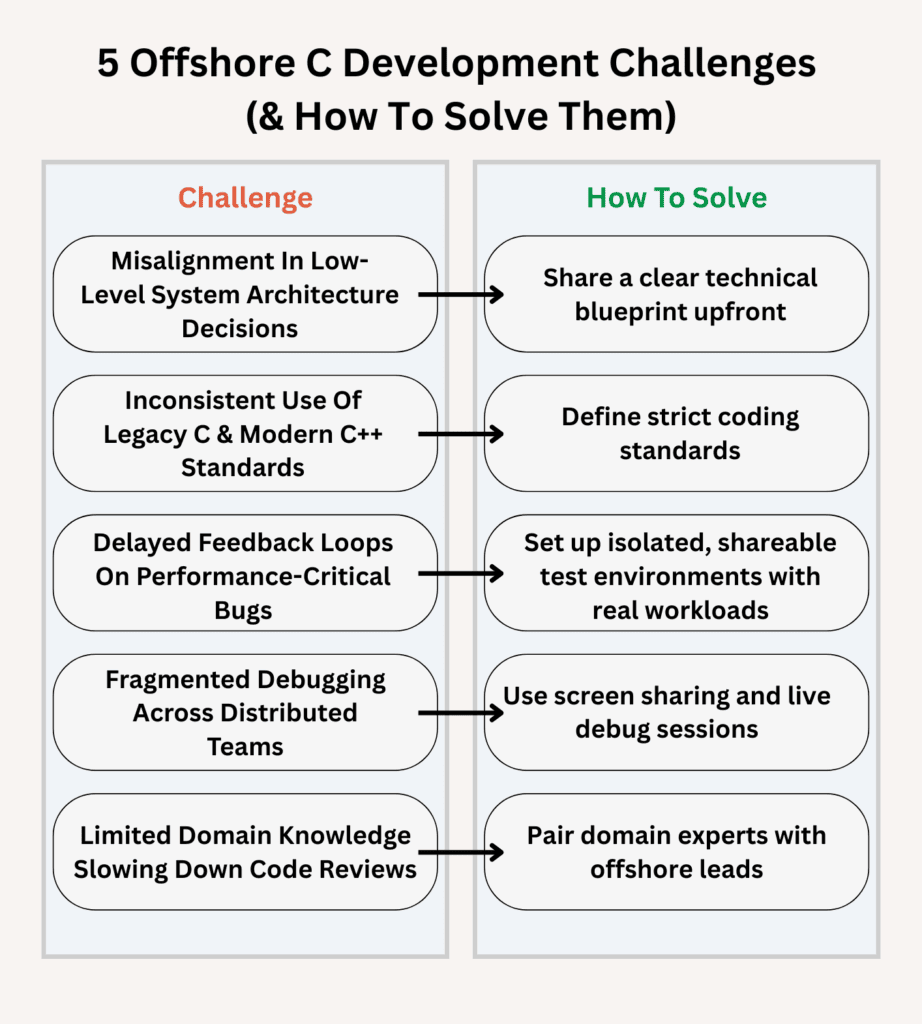
Here are some real-world offshore C development challenges and how you can solve them effectively:
1. Misalignment In Low-Level System Architecture Decisions
Offshore teams may make assumptions about memory management, threading models, or hardware dependencies that clash with your system’s requirements.
How to fix it: Share a clear technical blueprint upfront. Conduct architecture alignment sessions during onboarding and use code reviews early to catch mismatches.
2. Inconsistent Use Of Legacy C & Modern C++ Standards
Offshore teams often mix older C-style patterns with modern C++ idioms, leading to messy or unpredictable codebases.
How to fix it: Define strict coding standards (e.g., C++17 or C++20) and enforce them via static analysis tools and CI pipelines.
3. Delayed Feedback Loops On Performance-Critical Bugs
When performance regressions occur (e.g., memory leaks, race conditions), offshore teams may not have immediate access to your production-like environments.
How to fix it: Set up isolated, shareable test environments with real workloads. Use profiling tools (like Valgrind, Perf, or Intel VTune) and create reproducible benchmarks.
4. Fragmented Debugging Across Distributed Teams
Debugging complex C++ issues especially in multi-threaded or embedded systems requires deep context, which can get lost across teams.
How to fix it: Use screen sharing and live debug sessions when possible. Maintain centralized logs, crash dumps, and annotated core files in a shared space.
5. Limited Domain Knowledge Slowing Down Code Reviews
Even strong C++ developers offshore might lack domain-specific knowledge (robotics, finance, telecom), causing them to miss critical context during reviews.
How to fix it: Pair domain experts with offshore leads. Record walkthroughs of key modules and document business logic clearly in architecture diagrams and review checklists.
🔎 This Is Interesting
Global teams using Follow-the-Sun workflows finish work 22% faster.
Conclusion
If you’re considering offshore C development, here’s the real advice: don’t just chase low costs—chase the right fit. Take the time to define what you need, ask the right questions, and test for real-world C++ skills. The truth is, offshore C development can absolutely work in your favor, but only if you treat it like building a real partnership, not a quick fix.
Ready to make offshore C development your edge? With Genius, you can hire US-quality C++ talent from the Philippines and Latin America for 80% less. We find true A-players through our on-the-ground sourcing network who can plug into your workflow and deliver from day one.
We back every hire with a 6-month talent guarantee. If it’s not the right fit, you get a 100% refund. No risk. No guesswork. Just a hiring experience built for speed and quality. Let’s build your offshore C++ dream team the right way.
FAQs
What types of C++ projects are best suited for offshore teams?
Offshore teams are ideal for embedded systems, real-time applications, cross-platform software, and performance-critical backend development. These projects benefit from specialized skills and structured workflows commonly found in experienced offshore setups.
Can offshore developers work on legacy C code as well as modern C++?
Yes, many offshore developers are proficient in both C and modern C++ standards. They can maintain legacy systems while gradually refactoring to newer practices like smart pointers, STL, and C++17/20 features.
How do I monitor the productivity of offshore C++ developers?
Use task-tracking tools like Jira or Trello, combined with regular code reviews and status updates. Clear deliverables and milestone-based progress checks help keep productivity transparent and measurable.
Can offshore teams help maintain and refactor legacy C++ code?
Absolutely. Skilled offshore teams can stabilize older codebases and incrementally refactor them using modern C++ practices, improving performance, readability, and maintainability over time.