
So someone in the meeting dropped the term “RPO company” into the conversation, and you nodded like it made perfect sense—and now here you are, quietly googling what is an RPO company. Totally fair. No judgment.
If you don’t have time to sit through 10 tabs of vague HR speak, this guide is for you—the manager, the founder, the someone in the room who is in charge of getting things done and just needs the simple version: What is an RPO company, what do they actually do, and should you care?
Understanding RPO Companies At A Glance
| Quick Answer | |
|---|---|
| What is an RPO Company? | An RPO company is a specialized service provider that manages all or part of an organization’s recruitment process. |
| Core Services | End-to-end recruitment, talent sourcing, screening, interviewing, offer management, employer branding |
| Main Types | Full-cycle, Project, On-demand, Hybrid/Staff Augmentation, Contingent |
| Key Benefits | Reduced hiring costs, faster time-to-hire, better candidate quality, scalability |
| Top Challenges | Potential loss of control, integration issues, communication gaps |
| Cost Models | Management fee (fixed), Pay-for-performance, Hybrid-blended |
What Is An RPO Company?
An RPO company is a specialized service provider that takes ownership of all or part of an organization’s recruitment processes. Unlike traditional staffing agencies or contingent recruiters who work on a transactional basis, RPO providers function as strategic partners within your organization’s talent acquisition framework.
RPO companies bring specialized expertise, advanced technology, and proven methodologies to optimize every stage of talent acquisition—from job requisition to onboarding—while aligning with your business goals and culture.
Here are the 6 core services of an RPO company:
- End-to-end recruitment – Manages the entire hiring process from job requisition to onboarding
- Talent sourcing – Finds qualified candidates through multiple channels and proactive outreach
- Screening – Evaluates applicants through resume reviews, assessments, and background checks
- Interviewing – Conducts preliminary interviews to identify the best matches for your company
- Offer management – Handles negotiations, extending offers, and coordinating start dates
- Employer branding – Enhances your company’s reputation to attract higher-quality candidates
How Does A Recruitment Process Outsourcing Company Work?

Recruitment Process Outsourcing (RPO) company handles the entire recruiting process and presents you with only pre-screened candidates for final decisions.
- Find candidates – RPO provider sources talent through multiple channels, including job boards, social media, and their own databases.
- Screens and evaluates – They conduct initial interviews, skills assessments, and background checks to filter out unqualified applicants.
- Present best matches – Only top candidates who meet your requirements are presented to your company for review.
- Handles paperwork – The RPO provider manages all administrative details, including offer letters, negotiations, and onboarding documentation.
🌟 RPO Payroll Process: Benefits, Strategies, & Best Practices
🔥 Offshore RPO: How It Works, Benefits, & Best Practices
💯 17 Best IT Recruitment Process Outsourcing Companies
5 Types Of Services & Engagement Models RPO Companies Offer
Here are 5 different types of RPO solutions.

1. Full-Cycle RPO (Enterprise RPO)
This comprehensive model covers the entire recruitment lifecycle from job requisition to onboarding. The RPO provider takes full responsibility for all hiring needs across the organization. This approach is ideal for companies looking to completely transform their recruitment function or those experiencing significant growth.
2. Project RPO
Companies offering project RPO address specific hiring initiatives, such as opening a new location, launching a new product line, or seasonal hiring surges. Project RPO provides the flexibility to scale recruitment resources up or down without long-term commitments. Implementation is faster, often just 2-4 weeks.
3. On-Demand RPO
On-demand RPO companies let businesses access RPO services as needed for specific departments or a predetermined volume of positions. It’s particularly valuable for organizations with unpredictable hiring patterns or those testing the waters with outsourced recruitment.
4. Hybrid/Staff Augmentation RPO
In this type of recruitment process outsourcing, the RPO provider supplements your existing recruitment team, taking responsibility for specific roles, departments, or recruitment processes. This approach allows you to maintain internal control while leveraging external expertise for particular challenges.
5. Contingent RPO
Contingent RPO is a newer model where the service provider focuses on managing the recruitment of temporary, contract, and gig workers. This approach has gained traction with the expansion of the contingent workforce and can be integrated with permanent placement solutions or offered independently.
“The true power of RPO lies in its ability to transform recruitment from a reactive function to a strategic advantage that directly impacts business outcomes.”
— Burkhard Berger, Founder/CEO
3 Ways RPO Companies Structure Their Costs
Here are the 3 types of RPO cost models:

1. Management Fee (Fixed)
The fixed management fee model provides predictability through a consistent monthly or annual payment regardless of hiring volume. RPO companies charge a set amount for dedicated recruitment resources and agreed-upon service levels, making budgeting simpler and ensuring continuous support.
This model works best for organizations with steady hiring needs and that value having a reliable recruitment team as an extension of their HR department.
2. Pay-for-Performance
In this model, the RPO companies align costs directly with results by charging for successful placements or specific recruitment milestones. Businesses only pay when candidates are hired or when pre-defined outcomes are achieved.
This approach minimizes upfront investment and creates strong accountability for organizations with fluctuating hiring needs, seasonal recruitment, or those launching specific hiring initiatives.
3. Hybrid-Blended
The hybrid-blended model combines elements of both approaches with a base management fee plus performance-based incentives. Companies pay a reduced fixed fee for core services, while additional compensation is tied to exceeding targets or achieving superior results.
This appeals to organizations looking for the stability of dedicated resources with the accountability of performance metrics.
6 Key Benefits Of Working With An RPO Company
Here are 6 advantages of partnering with an RPO company:
1. Lower Hiring Costs
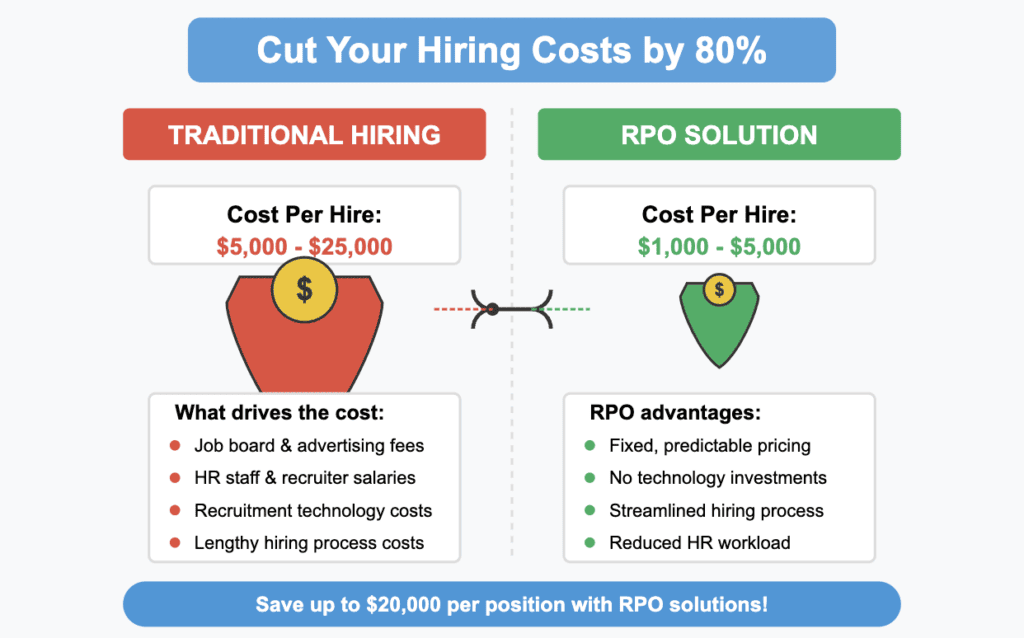
Traditional recruitment methods can cost your organization between $5,000-$25,000 per hire. RPO solutions can reduce these costs by up to 80%.
Where the savings come from:
- Eliminated job board and advertising expenses
- Reduced internal HR overhead
- Lower cost-per-hire across all positions
- No unexpected recruitment agency fees
- Performance-based pricing models
2. Better Quality Candidates
Research shows that 60% of businesses using RPO report significantly higher candidate quality. RPO’s extensive talent networks give you access to professionals you simply can’t reach through conventional methods.
Quality improvements through:
- In-depth candidate assessment and verification
- Industry-specialized recruiters who understand technical requirements
- Access to passive candidates not actively seeking new roles
- Sophisticated matching algorithms for skills and cultural alignment
- Comprehensive reference and background verification
3. Faster Hiring Process
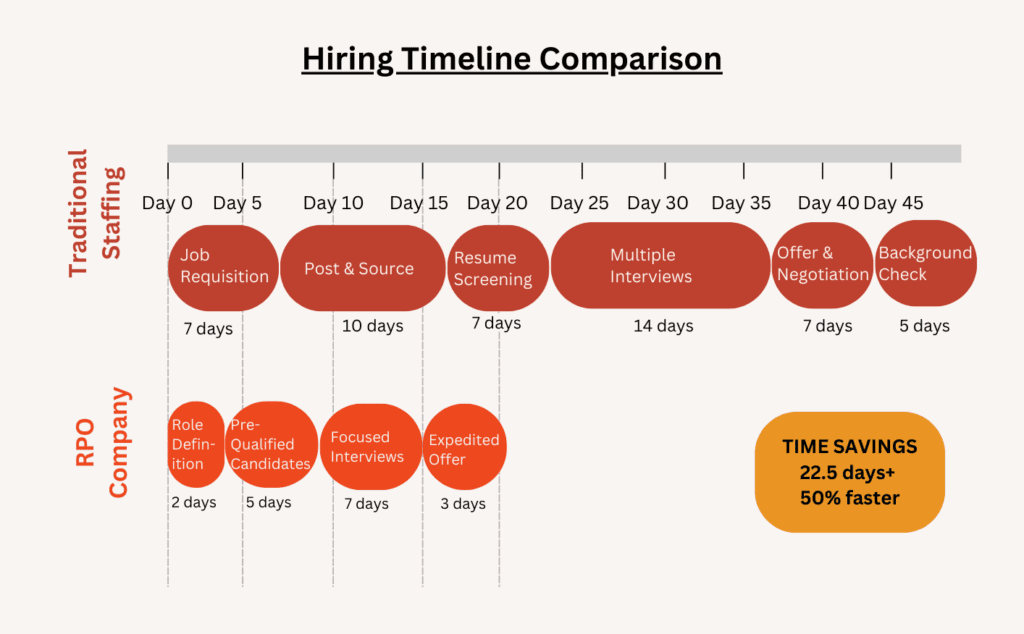
The average corporate hiring process takes 45+ days to fill a position. RPO companies cut this time in half.
Speed advantages include:
- Pre-qualified talent pipelines ready for immediate deployment
- Streamlined interview and assessment processes
- Dedicated recruitment specialists working your positions full-time
- Technology-enabled scheduling and coordination
- Rapid response to market opportunities and business growth
🤔 Did You Know?
36% of employers lack a structured onboarding process.
4. Scalable Recruitment
Business needs fluctuate, and your recruitment capabilities should adapt accordingly without disruption.
An RPO company’s scalable approach delivers:
- Seamless expansion during growth phases
- Cost control during slower periods
- Capacity for unexpected project-based hiring
- Consistent quality regardless of volume
- Geographic flexibility for multi-location businesses
5. Advanced Recruitment Technology Ecosystem
Enterprise recruitment technology is expensive to purchase and maintain. An RPO company gives you immediate access to best-in-class tools without capital investment.
RPO technology advantages include:

- AI-powered candidate matching and screening
- Advanced applicant tracking and workflow management
- Video interview and assessment platforms
- Predictive analytics for hiring success
- Comprehensive reporting dashboards
6. Strategic HR Transformation
When RPO teams handle the tactical aspects of recruitment, your HR department can focus on strategic initiatives that drive business value.
Transform your HR function by:
- Redirecting internal resources to employee development
- Reducing administrative burden on hiring managers
- Implementing strategic workforce planning
- Enhancing onboarding and retention programs
- Building a stronger, more resilient talent pipeline
“Companies rarely see the hidden potential in their recruitment process. A strong RPO partner reveals improvements you never knew existed.”
— Christian Cabaluna, Senior Recruiter
4 Challenges When Working With RPO Companies: Issues & Fixes
Prepare for these specific RPO challenges when you partner with an RPO company.

Challenge 1: Unclear Decision-Making Roles
Problem: HR, hiring managers, and executives have different expectations and evaluation criteria for the RPO relationship. This creates conflicting priorities and satisfaction metrics.
Solution:
- Implement a tiered governance structure with clear roles: Strategic Committee (quarterly reviews, strategic alignment), Operational Committee (monthly metrics review), and Daily Contacts (routine communication)
- Create a RACI matrix defining who is Responsible, Accountable, Consulted, and Informed for each recruitment decision type
- Document specific success criteria for each stakeholder group that align with business objectives
Challenge 2: Technology Integration Failures
Problem: Incompatible ATS systems, data migration errors, and API limitations frequently cause delays in implementation and reduced functionality.
Solution:
- Conduct a pre-implementation technical audit identifying every integration point between systems
- Build a phased integration roadmap with testing milestones before full deployment
- Include contractual clauses requiring the RPO provider to support custom API development if standard connections fail
- Maintain parallel systems during the first 30-60 days to mitigate transition risks
😱 This Might Surprise You
70% of the global workforce is made up of passive talent.
Challenge 3: Institutional Knowledge Loss
Problem: Critical candidate market insights, hiring manager preferences, and role-specific recruiting approaches get lost in transition to the RPO provider.
Solution:
- Create detailed role profiles documenting historical recruiting challenges, sources of successful candidates, and informal preferences
- Develop a “sourcing playbook” with target companies, ideal candidate profiles, and effective engagement strategies for key roles
- Schedule structured knowledge transfer sessions between internal recruiters and the RPO team before launch
- Maintain shadow recruiting periods where the internal team observes the RPO process for the highest-priority positions
Challenge 4: Unexplained Cost Variations
Problem: Initial ROI projections fail to materialize due to unexpected variable costs, including technology licensing, specialized market research, or extended sourcing for hard-to-fill roles.
Solution:
- Negotiate contract terms requiring notification when approaching 80% of any budget category
- Create comparative cost oversight dashboards tracking projected vs actual spend across all cost categories
- Build a reserve fund of 15-20% beyond projected costs for the first year to accommodate unexpected variables
- Implement quarterly cost variance reviews with root cause analysis for any category exceeding projections by 10%
When Should You Hire An RPO Company? RPO Readiness Assessment Scorecard
Rate your organization on each of the following factors from 1-5, with higher scores indicating a stronger need for RPO.
| Factor | Low Need (1) | Medium Need (3) | High Need (5) | Your Score |
|---|---|---|---|---|
| Hiring Volume | <15 hires per year | 15-50 hires per year | >50 hires per year | ____ |
| Hiring Fluctuations | Consistent, predictable hiring | Moderate seasonal variations | Significant unpredictable spikes | ____ |
| Time-to-Fill | At or below industry benchmark | 10-20% above benchmark | >20% above benchmark | ____ |
| Cost-per-Hire | Below industry average | At industry average | Above industry average | ____ |
| Recruitment Expertise | Strong in-house team | Some capabilities but gaps exist | Limited specialized knowledge | ____ |
| Technology | Robust talent acquisition tech stack | Basic systems with limitations | Inadequate or outdated systems | ____ |
| Geographic Scope | Single location | Multiple domestic locations | Global hiring needs | ____ |
| Hiring Manager Satisfaction | Consistently high (>85%) | Moderate (60-85%) | Low (<60%) | ____ |
| HR Strategic Focus | HR team has time for strategic initiatives | HR partially focused on administrative tasks | HR predominantly handling administrative work | ____ |
| Quality of Hire | Consistently strong performers | Mixed results | Frequent performance issues with new hires | ____ |
How to use this scorecard:
- Rate your organization honestly on each factor from 1-5
- Calculate your total score (out of 50 possible points)
- Interpret your results:
- 10-20 points: Your current recruitment approach is likely sufficient. Traditional recruiting methods or occasional staffing agency support may be adequate.
- 21-35 points: Consider selective RPO services like Project RPO or function-specific RPO to address specific pain points while maintaining your core recruitment capabilities.
- 36-50 points: Full-cycle RPO would likely deliver significant value. Your organization shows multiple indicators that a comprehensive RPO partnership could transform your talent acquisition function.
Consider these additional questions when evaluating if RPO is right for you:
- Are your hiring managers consistently frustrated with the recruitment process?
- Do you struggle to maintain a consistent candidate experience?
- Would your HR team deliver more value by focusing on other strategic priorities?
- Is your organization entering new markets where you lack recruitment expertise?
- Have you calculated the true cost of unfilled positions and poor hiring decisions?
How To Select The Right RPO Company In 6 Easy Steps
Find the right RPO provider with this process.

Step 1: Verify RPO Proven Industry-Specific Experience
- Review the provider’s client portfolio and identify at least 3 clients in your industry
- Ask for specific metrics they’ve achieved in your sector (e.g., “reduced time-to-hire for tech roles by 35%”)
- Request to speak with at least one reference client in your industry
- Examine their recruiter backgrounds to verify they’ve hired for your specific roles before
Step 2: Evaluate RPO Technology Stack & Integration Capabilities
- Request a live demonstration of their ATS and CRM systems
- Ask which specific AI tools they use for candidate matching and how they measure their effectiveness
- Get clarity on which metrics their technology tracks automatically vs. manually
- Confirm their compatibility with your existing HR tech stack with specific integration examples
- Request sample reports they provide to clients and their frequency (weekly, monthly)
Step 3: Confirm RPO Global Reach & Compliance Expertise
- Verify the specific countries where they have direct operations (not just partnerships)
- Ask about their multilingual capabilities and which languages they support in-house
- Request examples of compliance frameworks they’ve implemented for cross-border hiring
- Confirm they have country-specific employment law expertise with concrete examples
- Ask about their process for managing time zone differences with global candidates
Step 4: Assess RPO Cultural Alignment & Brand Representation
- Evaluate their communication style during the sales process—it often reflects how they’ll interact later
- Request to meet the actual delivery team who will handle your account, not just sales representatives
- Ask how they learn about and represent your company culture (request specific examples)
- Inquire about their process for gathering and incorporating feedback from your hiring managers
- Review their candidate communication templates to ensure alignment with your employer brand voice
Step 5: Test RPO Flexibility & Scalability Capabilities
- Ask for specific examples of how they’ve adapted to clients’ changing hiring needs
- Request details on their minimum contract terms and notice periods
- Confirm their capability to scale resources up or down with specific timelines
- Understand their process for handling urgent hiring needs outside the standard process
- Ask about additional services they can provide beyond their standard package
Step 6: Examine RPO Documented Performance & Success Metrics
- Request performance data comparing client metrics before and after implementation
- Ask for detailed case studies showing problem identification, solution, and measured results
- Check third-party review sites like G2, Capterra, or industry-specific RPO rankings
- Request client retention rates and average partnership duration
- Ask for specific examples of how they’ve overcome hiring challenges similar to yours
🔎 This Is Interesting
60% of job seekers quit an application process because it’s too long or complicated.
Conclusion
Now that you understand what is an RPO company, research a few providers that specialize in your industry, and don’t be afraid to ask for case studies from companies similar to yours. Remember, the right RPO partner should feel like an extension of your team, not just another vendor.
If you’re looking to maximize your recruitment budget while still finding exceptional talent, Genius is your go-to talent partner. We help businesses find elite global talent for up to 80% less than traditional hiring. We connect you with the top 1% of US-quality professionals from the Philippines and Latin America.
Fill out this form now and find your company’s next A-players.
FAQs
How is RPO different from working with a headhunter or recruitment agency?
Headhunters and agencies work on a transactional basis to fill specific positions, often charging a percentage of the hired candidate’s salary. RPO providers, in contrast, manage entire recruitment processes with dedicated resources and typically charge based on a fee structure unrelated to salary percentages.
Will an RPO provider replace our internal HR team?
RPO solutions complement rather than replace internal HR functions. Your HR team can focus more on strategic initiatives, employee development, and retention while the RPO provider handles the specialized work of candidate sourcing and recruitment.
Can RPO providers help with international hiring?
Yes. Many RPO providers offer global capabilities with regional expertise and knowledge of local labor laws, cultural considerations, and market conditions.
What happens to our recruitment data if we end an RPO relationship?
Proper data ownership and transition clauses should be established in your initial contract. Reputable RPO providers will ensure all candidate data, recruitment analytics, and process documentation are transferable back to your organization or to another provider if the relationship concludes.